Q1.GeographyAsked in: SSC CGL · 24 Aug 2021, Shift 3Medium
- A.lift channel
- B.command area
- C.warabandi system
- D.flow channel
Show answer
Correct answer: D. flow channel
Explanation
The correct answer is D, flow channel. In a flow channel the water runs from the canal head down to the fields purely under gravity, because the bed of the canal is laid at a slope and the source lies higher than the land it serves. Canals are therefore taken off a river or a reservoir at a point high enough for the water to move on its own, and flow irrigation is cheaper to run than any system that needs machinery. Option A is wrong because a lift channel carries water that has to be raised by pumps, the source lying below the land to be watered. Option B is wrong because the command area is the stretch of land a canal is able to irrigate, not a channel at all. Option C is wrong because warabandi is the roster that fixes each farmer's turn and time for drawing water, a method of sharing rather than a type of channel. Exam tip: flow irrigation works by gravity, lift irrigation needs pumps.
Q2.GeographyAsked in: SSC CGL · 13 April 2022, Shift 1Easy
- A.Chilika Lake
- B.Andaman and Nicobar Islands
- C.Thar Desert
- D.Mount Everest
Show answer
Correct answer: C. Thar Desert
Explanation
The correct answer is C, Thar Desert. A desert shows the largest difference between day and night temperature, called the diurnal range, because dry sand heats up quickly in the day and the cloudless, moisture-free air lets that heat escape just as quickly after sunset. Water vapour and clouds work like a blanket over the ground; where they are absent, as in western Rajasthan, summer days can touch 50 degrees Celsius while the night turns cold, and the daily range often crosses 20 degrees. Option A is wrong because Chilika Lake is a coastal lagoon, and the large water body with the sea breeze keeps its temperature even through the day. Option B is wrong because the Andaman and Nicobar Islands have a humid maritime climate with a very small daily range. Option D is wrong because Mount Everest is extreme in its low temperature, not in its day and night swing. Exam tip: dry air and clear skies give a high diurnal range; humidity and water bodies cut it down.
Q3.GeographyAsked in: SSC CGL · 02 Dec 2022, Shift 1Easy
- A.ox-bow
- B.levees
- C.floodplains
- D.meanders
Show answer
Correct answer: D. meanders
Explanation
The correct answer is D, meanders. In its middle course, over the gentle slope of the plain, a river loses the power to cut downward and begins to swing from side to side. It erodes the outer bank of each bend, where the current is fast, and drops its load on the inner bank, where the current is slow, so the loops grow larger and larger; these large bends are meanders, named after the winding Menderes river of Turkey. Option A is wrong because an ox-bow lake is the cut-off, abandoned loop that is left behind when the narrow neck of a meander is breached, so it is the result of meandering, not the bend itself. Option B is wrong because levees are the raised banks of silt that a river builds along its own channel when it floods. Option C is wrong because a floodplain is the flat alluvial land the river spreads over when it overflows. Exam tip: meander, then neck cut off, then ox-bow lake.
Q4.Indian HistoryAsked in: SSC CGL · 07 Dec 2022, Shift 4Medium
- A.Kanchipura
- B.Raichur
- C.Aihole
- D.Kolar
Show answer
Correct answer: C. Aihole
Explanation
The correct answer is C, Aihole. Aihole, on the Malaprabha river in the Bagalkot district of Karnataka, was the first capital of the early Chalukyas, the dynasty founded by Pulakeshin I in the sixth century. Its cluster of more than a hundred temples has earned it the name of the cradle of Indian temple architecture, and the Aihole inscription of Ravikirti records the victories of Pulakeshin II, the greatest ruler of the line, who defeated Harshavardhana on the Narmada. The dynasty later shifted its seat to Vatapi, today's Badami, while Pattadakal served as its coronation city. Option A is wrong because Kanchipuram was the capital of the Pallavas, the southern rivals of the Chalukyas. Option B is wrong because Raichur, in the Krishna-Tungabhadra doab, is known for its fort and for the later Vijayanagara and Bahmani struggle over the Raichur doab. Option D is wrong because Kolar in Karnataka is famous for its gold fields. Exam tip: Aihole the cradle, Badami the capital, Pattadakal the coronation city.
Q5.GeographyAsked in: SSC CGL · 24 Jul 2023, Shift 4Medium
- A.Tropical savannah
- B.Hot desert
- C.Monsoon with dry summer
- D.Polar type
Show answer
Correct answer: D. Polar type
Explanation
The correct answer is D, Polar type. Koeppen grouped climates by temperature and rainfall and gave each group a capital letter, and E stands for the polar group, where the mean temperature of the warmest month stays below 10 degrees Celsius. In India this type is met only in the high Himalaya, in Ladakh and the upper reaches of Jammu and Kashmir, where snow lies for much of the year and the vegetation is tundra-like. Option A is wrong because tropical savannah is Aw in the scheme and covers most of the peninsular interior. Option B is wrong because the hot desert of western Rajasthan is marked BWhw. Option C is wrong because monsoon with a dry summer is As, the climate of the Coromandel coast of Tamil Nadu, which gets most of its rain from the retreating monsoon. Exam tip: Koeppen's first letters are A tropical, B dry, C warm temperate, D cold snow forest and E polar.
Q6.Indian HistoryAsked in: SSC CGL · 19 Sept, 2024, Shift 2Easy
- A.India
- B.Yugoslavia
- C.New York
- D.Egypt
Show answer
Correct answer: B. Yugoslavia
Explanation
The correct answer is B, Yugoslavia. The first summit of the Non-Aligned Movement was held in September 1961 at Belgrade, then the capital of Yugoslavia, and twenty-five countries took part in it. The movement grew out of the understanding between Jawaharlal Nehru of India, Josip Broz Tito of Yugoslavia, Gamal Abdel Nasser of Egypt, Kwame Nkrumah of Ghana and Sukarno of Indonesia, who wanted the newly independent nations of Asia and Africa to keep out of the two Cold War blocs. The Bandung Conference of 1955 in Indonesia had prepared the ground for it. Option A is wrong because India hosted the seventh summit, at New Delhi in 1983, not the first. Option C is wrong because New York is the seat of the United Nations and no summit of the movement was held there. Option D is wrong because Egypt hosted the second summit, at Cairo in 1964. Exam tip: first NAM summit Belgrade 1961, and the five founders were Nehru, Tito, Nasser, Nkrumah and Sukarno.
Q7.General ScienceAsked in: SSC CGL · 13 Aug 2021, Shift 1Easy
- A.Condensation
- B.Radiation
- C.Conduction
- D.Convection
Show answer
Correct answer: D. Convection
Explanation
The correct answer is D, Convection. Convection is the transfer of heat by the bodily movement of the particles of a fluid. The part that is heated expands, becomes lighter and rises, and colder, denser fluid sinks to take its place, so a circulating convection current is set up. It can work only in liquids and gases, which is why water in a pan boils evenly, and why land and sea breezes, monsoon winds and the slow churning of the Earth's mantle all take place. Option A is wrong because condensation is a change of state, water vapour turning into liquid, and not a way of carrying heat. Option B is wrong because radiation carries heat as electromagnetic waves and needs no medium at all, as the Sun's heat reaching the Earth shows. Option C is wrong because in conduction heat passes from particle to particle while the particles stay in their places, the way a metal spoon in hot tea grows hot. Exam tip: conduction in solids, convection in moving fluids, radiation without any medium.
Q8.Art & CultureAsked in: SSC CGL · 01 Dec 2022, Shift 2Easy
- A.Makar Sankranti
- B.Kite Festival
- C.Bikaner Festival
- D.Onam
Show answer
Correct answer: D. Onam
Explanation
The correct answer is D, Onam. Onam is the harvest festival of Kerala and is kept in the Malayalam month of Chingam, which falls in August and September. It marks the yearly homecoming of the mythical king Mahabali, runs for about ten days from Atham to Thiruvonam, and is known for the pookalam flower carpet laid at the door, the Onasadya feast served on a banana leaf, the Vallamkali snake boat race and the Pulikali tiger dance. Option A is wrong because Makar Sankranti is celebrated in the middle of January, when the Sun enters Makara or Capricorn. Option B is wrong because the International Kite Festival of Gujarat is also a January event, held along with Uttarayan at Ahmedabad. Option C is wrong because the Bikaner Camel Festival of Rajasthan is a winter fair held in January. Exam tip: Onam belongs to Chingam, in August and September, while Makar Sankranti, the kite festival and the Bikaner festival all fall in January.
Q9.Indian HistoryAsked in: SSC CGL · 13 Dec 2022, Shift 3Medium
- A.Qutub-ud-din-Aybak
- B.Aram Shah
- C.Shams-ud-din-Iltutmish
- D.Ghiyasuddin Balban
Show answer
Correct answer: D. Ghiyasuddin Balban
Explanation
The correct answer is D, Ghiyasuddin Balban. Balban sat on the throne of the Delhi Sultanate from 1266 to 1287. He had been a slave of Iltutmish and one of the Chalisa, the band of forty Turkish nobles, and served as naib to the weak Sultan Nasiruddin Mahmud before taking power himself. He broke the strength of the Chalisa, raised the dignity of the crown by calling himself the deputy of God on earth, brought in the Persian court customs of sijda and paibos, and built up a strong spy system and a separate military department, the diwan-i-arz. Option A is wrong because Qutub-ud-din Aibak, who founded the Slave dynasty, ruled from 1206 to 1210. Option B is wrong because Aram Shah held the throne for only about a year after Aibak. Option C is wrong because Iltutmish, the real consolidator of the Sultanate, ruled from 1211 to 1236. Exam tip: the Slave dynasty order is Aibak, Aram Shah, Iltutmish, Raziya and then Balban from 1266 to 1287.
Q10.Indian EconomyAsked in: SSC CGL · 13 Sept, 2024, Shift 2Easy
- A.BHEL
- B.Reliance
- C.Tata
- D.Adani
Show answer
Correct answer: A. BHEL
Explanation
The correct answer is A, BHEL. Bharat Heavy Electricals Limited is a public sector undertaking, which means the government holds the majority of its shares and controls its management. Set up in 1964 with its headquarters at New Delhi, BHEL is the country's largest maker of power plant equipment such as boilers, turbines and generators, and it carries Maharatna status, the highest grade given to a central public sector enterprise. A public sector unit works for national priorities and balanced regional growth, not only for profit. Option B is wrong because Reliance Industries is a private company promoted by the Ambani family. Option C is wrong because the Tata group, founded by Jamsetji Tata, is a privately owned house of companies, even though many of them matter to the nation. Option D is wrong because the Adani group is likewise a private business house. Exam tip: a public sector undertaking is government owned, and BHEL, SAIL, ONGC, GAIL, NTPC and IOC are Maharatna companies, while Reliance, Tata and Adani are private.
Q11.Environment & EcologyAsked in: SSC CGL · 10 Sept, 2024, Shift 1Hard
- A.Grass
- B.Bamboo
- C.Tiger
- D.Crane
Show answer
Correct answer: A. Grass
Explanation
The correct answer is A, Grass. Hubbardia heptaneuron, known as Hubbard's grass or the Jog Falls grass, is a species of grass that grew only in the spray zone of the Jog Falls on the Sharavathi river in Karnataka. When the river was dammed for the Linganamakki hydel project the spray dried up and the plant was taken to be extinct; it was later found again at another site in the Western Ghats and is treated as critically endangered. It is the standard Indian example of an endemic species pushed to the edge by a single project. Option B is wrong because bamboos, although they belong to the grass family, fall in genera such as Bambusa and Dendrocalamus and not in Hubbardia. Option C is wrong because the tiger is Panthera tigris. Option D is wrong because Indian cranes carry names such as Antigone antigone, the sarus crane. Exam tip: Hubbardia heptaneuron is a critically endangered grass of Jog Falls in Karnataka.
Q12.GeographyAsked in: SSC CGL · 21 April 2022, Shift 1Medium
- A.Black cotton soil
- B.Alluvial soil
- C.Red laterite soil
- D.Arid soil
Show answer
Correct answer: C. Red laterite soil
Explanation
The correct answer is C, Red laterite soil. Cashew does best on light, well drained, slightly acidic red laterite soil, which is why it is grown on the coastal plains and hill slopes of Kerala, Karnataka, Goa, Maharashtra, Andhra Pradesh, Odisha and Tamil Nadu. Laterite soil forms in a hot and wet climate where heavy rain washes away the silica and leaves iron and aluminium behind; it is poor in nitrogen and lime and holds little water, but the deep roots of the cashew tree and its tolerance of poor ground let it grow where food crops fail, so it is widely used to reclaim wasteland. Option A is wrong because black cotton soil, or regur, holds moisture and turns sticky when wet, which cashew roots cannot bear. Option B is wrong because the alluvial soil of the plains is kept for rice, wheat and sugarcane. Option D is wrong because arid soil is sandy and often saline. Exam tip: cashew on red laterite soil, cotton on regur.
Q13.Indian HistoryAsked in: SSC CGL · 01 Dec 2022, Shift 2Medium
- A.English
- B.Marathi
- C.Hindi
- D.Gujarati
Show answer
Correct answer: B. Marathi
Explanation
The correct answer is B, Marathi. Jyotiba Phule wrote Gulamgiri, which means slavery, in Marathi in 1873, the same year in which he founded the Satyashodhak Samaj at Pune. The book attacks the caste order and the priestly domination it rested on, and Phule dedicated it to the people of the United States who had worked to end the slavery of Black people, drawing a direct parallel with the condition of the lower castes in India. With his wife Savitribai Phule he had already opened some of the first schools for girls and for Dalit children in the country, and his other well known work is Shetkaryacha Asud. Option A is wrong because Phule wrote in his own language and the English translations of Gulamgiri came much later. Option C is wrong because Hindi was not the language of his region. Option D is wrong because Phule, who lived and worked in Pune in the Bombay Presidency, never wrote in Gujarati. Exam tip: Phule wrote Gulamgiri in Marathi in 1873 and founded the Satyashodhak Samaj the same year.
Q14.Indian HistoryAsked in: SSC CGL · 11 April 2022, Shift 3Medium
- A.Chauhans of Ajmer
- B.Tomar Rajputs
- C.Iltutmish Dynasty
- D.Khilji Dynasty
Show answer
Correct answer: B. Tomar Rajputs
Explanation
The correct answer is B, Tomar Rajputs. Delhi first became a capital under the Tomar Rajputs, who founded the town of Dhillika, or Dilli, and built Lal Kot near present day Mehrauli, the earliest of the seven cities of Delhi. Anangpal Tomar is remembered for Lal Kot and for the Anangtal reservoir, and the Iron Pillar of the Gupta age was brought to this site. Coins and inscriptions of the Tomars are the first records to treat Delhi as a seat of power. Option A is wrong because the Chauhans of Ajmer took Delhi from the Tomars in the middle of the twelfth century and enlarged Lal Kot into Qila Rai Pithora, so they held it later and not first. Option C is wrong because Iltutmish made Delhi the capital of the Sultanate in 1211, long after the Tomars. Option D is wrong because the Khiljis came to power in 1290 and built Siri. Exam tip: the order at Delhi is Tomars with Lal Kot, Chauhans with Qila Rai Pithora, then the Delhi Sultanate.
Q15.General ScienceAsked in: SSC CGL · 10 Sept, 2024, Shift 2Hard
- A.Aplysia dactylomela
- B.Dentalium neohexagonum
- C.Chatepleura apiculata
- D.Pinctada margaritifera
Show answer
Correct answer: D. Pinctada margaritifera
Explanation
The correct answer is D, Pinctada margaritifera. Pinctada margaritifera is the black lip pearl oyster, a bivalve mollusc of the warm shallow water of the Indo-Pacific, where it fastens itself to coral reefs by strong threads. The dark rim of its shell gives the species its name, and the dark nacre inside yields the grey to black pearls sold as Tahitian pearls. In Indian waters it occurs around the Andaman and Nicobar Islands and in the Gulf of Mannar, while the related Pinctada fucata is the oyster of the old pearl fishery of the Gulf of Mannar. Option A is wrong because Aplysia dactylomela is the spotted sea hare, a sea slug. Option B is wrong because Dentalium neohexagonum is a tusk shell, a burrowing scaphopod. Option C is wrong because the name in option C belongs to a chiton, the flat mollusc with eight plates that clings to rocky shores. Exam tip: Pinctada is the pearl oyster genus, margaritifera the black lip species.
Q16.Indian EconomyAsked in: SSC CGL · 14 Jul 2023, Shift 1Medium
- A.LaQshya
- B.AB-PMJAY
- C.PM-ABHIM
- D.PM-MI
Show answer
Correct answer: C. PM-ABHIM
Explanation
The correct answer is C, PM-ABHIM. The Pradhan Mantri Ayushman Bharat Health Infrastructure Mission, launched in October 2021, is the largest pan-India scheme for building up health infrastructure, and it works at all three levels of care. It funds health and wellness centres for primary care, critical care hospital blocks at the block and district level for secondary care, integrated public health laboratories in the districts, disease surveillance units and support for tertiary institutions. Its aim is to close the gaps in the system that the pandemic exposed. Option A is wrong because LaQshya is a narrow quality initiative for labour rooms and maternity operation theatres, meant to improve care at the time of delivery. Option B is wrong because AB-PMJAY is the health assurance arm of Ayushman Bharat, which pays for the secondary and tertiary treatment of poor families instead of building facilities. Option D is wrong because PM-MI is not the infrastructure mission of Ayushman Bharat, which is ABHIM. Exam tip: Ayushman Bharat has two arms, PMJAY for treatment cost and PM-ABHIM for health infrastructure.
Q17.GeographyAsked in: SSC CGL · 01 Dec 2022, Shift 3Easy
- A.The Altai Railway
- B.The Amur Railways
- C.Trans-Baikal Railway
- D.Trans-Siberian Railways
Show answer
Correct answer: D. Trans-Siberian Railways
Explanation
The correct answer is D, Trans-Siberian Railways. The Trans-Siberian Railway is the longest railway line in the world, about 9,289 km from Moscow, with through services from St. Petersburg, to Vladivostok on the Pacific coast of Russia. Built between 1891 and 1916, it crosses the Ural mountains, seven time zones and the great Siberian rivers, and it opened the forests, coal, oil and minerals of Siberia to settlement and trade; Vladivostok at its eastern end is Russia's chief Pacific port. Option A is wrong because the Altai railway is only a branch serving the Altai region of southern Siberia. Option B is wrong because the Amur railway is one section of the Trans-Siberian route in the far east, not the whole line. Option C is wrong because the Trans-Baikal railway is likewise a stretch of the same system near Lake Baikal. Exam tip: the Trans-Siberian is the world's longest railway, and the Trans-Canadian and the Australian Trans-Continental are the other transcontinental lines to remember.
Q18.Government SchemesEasy
- A.Ministry of Electronics and Information Technology
- B.Ministry of Health and Family Welfare
- C.Ministry of Science and Technology
- D.Ministry of Rural Development
Show answer
Correct answer: B. Ministry of Health and Family Welfare
Explanation
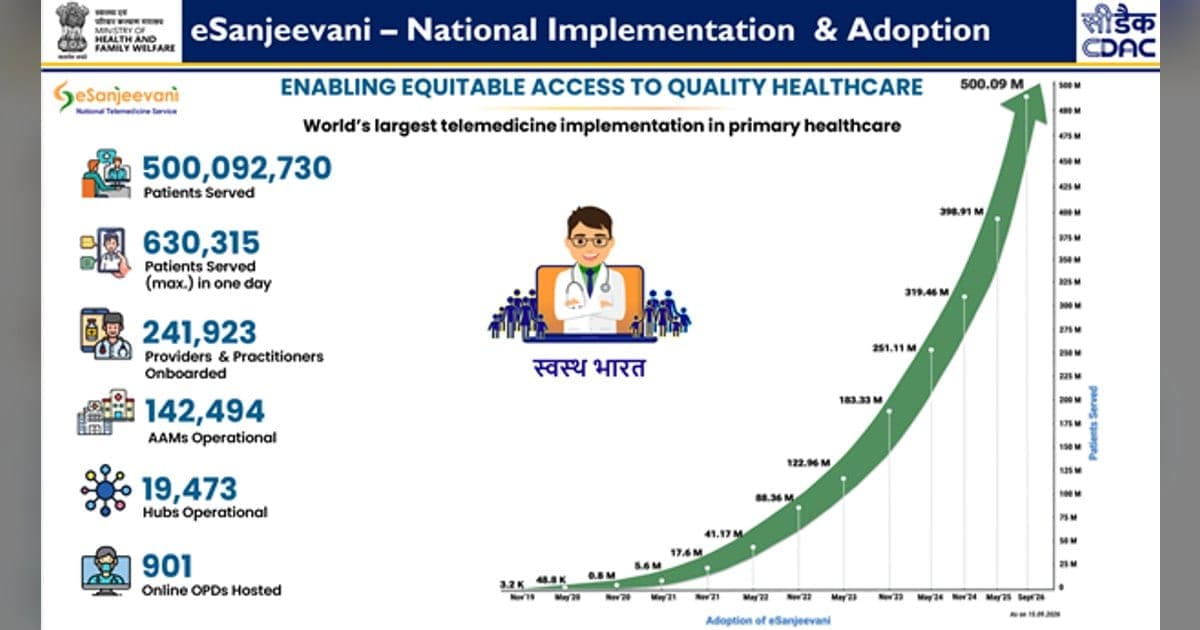
The correct answer is the Ministry of Health and Family Welfare. eSanjeevani is the national telemedicine service of India and the Ministry of Health and Family Welfare guides its working and its growth as the needs of the health system change. The ministry announced that the platform had gone past 50 crore teleconsultations, the mark being reached on 15 September 2026 with a running total of 50,00,92,730 sittings in all 36 States and Union Territories. Option A is wrong because the Ministry of Electronics and Information Technology is not named as the ministry running the service, although the software itself was built by C-DAC. Option C is wrong because the Ministry of Science and Technology has no role described here. Option D is wrong because the Ministry of Rural Development looks after rural employment and rural infrastructure, not telemedicine. So the answer is the health ministry.
Q19.Government SchemesMedium
- A.15 August 2026
- B.1 September 2026
- C.15 September 2026
- D.6 October 2026
Show answer
Correct answer: C. 15 September 2026
Explanation
The correct answer is 15 September 2026. On that day the running count of teleconsultations on eSanjeevani stood at 50,00,92,730, which took the platform past the figure of 50 crore, or 500 million, across all 36 States and Union Territories. Options A and B name earlier dates in 2026 on which no such mark was recorded, so both are wrong. Option D, 6 October 2026, is the day the Ministry of Health and Family Welfare set out the achievement in its statement, which is not the same as the day the mark itself was crossed; a careless reader picks the day of the announcement instead of the day of the milestone. Candidates should keep the two dates apart, because a paper setter may ask for either one. Hence 15 September 2026 is the right choice.
Q20.Government SchemesMedium
- A.Centre for Development of Advanced Computing (C-DAC)
- B.National Informatics Centre (NIC)
- C.Indian Space Research Organisation (ISRO)
- D.Council of Scientific and Industrial Research (CSIR)
Show answer
Correct answer: A. Centre for Development of Advanced Computing (C-DAC)
Explanation
The correct answer is the Centre for Development of Advanced Computing (C-DAC). eSanjeevani is described as a made-in-India digital health solution developed by C-DAC, and its Mohali centre has given end-to-end technological development and engineering support from the very beginning. The platform grew from a hub-and-spoke telemedicine model into a national digital health platform of population scale. Option B is wrong because the National Informatics Centre is not named as the developer of this platform. Option C is wrong because the Indian Space Research Organisation works on space missions and satellites, not on a telemedicine service of this kind. Option D is wrong because the Council of Scientific and Industrial Research runs a chain of research laboratories and has no role described here. Remembering the pair, C-DAC and C-DAC Mohali, is enough for most questions on this story.
Q21.Government SchemesHard
- A.16.25 per cent
- B.40.15 per cent
- C.47.14 per cent
- D.57.14 per cent
Show answer
Correct answer: D. 57.14 per cent
Explanation
The correct answer is 57.14 per cent. Women make up that share of all use of eSanjeevani, which shows how far telemedicine has gone in reaching people for whom a journey to a health facility means time, money and difficulty. Option B, 40.15 per cent, is the share of consultations taken by citizens of 46 years and above, so it belongs to an age group and not to women. Option A, 16.25 per cent, is the share of senior citizens of 60 years and above, who form part of that same older group. Option C is close to the right figure in look but is not the one reported, and it is the sort of near miss a paper setter puts in to catch a half-remembered number. Candidates should hold the three shares together, because questions often swap one for another.
Q22.Government SchemesEasy
- A.266
- B.300
- C.375
- D.425
Show answer
Correct answer: C. 375
Explanation
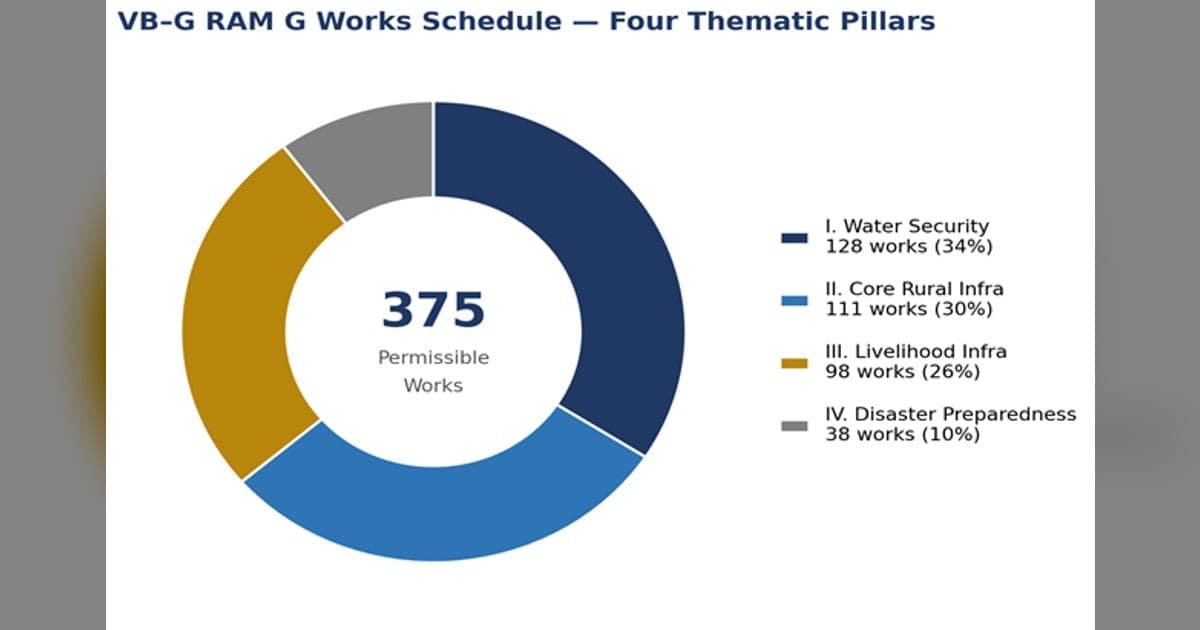
The correct answer is 375. The Ministry of Rural Development has notified a Schedule of Permissible Works allowing that many works under the new rural works framework of the VB-G RAM G Act. Option A is the trap, because 266 is the number of works the earlier framework carried; the new list is 41 per cent wider than that, which is how the figure of 375 is arrived at. Option B is a round number that appears nowhere in the notification. Option D is higher than the figure actually notified and is placed there to catch a candidate who remembers only that the list grew. Keep the pair of numbers together, the old count and the new one, with the percentage rise between them, because questions are set on all three. So the right choice is 375 works.
Q23.Government SchemesMedium
- A.Water Security
- B.Core Rural Infrastructure
- C.Livelihood-related Infrastructure
- D.Disaster Preparedness
Show answer
Correct answer: A. Water Security
Explanation
The correct answer is Water Security, which carries 128 works and is the largest of the four pillars. It covers check dams, gully plugs, underground dykes, recharge shafts, injection wells, the revival of rivers and nallahs, the reclaiming of waterlogged land, drip irrigation, sprinklers, rooftop rainwater harvesting and even ice-stupas and artificial glaciers. Option B is wrong because Core Rural Infrastructure has 111 works, which is second. Option C is wrong because Livelihood-related Infrastructure has 98 works, although its share of the list has risen sharply. Option D is wrong because Disaster Preparedness has 38 works and is the smallest of the four, even though it is the first time such a head has been given a place of its own in the rural works list. The descending order is 128, 111, 98 and 38.
Q24.Government SchemesMedium
- A.2023
- B.2024
- C.2025
- D.2026
Show answer
Correct answer: C. 2025
Explanation
The correct answer is 2025. The Ministry of Rural Development notified the Schedule of Permissible Works under the Viksit Bharat - Guarantee for Rozgar and Ajeevika Mission (Gramin) Act of that year, and the Schedule itself was put out on 6 October 2026. Options A and B name years before the Act and are wrong. Option D is the tempting one, because the notification of the Schedule came in that year; but the question asks for the year of the Act, not the year of the notification, and the two are a year apart. Candidates should fix the sequence in mind: the Act belongs to 2025, the Schedule of 375 permissible works was notified in 2026, and the whole effort is placed within the goal of a Viksit Bharat by 2047. Mixing the three years is the commonest mistake here.
Q25.Government SchemesMedium
- A.District Development Plan, approved by the Zila Parishad
- B.Viksit Gram Panchayat Plan, approved by the Gram Sabha
- C.Block Action Plan, approved by the Block Samiti
- D.State Rural Plan, approved by the State Legislature
Show answer
Correct answer: B. Viksit Gram Panchayat Plan, approved by the Gram Sabha
Explanation
The correct answer is the Viksit Gram Panchayat Plan, approved by the Gram Sabha. Every work under the new framework is to begin from the bottom up through a decentralised planning exercise, and the plan must be cleared by the Gram Sabha before a work can start. Each work is then followed on the Viksit Bharat National Rural Infrastructure Stack, a digital trail meant to bring Central, State and local money onto the same work and to stop the same work being taken up twice. Options A, C and D place the power of approval at the district, block and State level respectively, which runs against the village-level, bottom-up design the Schedule sets out. The point to remember is the pair: planning at the Gram Panchayat, approval by the Gram Sabha, tracking on the national stack.