
VB-G RAM G Schedule Notifies 375 Permissible Rural Works
The Ministry of Rural Development has notified 375 permissible works under the VB-G RAM G Act, 2025, a 41 per cent rise over the earlier 266 works.
Why in News
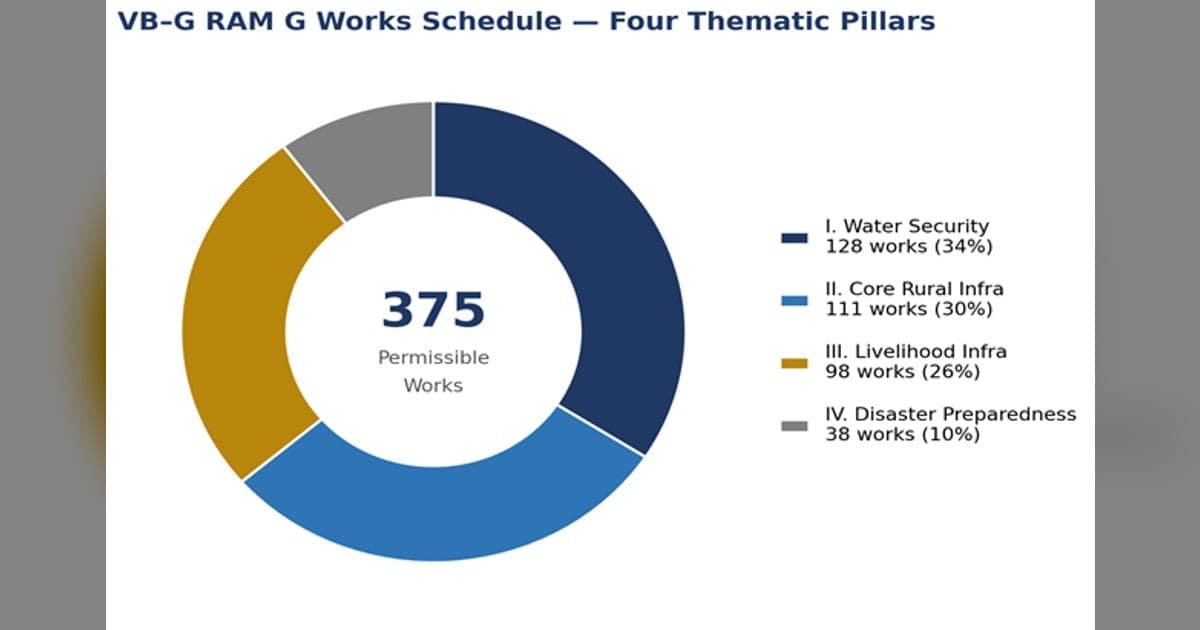
On 6 October 2026 the Ministry of Rural Development notified the Schedule of Permissible Works under the VB-G RAM G Act, 2025, allowing 375 works in rural areas. The list is 41 per cent wider than the 266 works of the earlier framework and is arranged under four pillars led by Water Security with 128 works.
The Ministry of Rural Development has notified the Schedule of Permissible Works under the Viksit Bharat - Guarantee for Rozgar and Ajeevika Mission (Gramin), short VB-G RAM G, Act of 2025. The Schedule, put out on 6 October 2026, allows 375 works under the new rural works framework. That is a 41 per cent widening on the 266 works the earlier framework carried.
Four pillars
The works have been grouped afresh under four themes instead of a plain list of asset types. The aim is to tie wage employment to assets that last and to development results that can be measured.
| Pillar | Works |
| Water Security | 128 |
| Core Rural Infrastructure | 111 |
| Livelihood-related Infrastructure | 98 |
| Special Works for Extreme Weather Events and Disaster Preparedness | 38 |
Water Security takes the largest share
With 128 works, Water Security is the biggest of the four. It covers check dams, gully plugs, underground dykes, recharge shafts, injection wells, the revival of rivers, rivulets and nallahs, the reclaiming of waterlogged land and the repair of field channels that carry water. Drip irrigation, sprinklers, rooftop rainwater harvesting and tankas are allowed, and so are newer ideas such as ice-stupas and artificial glaciers.
Rural infrastructure and livelihoods
The 111 works under Core Rural Infrastructure include solar street lighting, waste-to-wealth recycling plants, greywater treatment units, segregation sheds, village libraries, veterinary and rural health centres, Common Service Centres, multipurpose youth centres and extra classrooms and laboratories in government schools. Repair of Jal Jeevan Mission water-supply works, village parks and footpaths are also covered. Livelihood-related Infrastructure gets 98 works, among them agro-processing and value-addition units, cleaning, grading and packaging units, cold storages, mini flour mills, market yards, dairy structures, mushroom and sericulture sheds, poly-houses and aquaculture structures, besides worksheds, SHE Marts and federation buildings for Self-Help Groups. This head now takes 26 per cent of all permissible works against only 1.1 per cent earlier.
A first for disaster preparedness
For the first time the rural works list carries a head of its own for extreme weather and disaster preparedness, with 38 works. These are flood relief shelters, retaining walls, strengthening of embankments, flood protection works, the restoring of village roads and community assets after a disaster, and forest-fire measures such as fire lines and fuel-buffer zones.
Who the works are meant for
Agriculture and allied activity account for 181 works, of which 52 go to an individual beneficiary. Another 107 works are tagged for Antyodaya and vulnerable households, 68 of them for an individual beneficiary, covering housing, sanitation, energy, irrigation, plantations and livestock shelters. 36 works are tied to Nari Shakti and 36 to Yuva Shakti. The Schedule also writes in accessibility for Divyangjan through stairs and ramps in government buildings, and allows relief and evacuation shelters in border areas.
How a work will be chosen
Every work is to begin from the bottom up, through a Viksit Gram Panchayat Plan cleared by the Gram Sabha, and will then be followed on the Viksit Bharat National Rural Infrastructure Stack. The digital trail is meant to bring Central, State and local money together on the same work and to keep the same work from being taken up twice, in line with the goal of a Viksit Bharat by 2047.
Important Facts
| Notified by | Ministry of Rural Development |
|---|---|
| Scheme | Viksit Bharat - Guarantee for Rozgar and Ajeevika Mission (Gramin), VB-G RAM G |
| Act | VB-G RAM G Act, 2025 |
| Permissible works | 375 |
| Earlier framework | 266 works, so a rise of 41 per cent |
| Water Security | 128 works, the largest pillar |
| Core Rural Infrastructure | 111 works |
| Livelihood-related Infrastructure | 98 works, 26 per cent of the list against 1.1 per cent earlier |
| Disaster Preparedness | 38 works, a dedicated head for the first time |
| Agriculture and allied | 181 works, including 52 for individual beneficiaries |
| Antyodaya households | 107 works, including 68 for individual beneficiaries |
| Planning and tracking | Viksit Gram Panchayat Plan cleared by the Gram Sabha, tracked on the Viksit Bharat National Rural Infrastructure Stack |
Exam Point of View
Remember the full name behind VB-G RAM G (Viksit Bharat - Guarantee for Rozgar and Ajeevika Mission, Gramin), the year of the Act (2025), the ministry (Rural Development), the number of works (375 against 266 earlier, a rise of 41 per cent), the four pillars with their counts (Water Security 128, Core Rural Infrastructure 111, Livelihood 98, Disaster Preparedness 38), the first-ever disaster head, livelihood works at 26 per cent against 1.1 per cent, and the planning route: Viksit Gram Panchayat Plan, Gram Sabha approval, tracking on the Viksit Bharat National Rural Infrastructure Stack.
Practice Questions
How many permissible works have been notified under the new Schedule of the VB-G RAM G Act?
- A.266
- B.300
- C.375
- D.425
Show answer
Correct answer: C. 375
Explanation
The correct answer is 375. The Ministry of Rural Development has notified a Schedule of Permissible Works allowing that many works under the new rural works framework of the VB-G RAM G Act. Option A is the trap, because 266 is the number of works the earlier framework carried; the new list is 41 per cent wider than that, which is how the figure of 375 is arrived at. Option B is a round number that appears nowhere in the notification. Option D is higher than the figure actually notified and is placed there to catch a candidate who remembers only that the list grew. Keep the pair of numbers together, the old count and the new one, with the percentage rise between them, because questions are set on all three. So the right choice is 375 works.
Which pillar of the new VB-G RAM G Schedule carries the highest number of permissible works?
- A.Water Security
- B.Core Rural Infrastructure
- C.Livelihood-related Infrastructure
- D.Disaster Preparedness
Show answer
Correct answer: A. Water Security
Explanation
The correct answer is Water Security, which carries 128 works and is the largest of the four pillars. It covers check dams, gully plugs, underground dykes, recharge shafts, injection wells, the revival of rivers and nallahs, the reclaiming of waterlogged land, drip irrigation, sprinklers, rooftop rainwater harvesting and even ice-stupas and artificial glaciers. Option B is wrong because Core Rural Infrastructure has 111 works, which is second. Option C is wrong because Livelihood-related Infrastructure has 98 works, although its share of the list has risen sharply. Option D is wrong because Disaster Preparedness has 38 works and is the smallest of the four, even though it is the first time such a head has been given a place of its own in the rural works list. The descending order is 128, 111, 98 and 38.
The Schedule of Permissible Works has been notified under the VB-G RAM G Act of which year?
- A.2023
- B.2024
- C.2025
- D.2026
Show answer
Correct answer: C. 2025
Explanation
The correct answer is 2025. The Ministry of Rural Development notified the Schedule of Permissible Works under the Viksit Bharat - Guarantee for Rozgar and Ajeevika Mission (Gramin) Act of that year, and the Schedule itself was put out on 6 October 2026. Options A and B name years before the Act and are wrong. Option D is the tempting one, because the notification of the Schedule came in that year; but the question asks for the year of the Act, not the year of the notification, and the two are a year apart. Candidates should fix the sequence in mind: the Act belongs to 2025, the Schedule of 375 permissible works was notified in 2026, and the whole effort is placed within the goal of a Viksit Bharat by 2047. Mixing the three years is the commonest mistake here.
Under VB-G RAM G, through which plan will works be taken up, and who approves it?
- A.District Development Plan, approved by the Zila Parishad
- B.Viksit Gram Panchayat Plan, approved by the Gram Sabha
- C.Block Action Plan, approved by the Block Samiti
- D.State Rural Plan, approved by the State Legislature
Show answer
Correct answer: B. Viksit Gram Panchayat Plan, approved by the Gram Sabha
Explanation
The correct answer is the Viksit Gram Panchayat Plan, approved by the Gram Sabha. Every work under the new framework is to begin from the bottom up through a decentralised planning exercise, and the plan must be cleared by the Gram Sabha before a work can start. Each work is then followed on the Viksit Bharat National Rural Infrastructure Stack, a digital trail meant to bring Central, State and local money onto the same work and to stop the same work being taken up twice. Options A, C and D place the power of approval at the district, block and State level respectively, which runs against the village-level, bottom-up design the Schedule sets out. The point to remember is the pair: planning at the Gram Panchayat, approval by the Gram Sabha, tracking on the national stack.
Frequently Asked Questions
How many works are permissible under the new VB-G RAM G Schedule?
375 works. The Ministry of Rural Development notified the Schedule under the VB-G RAM G Act, 2025, and the list is 41 per cent wider than the 266 works allowed under the earlier framework.
What are the four pillars of the new Schedule?
Water Security with 128 works, Core Rural Infrastructure with 111, Livelihood-related Infrastructure with 98, and Special Works for Extreme Weather Events and Disaster Preparedness with 38. Water Security is the largest of the four.
What does VB-G RAM G stand for?
Viksit Bharat - Guarantee for Rozgar and Ajeevika Mission (Gramin). The Schedule of Permissible Works has been notified under its Act of 2025 by the Ministry of Rural Development.
How will a work be selected and tracked?
Each work must come up through a bottom-up, decentralised Viksit Gram Panchayat Plan approved by the Gram Sabha, and will then be tracked on the Viksit Bharat National Rural Infrastructure Stack to pool Central, State and local funds and avoid duplication.
Sources
- https://www.pib.gov.in/PressReleasePage.aspx?PRID=2319426 (opens in a new tab) — Press Information Bureau
Current Affairs 6 October 2026
- eSanjeevani Crosses 50 Crore Teleconsultations in IndiaGovernment Schemes
Related Current Affairs
- Government Schemes
eSanjeevani Crosses 50 Crore Teleconsultations in India
6 October 2026 · 2 min read
- Government Schemes
Agriculture Ministry Reports 10.77 Crore Farmer IDs Made
5 October 2026 · 2 min read
- Government Schemes
Swachhta Udyami Yojana and NFSC: Three Scheme Case Studies
5 October 2026 · 2 min read
- Government Schemes
PMGSY Chintan Shivir: 62 Thousand km Roads in Fourth Phase
5 October 2026 · 3 min read
- Government Schemes
DST Marks Swachhata Hi Sewa 2026, Felicitates 110 Safai Mitras
5 October 2026 · 2 min read
Related GK
- Science Policy and Research Funding in India: Exam Notes
6 October 2026 · Science & Technology
- Goa GK: Liberation, Statehood, Geography and Facts
6 October 2026 · Indian States & UTs
- Statues, Towers and Landmarks of India for Exams
6 October 2026 · Static GK