
Textile Industry Development Council Holds Its First Meeting
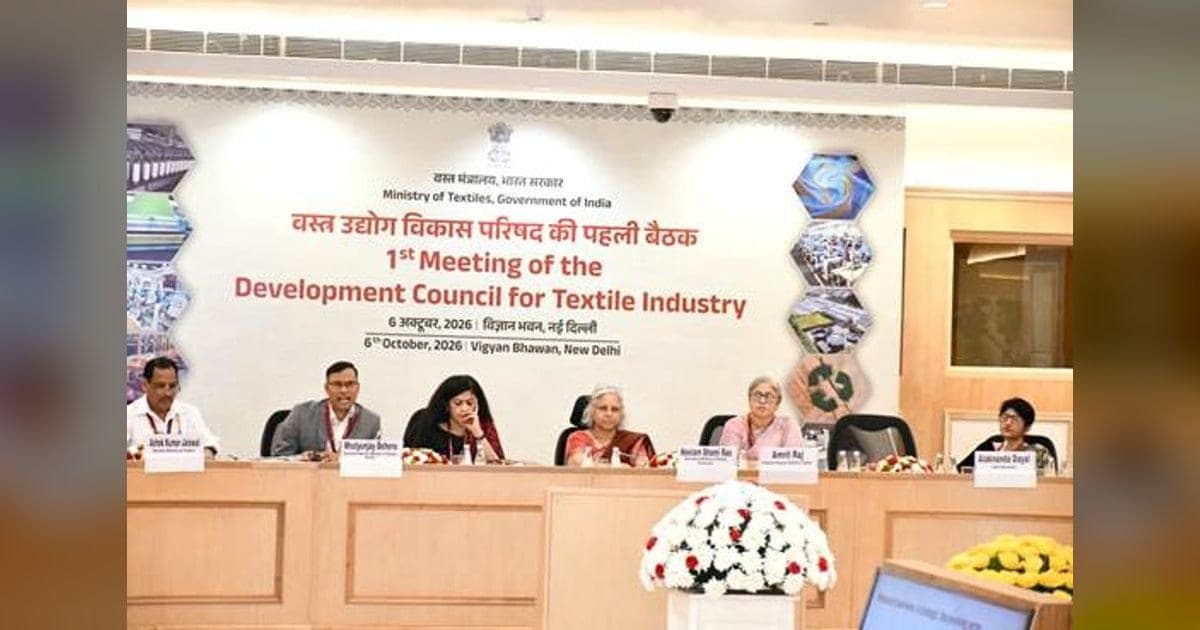
The Development Council for Textile Industry met for the first time at Vigyan Bhawan in New Delhi, chaired by Textiles Secretary Neelam Shami Rao.
Why in News
On 6 October 2026 the Development Council for Textile Industry held its first meeting at Vigyan Bhawan, New Delhi, under the chairpersonship of Textiles Secretary Neelam Shami Rao, and agreed to form working groups on priority themes.
The Development Council for Textile Industry (DCTI) met for the first time on 6 October 2026 at Vigyan Bhawan in New Delhi. Neelam Shami Rao, Secretary in the Ministry of Textiles, took the chair.
What the council is for
The council has been set up as the apex consultative platform where the government, industry and other stakeholders sit together. Its mandate is to advise the government on the orderly growth and development of the textile industry. The first sitting was called to work through that mandate, and it drew senior officers of the ministry along with representatives of industry associations, export promotion councils, research associations, state governments and sector experts.
The chair’s argument
Addressing the members, the chair pointed out that textiles and apparel remain among the largest generators of employment and earners of export revenue for the country, and called for a coordinated approach that covers the whole value chain rather than one segment at a time, taking in production, innovation and access to global markets together.
The five areas taken up
- Production and productivity: adding capacity, modernising plants and improving scale and cost competitiveness across fibre, yarn, fabric, processing and apparel, with attention to the gaps between those stages.
- Research and development: tying industry to research institutions, encouraging work on new-age fibres and technical textiles, and moving laboratory results into commercial use faster through research associations.
- Exports and market access: widening the range of products and the list of markets, using trade agreements, and clearing the quality, compliance and logistics hurdles exporters run into.
- Raw material and input availability: keeping cotton, man-made fibres, yarn, dyes and chemicals available at competitive prices, backed by sound market intelligence.
- Investment, skilling and sustainability: easing the conduct of business, strengthening support for small and medium enterprises, training the workforce, and adopting sustainable and circular practices.
What was decided
Members offered suggestions on each of these themes and welcomed the formal channel the council gives them to the government. The council agreed to set up working groups and sub committees on priority themes and to meet at regular intervals to review progress. Its recommendations will feed into the policy and programmes of the Ministry of Textiles.
At a glance
| Body | Development Council for Textile Industry (DCTI) |
| Meeting | First meeting, 6 October 2026 |
| Venue | Vigyan Bhawan, New Delhi |
| Chairperson | Neelam Shami Rao, Secretary, Ministry of Textiles |
Important Facts
| Body | Development Council for Textile Industry (DCTI) |
|---|---|
| Occasion | First meeting of the council |
| Date | 6 October 2026 |
| Venue | Vigyan Bhawan, New Delhi |
| Chairperson | Neelam Shami Rao, Secretary, Ministry of Textiles |
| Nature of the body | Apex consultative platform of government, industry and stakeholders |
| Mandate | To advise the government on the orderly growth and development of the textile industry |
| Decision taken | Working groups and sub committees on priority themes; meetings at regular intervals |
Exam Point of View
Remember the body (Development Council for Textile Industry), that this was its first meeting, the date and venue (6 October 2026, Vigyan Bhawan, New Delhi), the chairperson (Textiles Secretary Neelam Shami Rao) and the five areas the council deliberated on.
Practice Questions
Who chaired the first meeting of the Development Council for Textile Industry?
- A.The Union Minister of Textiles
- B.The Secretary, Ministry of Textiles
- C.The Chairman of the Cotton Corporation of India
- D.The Vice-Chairman of NITI Aayog
Show answer
Correct answer: B. The Secretary, Ministry of Textiles
Explanation
The correct answer is the Secretary, Ministry of Textiles, Neelam Shami Rao. The council met for the first time at Vigyan Bhawan in New Delhi under her chairpersonship, and in her address she stressed that textiles and apparel are among the largest employment generators and export earners for the country and called for a whole-of-value-chain approach to production, innovation and global market access. Option A is wrong because the meeting was chaired by the Secretary and not by the minister, a distinction question setters like to test. Option C is wrong because the head of a public sector cotton agency has no role in chairing this council. Option D is wrong because the policy think tank of the government is a separate institution altogether and does not chair sectoral development councils of a ministry. Remember both the office and the name, and note that senior officers, industry associations, export promotion councils, research associations, state governments and sector experts attended.
At which venue was the first meeting of the Development Council for Textile Industry held?
- A.Bharat Mandapam, New Delhi
- B.Udyog Bhawan, New Delhi
- C.Vigyan Bhawan, New Delhi
- D.Pragati Maidan, New Delhi
Show answer
Correct answer: C. Vigyan Bhawan, New Delhi
Explanation
The correct answer is Vigyan Bhawan, New Delhi. The Development Council for Textile Industry held its first meeting there on 6 October 2026, chaired by the Secretary of the Ministry of Textiles, with senior officers of the ministry, industry associations, export promotion councils, research associations, state governments and sector experts in attendance. Options A and D are wrong because, although both are well-known Delhi venues for large exhibitions and conferences, neither hosted this meeting. Option B is wrong because, while it is the seat of several economic ministries and therefore a plausible guess, the council did not meet there. Venue questions are common in current affairs papers because they are easy to set and easy to get wrong, so the venue should be learnt along with the date, the chair and the decision to constitute working groups and sub committees on priority themes.
Which of the following was NOT among the areas the council deliberated upon at its first meeting?
- A.Research and development, including new-age fibres and technical textiles
- B.Exports and market access
- C.Minimum support price for sugarcane
- D.Investment, skilling and sustainability
Show answer
Correct answer: C. Minimum support price for sugarcane
Explanation
The correct answer is minimum support price for sugarcane, which was not on the agenda. The council took up five areas: production and productivity, covering capacity addition, modernisation and cost competitiveness across fibre, yarn, fabric, processing and apparel; research and development, including industry and research linkages, new-age fibres and technical textiles; exports and market access, covering diversification of products and markets and the quality, compliance and logistics constraints exporters face; raw material and input availability, covering cotton, man-made fibres, yarn, dyes and chemicals; and investment, skilling and sustainability, covering ease of doing business, support for small and medium enterprises, workforce skilling and circular practices. Options A, B and D are therefore all part of the agenda. Sugarcane pricing belongs to a different ministry and a different crop economy, which is why it stands out as the exception here.
Frequently Asked Questions
Who chaired the first meeting of the Development Council for Textile Industry?
Neelam Shami Rao, Secretary in the Ministry of Textiles. The meeting was held on 6 October 2026 at Vigyan Bhawan in New Delhi.
What is the mandate of the DCTI?
It is the apex consultative platform of government, industry and stakeholders, set up to advise the government on the orderly growth and development of the textile industry.
Which areas did the first meeting deliberate on?
Production and productivity, research and development, exports and market access, raw material and input availability, and investment, skilling and sustainability.
Sources
- https://www.pib.gov.in/PressReleasePage.aspx?PRID=2319524 (opens in a new tab) — Press Information Bureau
Current Affairs 6 October 2026
- eSanjeevani Crosses 50 Crore Teleconsultations in IndiaGovernment Schemes
- VB-G RAM G Schedule Notifies 375 Permissible Rural WorksGovernment Schemes
- Steel Ministry to Set Up Steel Industry Safety Council (SISC)Economy
- MoD Signs Rs 661.50 Crore BrahMos Fire Control System DealDefence
- First Fleet Support Ship Surya Launched at HSL VisakhapatnamDefence
- ARIES Study Tracks Blazar OJ 287 Twin Black Holes for a DecadeScience & Technology
- India Joins 153rd IPU Assembly at Arusha in TanzaniaInternational
- ESTIC 2026 Ocean Sciences Curtain Raiser Held at KochiSummits & Conferences
Related Current Affairs





Related GK
- Science Policy and Research Funding in India: Exam Notes
6 October 2026 · Science & Technology
- Goa GK: Liberation, Statehood, Geography and Facts
6 October 2026 · Indian States & UTs
- Statues, Towers and Landmarks of India for Exams
6 October 2026 · Static GK
Take the Quiz
- Current Affairs Quiz
SSC CHSL Current Affairs Quiz: 6 October 2026
13 questions13 minutesStart Quiz