
RRI Study Shows Black Hole Jets Choke Star Birth in Galaxies
Raman Research Institute and Arizona State University found that jets from black holes heat gas along their path and stop new stars from forming in galaxies.
Why in News
On 25 September 2026 the Ministry of Science and Technology announced that a team from the Raman Research Institute and Arizona State University has shown how jets from supermassive black holes energise the circumgalactic medium and suppress star formation.
Astronomers from the Raman Research Institute (RRI), an autonomous institute of the Department of Science and Technology, working with colleagues at Arizona State University, have traced one way in which the black hole at a galaxy's core can decide whether that galaxy keeps making stars. Their paper has appeared in the journal The Astrophysical Journal Letters.
The gas beyond the galaxy
Past the visible disc of stars and dust, every galaxy is wrapped in a thin, faint envelope of gas that stretches 10 to 20 times the width of the galaxy itself. Astronomers call it the circumgalactic medium, or CGM, and it is the fuel store from which new stars are eventually built. If all of that gas collapsed into stars, the sky would be full of blindingly bright galaxies, and it is not. For over a decade the suspicion has been that the supermassive black hole sitting at the centre keeps the gas too hot to cool and collapse, but nobody could say how.
A jet that punches
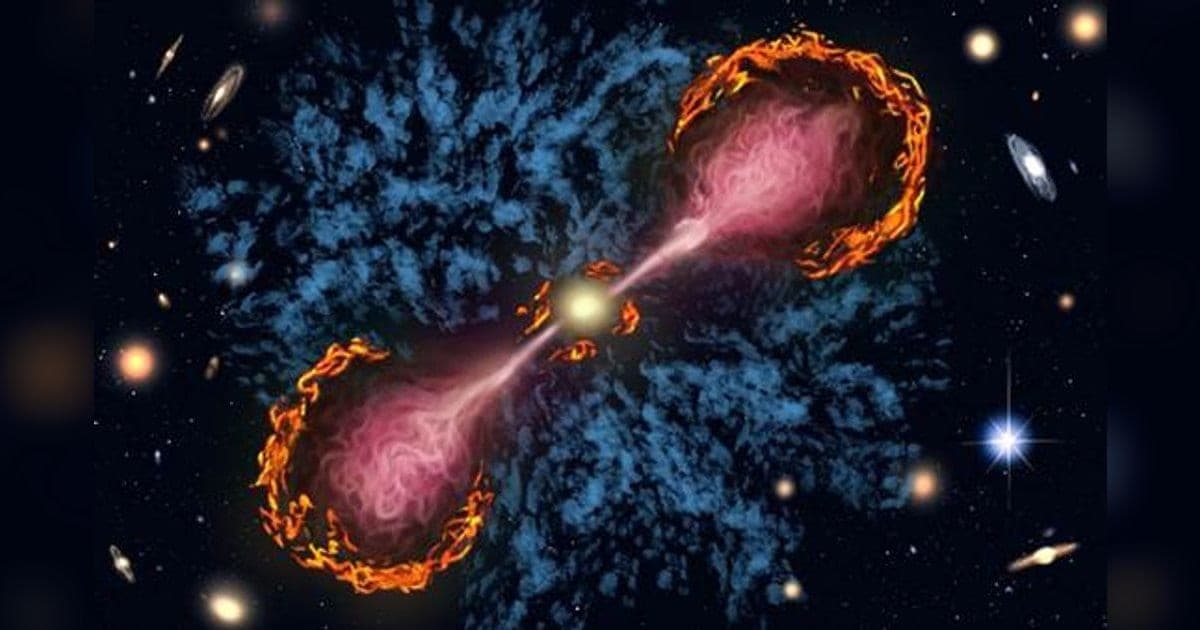
A black hole is a swallower of matter, but it also throws out jets of searing plasma, a soup of charged particles. The team asked whether such a jet reaches all the way into the outer gas. Ionised gas glows in a particular way, so they looked for that glow. Averaged over every direction around the galaxies they found nothing at all. Along the line of the jet, the signal was strong. The jet, in other words, lights up only the gas lying in its path and leaves the rest alone.
Two places where the punch lands
The signal turned out to be strongest at two spots, at the rim of the stellar disc where the jet first strikes the outer gas, and again at the far boundary of that envelope, where the slowed jet shoves against the gas a second time. Energy is dumped at both, the gas is stirred and warmed, and cool gas that might otherwise have clumped into stars never gets the chance. The galaxy grows quiet and passive.
Who did the work
The lead author is Namrata Roy, assistant professor in the astronomy and astrophysics division at RRI. A co-author, Sanchayeeta Borthakur, associate professor at Arizona State University, summed up the finding by saying black holes can shape the lives of galaxies far beyond the small central region they occupy. To see the scale of it, an average supermassive black hole may be about as wide as the solar system, while the galaxy around it can hold 100 billion such systems.
Important Facts
| Indian institute | Raman Research Institute (RRI), Bengaluru |
|---|---|
| Parent department | Department of Science and Technology |
| Partner university | Arizona State University, United States |
| Lead author | Namrata Roy, assistant professor, astronomy and astrophysics division, RRI |
| Co-author quoted | Sanchayeeta Borthakur, Arizona State University |
| Journal | The Astrophysical Journal Letters |
| Key term | Circumgalactic medium (CGM), the gas envelope around a galaxy |
| Extent of CGM | 10 to 20 times the size of the galaxy |
| Finding | Black hole jets energise gas along their path and suppress star formation |
Exam Point of View
Remember the institute (Raman Research Institute, under the Department of Science and Technology), the foreign partner (Arizona State University), the lead author (Namrata Roy), the journal (The Astrophysical Journal Letters), the term CGM or circumgalactic medium and the fact that the jet acts along its own direction, energising gas and stopping star formation.
Practice Questions
The circumgalactic medium (CGM) referred to in the study is best described as
- A.The dense core of a galaxy where stars are packed together
- B.The faint envelope of gas surrounding a galaxy beyond its disc
- C.The ring of dust that forms the spiral arms of a galaxy
- D.The region inside the event horizon of a black hole
Show answer
Correct answer: B. The faint envelope of gas surrounding a galaxy beyond its disc
Explanation
The correct answer is the faint envelope of gas surrounding a galaxy beyond its disc. The study describes the circumgalactic medium as a diffuse, ghostly reservoir of gas that lies past the edge of the stellar disc and spreads out to between ten and twenty times the size of the galaxy, and this reservoir supplies the fuel from which stars are eventually made. Option A describes the crowded central region of a galaxy, which is a different thing altogether. Option C refers to the dust in the spiral arms, which lies within the visible disc and not outside it. Option D describes the region bounded by the event horizon of a black hole, a region from which nothing escapes, and it has nothing to do with this outer gas. The whole point of the study is that a jet from the central black hole reaches out into this envelope.
Which Indian institute, along with Arizona State University, carried out the study on black hole jets and star formation?
- A.Indian Institute of Astrophysics
- B.Raman Research Institute
- C.Physical Research Laboratory
- D.Tata Institute of Fundamental Research
Show answer
Correct answer: B. Raman Research Institute
Explanation
The correct answer is the Raman Research Institute, an autonomous institute of the Department of Science and Technology, whose scientists worked with colleagues at Arizona State University in the United States. The lead author of the paper, published in The Astrophysical Journal Letters, is Namrata Roy, an assistant professor in the astronomy and astrophysics division of that institute, and a co-author quoted on the finding is Sanchayeeta Borthakur of the American university. The other three names in the options are all genuine and well-known Indian research institutions working in astronomy and physics, which makes them plausible distractors, but none of them is credited with this particular study. In current affairs, always tie a discovery to the exact institute, the lead researcher and the journal, because a question can be set on any of the three.
According to the study, how does a black hole jet affect the gas around a galaxy?
- A.It cools the gas equally in all directions so that stars form faster
- B.It energises the gas only along its own direction and suppresses star formation
- C.It pulls the entire gas envelope into the black hole within a few years
- D.It has no measurable effect beyond the central region of the galaxy
Show answer
Correct answer: B. It energises the gas only along its own direction and suppresses star formation
Explanation
The correct answer is that the jet energises the gas only along its own direction and suppresses star formation. When the team averaged their measurements over all directions around the galaxies they picked up no signal, but when they probed along the direction of the jet they found a strong one, which showed that the jet illuminates only the gas in its path. The signal was strongest where the jet first meets the outer gas at the rim of the stellar disc, and again at the outer boundary of the envelope where the slowed jet strikes once more, depositing energy at both places. Because cool gas is needed for gas to clump into stars, this heating keeps the galaxy quiet and passive, so option A is the opposite of the finding. Options C and D are ruled out for the same reason, since the study shows an effect reaching far beyond the centre.
Frequently Asked Questions
What is the circumgalactic medium?
It is the diffuse, faint envelope of gas that surrounds a galaxy beyond the edge of its disc, spreading 10 to 20 times the size of the galaxy. It supplies the fuel from which stars form.
What did the researchers find about black hole jets?
That a jet lights up and energises only the gas lying along its direction, with the signal strongest at the edge of the stellar disc and at the outer boundary of the gas envelope, which prevents the gas from cooling into stars.
Which Indian institute carried out this study?
The Raman Research Institute, an autonomous institute of the Department of Science and Technology, together with Arizona State University. The lead author is Namrata Roy of RRI.
Sources
- A powerful punch by black hole jets shapes the fate of galaxies (opens in a new tab) — Press Information Bureau
Current Affairs 25 September 2026
- Mixed 4x400m Relay Team Wins Asian Games Silver for IndiaSports
- DDU-GKY 2.0 to Train 70,000 Rural Youth from October 2026Government Schemes
- TRAI Launches Digital Connectivity Rating Platform for PropertiesScience & Technology
- Pharma PLI Draws Rs 46,744 Crore Investment, 57 Devices MadeGovernment Schemes
- Vice-President Opens 4th IN-STEP with 22 Nations Taking PartInternational
- New Bhuj-Barauni Amrit Bharat Express to Cover 2,532 kmNational
- 11th National Traders Welfare Board Meeting Held in New DelhiEconomy
Related Current Affairs
- Science & Technology
TRAI Launches Digital Connectivity Rating Platform for Properties
25 September 2026 · 2 min read
- Science & Technology
Bio-based Biodegradable PLA Plastic Launched Under BioE3 Framework
24 September 2026 · 2 min read
- Science & Technology
TDB Gives GalaxEye Rs 63.84 Crore for OptoSAR Satellite
24 September 2026 · 2 min read
- Science & Technology
TDB Clears Rs 285 Crore for Ubifly's Indigenous ePlane e200X
23 September 2026 · 2 min read
- Science & Technology
WAVES OTT and MyWAVES Turn Viewers Into Content Creators
23 September 2026 · 2 min read
- Science & Technology
KAVACH 4.0 Goes Live First Time on South Central Railway
23 September 2026 · 2 min read



Related GK
- First in the World: Space, Exploration and Records
25 September 2026 · Static GK
- Folk Dances of India: State-wise List with Festivals
25 September 2026 · Art & Culture
- Asian Games and Commonwealth Games: Hosts, Mascots and MCQs
25 September 2026 · Sports GK
Take the Quiz
- Current Affairs Quiz
State Exams Current Affairs Quiz: 25 September 2026
24 questions24 minutesStart Quiz