
Indian Astronomers Find Star Cluster UBC 63 Is Really Two
A team led by Indian astronomers using ESA's Gaia data found that the open cluster UBC 63 is in fact two clusters that passed close to each other.
Why in News
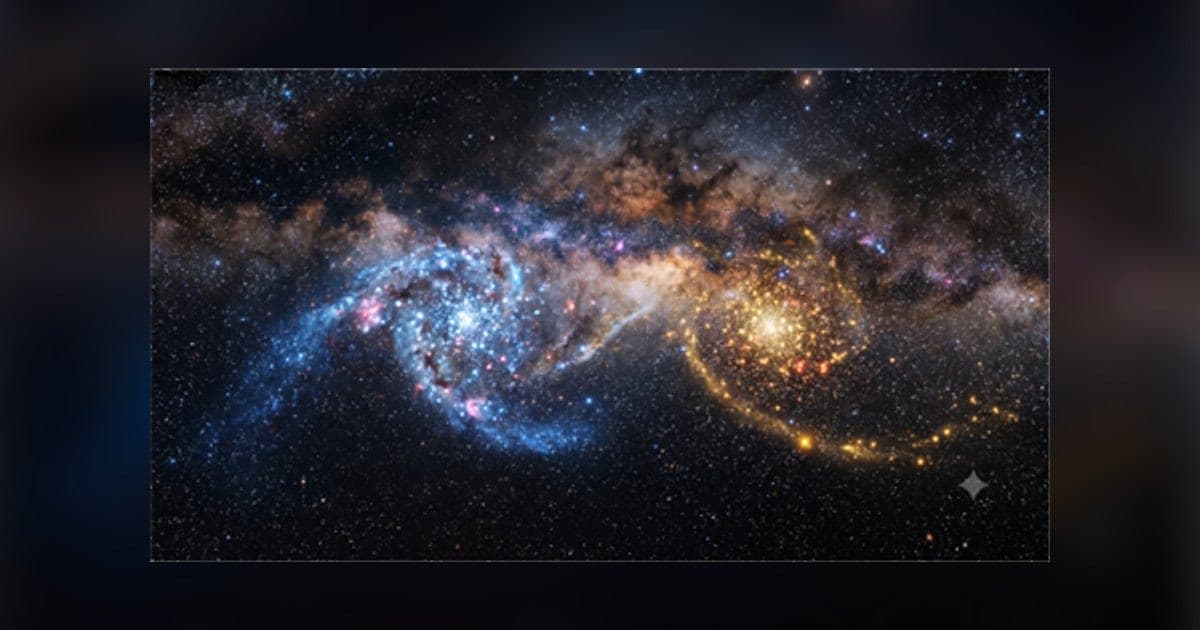
A team led by Indian astronomers reported that the open cluster UBC 63, about 4892 light years from Earth, is not one cluster but two, caught soon after a close flyby that left them drifting apart.
A group of stars long catalogued as a single galactic open cluster has turned out to be two. UBC 63, a thinly populated and loosely bound group lying about 4892 light years from Earth, is actually made up of two separate clusters that recently drifted past one another, a team led by Indian astronomers has found. The chance finding gives researchers a rare look at what happens soon after two stellar systems brush past each other, and adds to what is known about how clusters change over time in the Milky Way.
Who did the work
The team included a Department of Science and Technology INSPIRE Senior Research Fellow and researchers from Gauhati University, together with scientists of the Indian Institute of Astrophysics, an autonomous institution of the department. They had set out only to study how stars form inside UBC 63, using measurements from the European Space Agency's Gaia mission, which maps the positions and motions of stars across the Galaxy with great precision. The paper appeared in the Astronomical Journal, with Samrat Biswas of Gauhati University as lead author and Maheswar Gopinathan and Ram Sagar of the Indian Institute of Astrophysics among the co-authors.
How two clusters were spotted
Studying the brightness and colours of member stars, the researchers saw two distinct sequences in the colour magnitude diagram, the standard tool for reading the evolutionary stage of a cluster. That hinted at two systems rather than one. Machine learning methods and dynamical simulations run on high-performance computers then confirmed two separate populations, now named UBC 63A and UBC 63B.
Two very different ages
The ages settled the question. UBC 63A is young, roughly 21 million years old, while UBC 63B is far older at about 562 million years. Such a gap rules out a common origin, so the two could not have begun life as one cluster.
| Stage | Separation |
| When UBC 63A formed | About 60 parsecs, nearly 196 light years |
| Closest approach, 6 million years ago | About 7 parsecs, nearly 23 light years |
| Today | About 26 parsecs, nearly 85 light years |
Drifting apart
Simulating their paths through the Milky Way showed that the pair came remarkably close some 6 million years ago and are now moving away from each other. Their motions show they are not gravitationally bound, so this was an encounter and not a marriage. Encounters between clusters are uncommon, and catching one so soon afterwards helps astronomers judge how gravity reshapes a cluster's structure and motion. The study also shows how surveys such as Gaia can reveal structures that stay hidden when stars are seen only as a flat pattern projected on the sky.
Important Facts
| Object | UBC 63, a galactic open cluster |
|---|---|
| Distance | About 4892 light years from Earth |
| Finding | Two clusters, UBC 63A and UBC 63B, not one |
| Ages | UBC 63A about 21 million years; UBC 63B about 562 million years |
| Closest approach | About 7 parsecs, nearly 23 light years, some 6 million years ago |
| Present separation | About 26 parsecs, nearly 85 light years; not gravitationally bound |
| Data source | Gaia mission of the European Space Agency (ESA) |
| Institutions | Gauhati University and Indian Institute of Astrophysics, with a DST INSPIRE Senior Research Fellow |
| Published in | Astronomical Journal |
Exam Point of View
Remember the name UBC 63 and its two parts UBC 63A and UBC 63B, the distance of about 4892 light years, the ages of roughly 21 million and 562 million years, the closest approach of about 7 parsecs some 6 million years ago, the present gap of about 26 parsecs, the use of the European Space Agency's Gaia mission, and the institutions involved, Gauhati University and the Indian Institute of Astrophysics under DST.
Practice Questions
What did a team led by Indian astronomers find about the galactic open cluster UBC 63?
- A.It is the nearest open cluster to the Sun
- B.It is actually two distinct clusters that passed close to each other
- C.It hosts the first planet found outside the Milky Way
- D.It is merging with the Andromeda galaxy
Show answer
The group, which lies about 4892 light years away and had been treated in the limited earlier literature as a single cluster, was found to hold two separate stellar populations, now named UBC 63A and UBC 63B. Their brightness and colours formed two sequences in the colour magnitude diagram, and…
Read the full explanation →What are the approximate ages of UBC 63A and UBC 63B?
- A.21 million years and 562 million years
- B.562 million years and 21 million years
- C.100 million years and 400 million years
- D.6 million years and 26 million years
Show answer
UBC 63A is the young cluster of the pair at roughly twenty-one million years, while UBC 63B is much older at about five hundred sixty-two million years.
Read the full explanation →Data from which space mission enabled the discovery that UBC 63 is a double cluster system?
- A.Hubble Space Telescope of NASA
- B.Gaia mission of the European Space Agency
- C.AstroSat of ISRO
- D.James Webb Space Telescope
Show answer
The researchers used Gaia measurements, which give exceptionally precise positions and motions for stars right across the Milky Way, and it was these data that revealed two populations of starkly different ages inside what had been taken for one cluster.
Read the full explanation →Frequently Asked Questions
What did astronomers discover about UBC 63?
That it is not a single star cluster but two, now called UBC 63A and UBC 63B. They lie about 4892 light years from Earth and recently passed very close to each other.
How old are the two clusters?
UBC 63A is young, roughly 21 million years, while UBC 63B is about 562 million years old. This large age difference shows that the two systems did not form together as one cluster.
Which mission's data made the discovery possible?
The Gaia mission of the European Space Agency, which measures the positions and motions of stars across the Milky Way very precisely. Machine learning and dynamical simulations confirmed the two populations.
Sources
- https://www.pib.gov.in/PressReleasePage.aspx?PRID=2333191 (opens in a new tab) — Press Information Bureau
Current Affairs 5 November 2026
- VB-G RAM G: Centre Marks 22 Fodder and Livestock WorksGovernment Schemes
- 4th Conference of Mining Ministers Begins in GoaSummits & Conferences
- Watershed Guidelines: 3rd National Consultation in NagpurGovernment Schemes
- NHRC Push Sets Up Gender-Neutral Cell in Hyderabad JailNational
- CAPEX Scheme Backs Lithium, Nickel Units with Rs 2,814 CroreGovernment Schemes
- BIS Hallmarking: 65 Crore Gold Articles Carry HUID CodeNational
- Railways Wins PM Surya Ghar Excellence Award from VPAwards & Honours
- AIIMS Awantipora OPD to Open Before December 2026National
Related Current Affairs
- Science & Technology
TRAI Recommends New Satellite Network Provider Authorisation
5 November 2026 · 2 min read
- Science & Technology
India Eyes Debris-Free Space by 2030 as Base 1 Opens
5 November 2026 · 2 min read
- Science & Technology
India Plans First Human Deep-Sea Mission to 6,000 m by 2028
4 November 2026 · 2 min read
- Science & Technology
JNCASR Silicon Chip Carries Terahertz Data at 100 Gbit/s
4 November 2026 · 2 min read
- Science & Technology
TRAI Launches Network Anubhav Platform for Network Quality
4 November 2026 · 2 min read
- Science & Technology
CSIR and DAKSHIN-RIS Sign Pact for Global South Science
4 November 2026 · 2 min read


Related GK
- Famous Personalities of Rajasthan: Exam Notes
28 October 2026 · Rajasthan
- Districts and Divisions of Rajasthan: Exam Notes
28 October 2026 · Rajasthan
- Tourism and World Heritage Sites of Rajasthan Notes
27 October 2026 · Rajasthan
Take the Quiz
- Current Affairs Quiz
Banking Current Affairs Quiz: 5 November 2026
25 questions25 minutesStart Quiz