
Pharma PLI Draws Rs 46,744 Crore Investment, 57 Devices Made
The Department of Pharmaceuticals said its three PLI schemes drew Rs 46,744 crore in pharma investment and started production of 57 medical devices in India.
Why in News
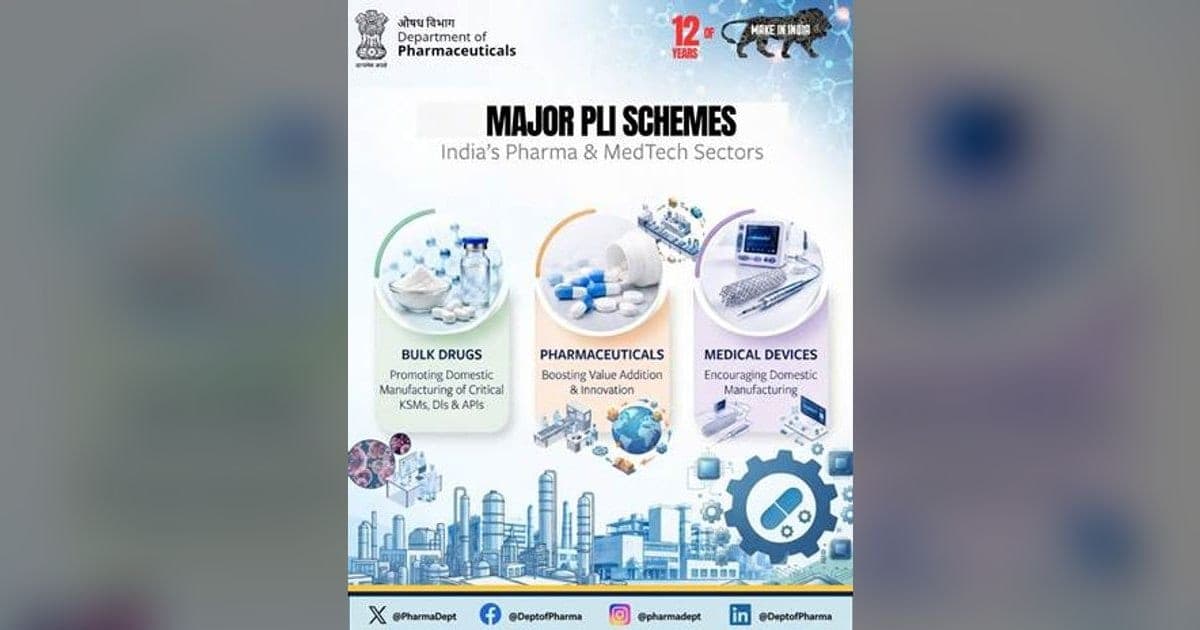
On 25 September 2026 the Department of Pharmaceuticals set out the results of its three production linked incentive schemes for bulk drugs, pharmaceuticals and medical devices, with investment, sales, export and employment figures counted up to June 2026.
The Department of Pharmaceuticals, which works under the Ministry of Chemicals and Fertilizers, has placed on record what its three production linked incentive schemes have delivered for bulk drugs, finished medicines and medical devices. Together they cover the whole chain, from the raw material that goes into a tablet to the scanner in a hospital, and the numbers below are counted up to June 2026.
Bulk drugs: the raw material end
The scheme for key starting materials, drug intermediates and active pharmaceutical ingredients was cleared in 2020 with an outlay of Rs 6,940 crore and it targets 41 critical products on which the country leaned heavily on imports. Of the 48 projects cleared, 39 have been commissioned and they make 28 ingredients. Investment on the ground stands at Rs 5,210.74 crore, ahead of the promised Rs 4,330 crore. Beneficiaries have sold goods worth Rs 3,792.49 crore, of which exports account for Rs 560.16 crore, and about 5,127 people have found work. Penicillin-G, Clavulanic Acid and Rifampicin, which came largely from abroad earlier, are now fermented in the country, with plants at Visakhapatnam in Andhra Pradesh among the new units.
Pharmaceuticals: the high-value end
The second scheme was approved in 2021 with an outlay of Rs 15,000 crore and pushes makers towards biopharmaceuticals, complex generics, patented and off-patent drugs, orphan drugs and auto-immune medicines. 55 applicants were picked, 20 of them small and medium units. Actual investment has reached Rs 46,744 crore against a target of Rs 17,275 crore, jobs created number 1,21,294, and sales from the start of the performance period in 2022-23 add up to Rs 4,02,869 crore, including exports of Rs 2,57,370 crore.
Medical devices: machines made at home
The device scheme was also approved in 2020, with an outlay of Rs 3,420 crore. It pays a 5 per cent incentive on incremental sales of eligible devices made in India for five years and covers four segments: cancer care and radiotherapy, radiology and imaging, anaesthesia along with cardio-respiratory and renal care, and implants. 57 devices are now in production here, among them magnetic resonance imaging machines, computed tomography scanners, cath labs, linear accelerators, C-arms, mammography and ultrasound machines and heart valves. Global names such as GE Healthcare, Siemens, Philips, Varex, Nipro and Omron have set up or widened plants, several of them with technology transfer arrangements.
Important Facts
| Implementing body | Department of Pharmaceuticals, Ministry of Chemicals and Fertilizers |
|---|---|
| Bulk drugs PLI | Approved 2020, outlay Rs 6,940 crore, 41 critical products |
| Bulk drugs progress | 48 projects approved, 39 commissioned, 28 ingredients made |
| Bulk drugs investment | Rs 5,210.74 crore against a committed Rs 4,330 crore |
| Pharmaceuticals PLI | Approved 2021, outlay Rs 15,000 crore, 55 applicants including 20 MSMEs |
| Pharma investment | Rs 46,744 crore against a target of Rs 17,275 crore |
| Pharma jobs and sales | 1,21,294 jobs; sales Rs 4,02,869 crore including exports of Rs 2,57,370 crore |
| Medical devices PLI | Approved 2020, outlay Rs 3,420 crore, 5 per cent incentive for five years |
| Devices made | 57 devices, including MRI machines, CT scanners, cath labs and linear accelerators |
| Figures as on | June 2026 |
Exam Point of View
Learn the three schemes apart: bulk drugs, 2020, Rs 6,940 crore, 41 products; pharmaceuticals, 2021, Rs 15,000 crore, 55 applicants; medical devices, 2020, Rs 3,420 crore, a 5 per cent incentive for five years and 57 devices. The biggest single figure to remember is investment of Rs 46,744 crore under the pharmaceuticals scheme, against a target of Rs 17,275 crore.
Practice Questions
What is the total financial outlay of the PLI scheme for bulk drugs?
- A.Rs 3,420 crore
- B.Rs 6,940 crore
- C.Rs 15,000 crore
- D.Rs 17,275 crore
Show answer
Correct answer: B. Rs 6,940 crore
Explanation
The correct answer is Rs 6,940 crore. The bulk drugs scheme, which covers key starting materials, drug intermediates and active pharmaceutical ingredients, was approved in 2020 with that outlay and it works on 41 critical products where imports dominated. Rs 3,420 crore is the outlay of a different scheme, the one for domestic manufacturing of medical devices, also approved in 2020, so option A confuses two schemes of the same year. Rs 15,000 crore belongs to the pharmaceuticals scheme approved in 2021, which supports complex generics, biopharmaceuticals and other high-value products, so option C is wrong. Rs 17,275 crore is not an outlay at all; it is the targeted investment under the pharmaceuticals scheme, a figure that actual investment has crossed. Keep outlay, target and actual investment separate while revising, because questions are set on exactly this distinction.
How many unique medical devices have gone into production under the PLI scheme for medical devices?
- A.28
- B.39
- C.48
- D.57
Show answer
Correct answer: D. 57
Explanation
The correct answer is 57. Production of 57 unique medical devices has begun under the scheme, and the list runs from magnetic resonance imaging machines, computed tomography scanners, cath labs and linear accelerators to C-arms, mammography machines, ultrasound systems, anaesthesia machines and heart valves, most of which were earlier brought in from outside. The other three options are all numbers from the bulk drugs scheme and are placed here precisely to test whether the two schemes have been mixed up: 48 projects were approved under that scheme, 39 of them have been commissioned, and those commissioned projects make 28 ingredients. Keeping a small table of scheme, year, outlay and the headline count is the safest way to hold these figures apart in the examination hall.
Which ministry's department implements the production linked incentive schemes for pharmaceuticals and medical devices?
- A.Ministry of Health and Family Welfare
- B.Ministry of Chemicals and Fertilizers
- C.Ministry of Commerce and Industry
- D.Ministry of Science and Technology
Show answer
Correct answer: B. Ministry of Chemicals and Fertilizers
Explanation
The correct answer is the Ministry of Chemicals and Fertilizers. The Department of Pharmaceuticals sits in that ministry and runs all three schemes, the one for bulk drugs, the one for pharmaceuticals and the one for medical devices. The Ministry of Health and Family Welfare deals with hospitals, public health programmes and the regulation of drugs through its own bodies, but it does not run these incentive schemes, so option A is wrong. The Ministry of Commerce and Industry handles trade policy and industrial promotion in general and is not the implementing ministry here, which rules out option C. The Ministry of Science and Technology funds research through its departments and has no role in disbursing these incentives, so option D is also wrong. The schemes are aligned with the Make in India and Atmanirbhar Bharat goals of cutting import dependence.
Frequently Asked Questions
How many production linked incentive schemes does the Department of Pharmaceuticals run?
Three, one for bulk drugs covering key starting materials, drug intermediates and active pharmaceutical ingredients, one for pharmaceuticals and one for domestic manufacturing of medical devices.
What investment has the pharmaceuticals PLI scheme attracted?
Rs 46,744 crore up to June 2026, well above the target of Rs 17,275 crore. The scheme was approved in 2021 with an outlay of Rs 15,000 crore and 55 applicants were selected, of whom 20 are MSMEs.
What incentive does the medical devices PLI scheme give?
5 per cent on incremental sales of eligible devices made in India for a period of five years, across cancer care and radiotherapy, radiology and imaging, anaesthesia with cardio-respiratory and renal care, and implants.
Sources
Current Affairs 25 September 2026
- Mixed 4x400m Relay Team Wins Asian Games Silver for IndiaSports
- DDU-GKY 2.0 to Train 70,000 Rural Youth from October 2026Government Schemes
- TRAI Launches Digital Connectivity Rating Platform for PropertiesScience & Technology
- Vice-President Opens 4th IN-STEP with 22 Nations Taking PartInternational
- RRI Study Shows Black Hole Jets Choke Star Birth in GalaxiesScience & Technology
- New Bhuj-Barauni Amrit Bharat Express to Cover 2,532 kmNational
- 11th National Traders Welfare Board Meeting Held in New DelhiEconomy
Related Current Affairs
- Government Schemes
DDU-GKY 2.0 to Train 70,000 Rural Youth from October 2026
25 September 2026 · 2 min read
- Government Schemes
DDU-GKY 2.0 Raises Minimum Placement Period to Six Months
24 September 2026 · 2 min read
- Government Schemes
MY Bharat Crosses 3 Crore Registered Youth in Under Three Years
23 September 2026 · 2 min read
- Government Schemes
Ayushman Bharat Completes Eight Years, 60 Crore Beneficiaries
23 September 2026 · 2 min read
- Government Schemes
NAMASTE Scheme: 90,186 Sewer Workers Validated in 36 States, UTs
22 September 2026 · 2 min read
- Government Schemes
Ayushman Bharat PM-JAY at 8: 48.51 Crore Cards, ₹2.03 Lakh Crore Care
22 September 2026 · 2 min read

Related GK
- First in the World: Space, Exploration and Records
25 September 2026 · Static GK
- Folk Dances of India: State-wise List with Festivals
25 September 2026 · Art & Culture
- Asian Games and Commonwealth Games: Hosts, Mascots and MCQs
25 September 2026 · Sports GK
Take the Quiz
- Current Affairs Quiz
State Exams Current Affairs Quiz: 25 September 2026
24 questions24 minutesStart Quiz