
PM Dhan-Dhaanya Krishi Yojana Completes One Year in 100 Districts
PM Dhan-Dhaanya Krishi Yojana completes one year on 11 October 2026; the average score of its 100 aspirational agricultural districts rose to 46.89 in August 2026.
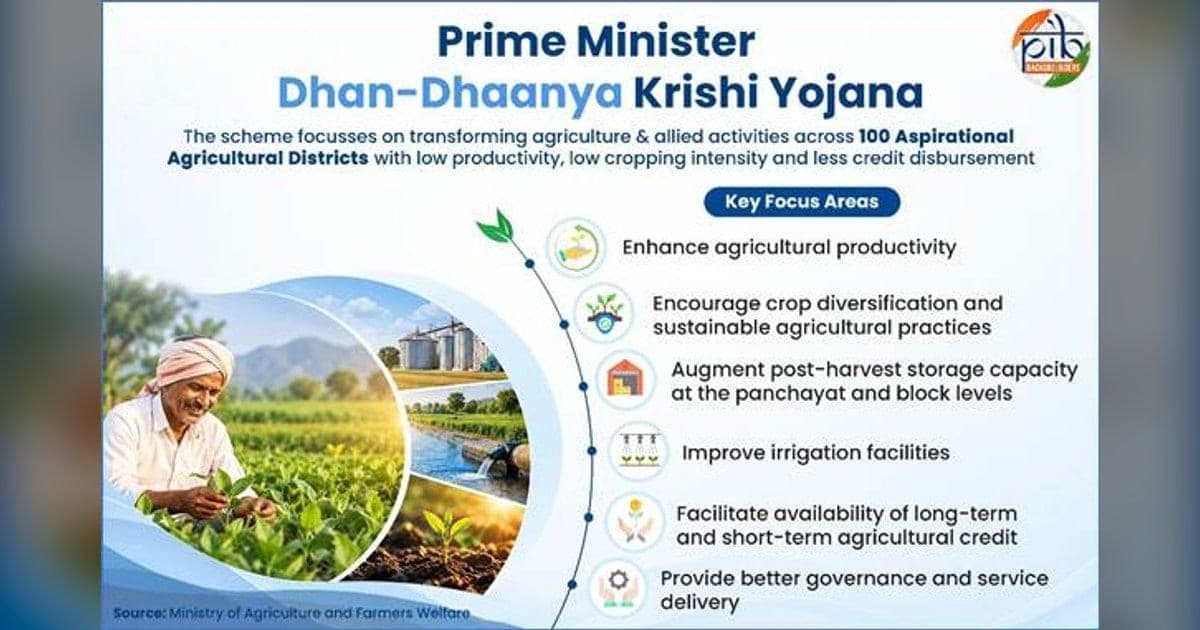
Why in News
PM Dhan-Dhaanya Krishi Yojana completes its first year on 11 October 2026, and a review of the year shows the average score of its 100 aspirational agricultural districts rising from 18.85 in April 2026 to 46.89 in August 2026.
The Prime Minister Dhan-Dhaanya Krishi Yojana (PMDDKY) finishes its first year on 11 October 2026. The scheme was cleared by the Union Cabinet on 16 July 2025 for a six-year run beginning with 2025-26, and the Prime Minister launched it on 11 October 2025. Its purpose is to lift farming in 100 Aspirational Agricultural Districts where yields, irrigation, credit and storage all lag behind.
How the districts were chosen
Three indicators decided the list: low productivity, low cropping intensity and weak disbursement of farm credit. The share of net cropped area and of operational holdings in each State and Union Territory was also weighed, and every State has at least one district on the list. Work on the ground draws on 36 Central schemes spread across 11 Ministries and Departments, together with State schemes and private participation, so that each district can bend the money towards its own gaps.
Three tiers of implementation
- District: the District Dhan Dhaanya Krishi Yojana Samiti, headed by the District Collector or District Magistrate, draws up and runs the District Action Plan.
- State: the State Dhan Dhaanya Krishi Yojana Samiti, headed by the Chief Secretary, reviews and monitors those plans.
- National: the National Executive Committee is headed by the Union Minister for Agriculture and Farmers Welfare, and the National Monitoring Committee by the Secretary, Department of Agriculture and Farmers Welfare.
What the first year shows
Progress is read through 121 indicators drawn from 36 schemes, of which 74 measure output and 47 measure outcomes, and districts are ranked every month on the PM-DDKY dashboard. The dashboard went live in the last week of October 2025 and monthly rankings started that November. All 100 districts have prepared and begun their action plans, and all of them filed output data up to August 2026 along with outcome data for 2025-26.
The average score of the 100 districts across the six objectives moved from 18.85 in April 2026 to 46.89 in August 2026, a gain of 28.04 points. Objective-wise, productivity rose from 1.50 to 8.08, crop diversification from 4.08 to 10.18, post-harvest storage from 2.14 to 5.19, irrigation from 1.38 to 4.91, credit access from 2.40 to 6.53 and governance from 7.41 to 12.05.
Farmer producer organisations
The PM-DDKY FPO Sangam of December 2025 brought in more than 72 Farmer Producer Organisations from 15 States and 33 scheme districts. Among the cases cited, the Desaiganj FPO in Gadchiroli, Maharashtra, with 800 farmer members, runs a rice mill of 3 tonnes per hour and a 900 metric tonne warehouse for its Jay Sri Ram variety and turned over ₹1.24 crore in 2025-26. The Tiptur FPO in Tumakuru, Karnataka, with 750 members, sells ball copra to a French multinational, turned over ₹1.60 crore and had pooled more than 138 tonnes of copra by 12 September 2026. In Jaisalmer, Rajasthan, a producer company of 1,236 members grows cumin on 2,000 acres using integrated pest management and solar sprinklers on 500 acres. The Department of Public Enterprises has also asked central public enterprises to adopt scheme districts for corporate social responsibility work in 2026-27 and 2027-28.
Important Facts
| Scheme | Prime Minister Dhan-Dhaanya Krishi Yojana (PMDDKY) |
|---|---|
| Cabinet approval | 16 July 2025, for six years from 2025-26 |
| Launched | 11 October 2025; first anniversary on 11 October 2026 |
| Coverage | 100 Aspirational Agricultural Districts, at least one per State |
| Selection indicators | Low productivity, low cropping intensity, low agricultural credit disbursement |
| Convergence | 36 Central schemes across 11 Ministries and Departments |
| Monitoring | 121 indicators (74 output, 47 outcome) on the PM-DDKY dashboard |
| Average district score | 18.85 in April 2026 to 46.89 in August 2026, up 28.04 points |
| District committee | District Dhan Dhaanya Krishi Yojana Samiti, headed by the District Collector or DM |
| National Executive Committee | Headed by the Union Minister for Agriculture and Farmers Welfare |
Exam Point of View
Remember the Cabinet approval of 16 July 2025, the launch on 11 October 2025, the six-year span from 2025-26, the 100 Aspirational Agricultural Districts and the three selection indicators, the convergence of 36 Central schemes across 11 Ministries, the 121 indicators split 74 output and 47 outcome, the score moving from 18.85 to 46.89, and who heads each of the three committees.
Practice Questions
How many districts are covered by the Prime Minister Dhan-Dhaanya Krishi Yojana?
- A.75
- B.100
- C.150
- D.250
Show answer
Explanation
The correct answer is 100. The scheme works in 100 Aspirational Agricultural Districts, and these were identified using three indicators: low productivity, low cropping intensity and low disbursement of agricultural credit. The share of net cropped area and of operational holdings in each State and Union Territory was also taken into account, and the design ensures that every State has at least one district in the list. All 100 districts have prepared District Action Plans, all of them submitted output indicator data up to August 2026, and all submitted outcome indicator data for 2025-26. Option A, 75, option C, 150, and option D, 250, do not match the number of districts named for the scheme. Candidates should also recall that progress across these districts is ranked every month on the PM-DDKY dashboard, and that the average score across the six objectives improved from 18.85 in April 2026 to 46.89 in August 2026.
Who heads the National Executive Committee of the Prime Minister Dhan-Dhaanya Krishi Yojana?
- A.The Prime Minister
- B.The Union Minister for Agriculture and Farmers Welfare
- C.The Secretary, Department of Agriculture and Farmers Welfare
- D.The Vice-Chairman of NITI Aayog
Show answer
Explanation
The correct answer is the Union Minister for Agriculture and Farmers Welfare. The scheme runs on a three-tier structure. At the district level, the District Dhan Dhaanya Krishi Yojana Samiti, headed by the District Collector or District Magistrate, prepares and implements the District Action Plan. At the State level, the State Dhan Dhaanya Krishi Yojana Samiti, headed by the Chief Secretary, reviews and monitors those district plans. At the national level two committees oversee the scheme: the National Executive Committee under the Union Agriculture Minister, and the National Monitoring Committee under the Secretary of the Department of Agriculture and Farmers Welfare. Option C names the head of the National Monitoring Committee, not the Executive Committee, which makes it the most tempting distractor. Option A is wrong because the Prime Minister launched the scheme but does not head this committee, and option D is wrong because NITI Aayog hosts the dashboard rather than chairing the committee.
The average score of the scheme districts across the six objectives in August 2026 was:
- A.18.85
- B.28.04
- C.46.89
- D.62.15
Show answer
Explanation
The correct answer is 46.89. The average score of the 100 districts across the six objectives of the scheme stood at 18.85 in April 2026 and reached 46.89 in August 2026, which is an improvement of 28.04 points over those months. Option A, 18.85, is the April 2026 figure and not the August one, so it tests whether a candidate has read the direction of the change. Option B, 28.04, is the size of the improvement rather than the score itself, a classic trap in data questions. Option D does not appear in the review at all. The objective-wise gains over the same period are worth noting as well: productivity moved from 1.50 to 8.08, crop diversification from 4.08 to 10.18, post-harvest storage from 2.14 to 5.19, irrigation from 1.38 to 4.91, credit access from 2.40 to 6.53, and governance and service delivery from 7.41 to 12.05.
Which three indicators were used to identify the Aspirational Agricultural Districts under the scheme?
- A.Low productivity, low cropping intensity and low agricultural credit disbursement
- B.Rainfall, soil quality and farm size
- C.Population density, literacy and road length
- D.Market arrivals, export share and warehouse capacity
Show answer
Explanation
The correct answer is low productivity, low cropping intensity and low agricultural credit disbursement. These three measures were used to pick the districts, after which the share of net cropped area and of operational holdings in each State and Union Territory was also considered so that the spread remained fair, with at least one district per State. Option B names rainfall, soil quality and farm size, which are familiar agricultural variables but not the selection criteria here. Option C lists general development indicators of the kind used for other aspirational programmes, not for this scheme. Option D names market and trade measures that the scheme seeks to improve rather than measures used for selection. Candidates should link the criteria to the scheme design: because the chosen districts were weak in yield, cropping intensity and credit, the plans converge 36 Central schemes of 11 Ministries and Departments to close exactly those gaps.
Frequently Asked Questions
How many districts does PM Dhan-Dhaanya Krishi Yojana cover?
It covers 100 Aspirational Agricultural Districts, chosen for low productivity, low cropping intensity and low farm credit disbursement. Every State and Union Territory has at least one district on the list.
When was PM Dhan-Dhaanya Krishi Yojana launched?
The Union Cabinet approved it on 16 July 2025 for six years beginning with 2025-26, and the Prime Minister launched it on 11 October 2025. Its first anniversary falls on 11 October 2026.
How is the scheme monitored?
Through 121 indicators drawn from 36 schemes, of which 74 track output and 47 track outcomes. Districts are ranked every month on the PM-DDKY dashboard, which became operational in the last week of October 2025.
Sources
- https://www.pib.gov.in/PressReleasePage.aspx?PRID=2321731 (opens in a new tab) — Press Information Bureau
Current Affairs 10 October 2026
- Forest Rights Act Review Conference Held in Kolkata for Eight StatesNational
- Exercise Tarang Shakti 2026 Second Edition Held at JodhpurDefence
- Milton Dick of Australia Elected President of the IPU at ArushaInternational
- BRICS Traditional Sports Demonstration Games to Open in AhmedabadSports
- Vice-President Addresses Second Convocation of AIIMS DeogharNational
- 94th Fit India Sundays on Cycle to Be Held in VaranasiGovernment Schemes
- Lighthouse Tourism Grows to 18.63 Lakh Visitors in 2024-25National
- National Quantum Mission Crosses 1,000 km Quantum-Secure LinkScience & Technology
Related Current Affairs
- National
Special Campaign 6.0 to Run in Government Offices From 2 October
28 September 2026 · 3 min read
- Reports & Indices
NITI Aayog Releases Ninth Trade Watch Quarterly Edition
16 September 2026 · 2 min read




Related GK
- Sustainable Development and the SDGs: All 17 Goals
9 October 2026 · Environment & Ecology
- Planning in India and NITI Aayog: Plans, Models and Bodies
25 September 2026 · Indian Economy
Take the Quiz
- Current Affairs Quiz
State Exams Current Affairs Quiz: 10 October 2026
25 questions25 minutesStart Quiz