
ARIES Study Tracks Blazar OJ 287 Twin Black Holes for a Decade
An ARIES Nainital study with 106 scientists from 18 countries tracked blazar OJ 287 for ten years and put its main black hole at 3.89 billion solar masses.
Why in News
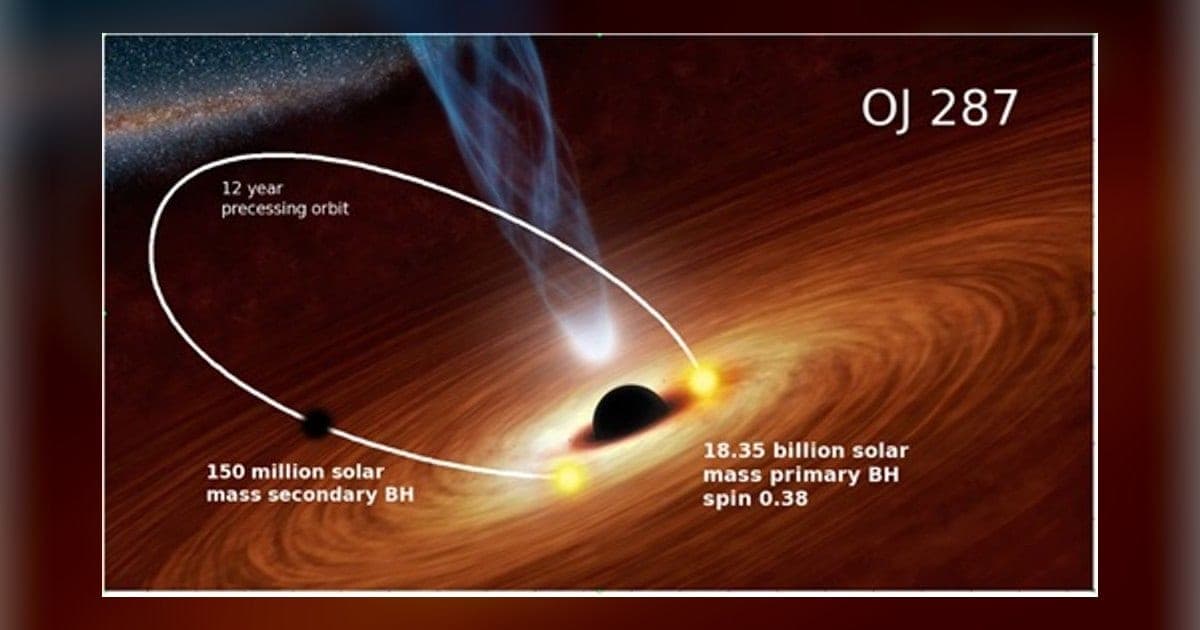
A multi-institutional study coordinated by ARIES, Nainital and led by Dr Alok C. Gupta tracked the blazar OJ 287 over ten years, produced its densest optical dataset in 150 years and weighed its central black hole at least 3.89 billion solar masses.
A ten-year watch on the brightness and colour of the blazar OJ 287 has given astronomers a sharper picture of its twin black holes and the radiation they throw out. The work was coordinated by scientists at the Aryabhatta Research Institute of Observational Sciences (ARIES), Nainital, an autonomous institute of the Department of Science and Technology.
What makes OJ 287 unusual
The object sits roughly 4 billion light years from the Earth and holds two supermassive black holes at its centre, circling each other on a twelve-year orbit. Supermassive black holes run from millions to billions of times the mass of the Sun. Being a blazar, OJ 287 shoots jets of plasma almost at the speed of light, aimed in our direction, and its output swings strongly and quickly from radio waves right up to gamma rays.
A pattern first spotted in 1988
The object brightens in a distinctive double peak. Finnish scientists found this rhythm in 1988 after combing through nearly 100 years of optical records reaching back to 1880, and observatories have followed the twelve-year cycle of twin outbursts ever since to map the orbital motion.
How large the campaign was
The study, led by Dr Alok C. Gupta of ARIES, drew in 106 scientists from 18 countries and 48 institutions and universities, who used about two dozen telescopes between 2015 and 2025; the outbursts captured fall between 2015 and 2019. The result is the densest optical time series anyone has assembled on this object in 150 years, covering changes that take years and flickers that take far less.
What came out of it
The data helped place the two black holes relative to each other at different moments, follow how brightness, spectrum and polarisation shifted, hunt for radiation from the smaller black hole and read the behaviour of the pair. From the width of the oxygen emission line in eight spectra taken at Steward Observatory in the United States during low-brightness spells in October and November 2017, the central black hole was weighed at no less than 3.89 billion solar masses. Earlier papers in the series were led by Dr Gupta with Professor Mauri J. Valtonen of the University of Turku, Finland, from 2017 onwards.
Why it matters
OJ 287 now serves as a laboratory for relativistic jets and for multimessenger astronomy, the practice of reading light, gravitational waves, neutrinos and cosmic rays from one source together.
Important Facts
| Object studied | OJ 287, a blazar with two supermassive black holes |
|---|---|
| Coordinating institute | Aryabhatta Research Institute of Observational Sciences (ARIES), Nainital |
| Parent department | Department of Science and Technology |
| Study leader | Dr Alok C. Gupta |
| Distance from Earth | About 4 billion light years |
| Orbital period of the pair | Twelve years |
| Team size | 106 scientists from 18 countries and 48 institutions |
| Observation span | About two dozen telescopes, 2015 to 2025 |
| Central black hole mass | At least 3.89 billion solar masses |
| Pattern discovered | 1988, by Finnish scientists using records from 1880 |
Exam Point of View
Note the institute (ARIES, Nainital, under the Department of Science and Technology), the object (blazar OJ 287, about 4 billion light years away, twin supermassive black holes on a twelve-year orbit), the leader (Dr Alok C. Gupta), the scale (106 scientists, 18 countries, 48 institutions, 2015 to 2025) and the mass estimate of 3.89 billion solar masses.
Practice Questions
Which Indian institute coordinated the decade-long optical study of the blazar OJ 287?
- A.Indian Institute of Astrophysics, Bengaluru
- B.Aryabhatta Research Institute of Observational Sciences, Nainital
- C.Inter-University Centre for Astronomy and Astrophysics, Pune
- D.Physical Research Laboratory, Ahmedabad
Show answer
Correct answer: B. Aryabhatta Research Institute of Observational Sciences, Nainital
Explanation
The correct answer is the Aryabhatta Research Institute of Observational Sciences, Nainital. The multi-institutional campaign on the blazar OJ 287 was coordinated by scientists of this institute, which is an autonomous body of the Department of Science and Technology, and the study was led by Dr Alok C. Gupta of the same institute. The team gathered 106 scientists from 18 countries and 48 institutions and universities, who observed the object with about two dozen telescopes between 2015 and 2025. Options A, C and D name well-known Indian centres for astronomy and space science, but none of them is credited with coordinating this particular study; they are offered because candidates often confuse the national astronomy institutes with one another. The safest way to remember the fact is to link the Nainital institute, its parent department and the name of the lead scientist together, since any of the three can be asked.
The two supermassive black holes at the centre of OJ 287 orbit each other once in how many years?
- A.Five years
- B.Eight years
- C.Twelve years
- D.Twenty years
Show answer
Correct answer: C. Twelve years
Explanation
The correct answer is twelve years. OJ 287 is a rare object lying about 4 billion light years away in which two supermassive black holes circle each other on a twelve-year orbit, forming a binary system. Because of that orbit the blazar brightens in a distinctive double peak, a rhythm that Finnish scientists identified in 1988 after studying nearly 100 years of optical observations going back to 1880, and astronomers have since followed each twelve-year cycle of twin outbursts to map the motion. The recent campaign captured the outbursts that fell between 2015 and 2019. Options A, B and D are wrong because none of them matches the period of the pair; they are included because a candidate who remembers only that the object has a repeating cycle may guess at the number. Remember the orbital period along with the distance, as the two facts are usually asked together.
What minimum mass was estimated for the central black hole of OJ 287 in the study?
- A.3.89 million solar masses
- B.3.89 billion solar masses
- C.18 billion solar masses
- D.106 million solar masses
Show answer
Correct answer: B. 3.89 billion solar masses
Explanation
The correct answer is 3.89 billion solar masses. Using eight optical spectra recorded at Steward Observatory in the United States during low-brightness phases of the object in October and November 2017, the team estimated the central black hole to weigh no less than that, reading the figure from the width of the oxygen emission line. Option A is wrong because it shifts the same digits down by a factor of a thousand; supermassive black holes can range from millions to billions of solar masses, so a candidate who misses the unit will fall for it. Option C is wrong because eighteen is the number of countries whose scientists joined the study, not a mass. Option D is wrong for the same kind of reason, since one hundred and six is the number of scientists in the team. The lesson is to keep the three large numbers of this study separate: the team size, the number of countries and the mass estimate.
Frequently Asked Questions
What is OJ 287?
A rare blazar about 4 billion light years from the Earth that contains two supermassive black holes at its centre orbiting each other on a twelve-year cycle and firing plasma jets towards us at nearly the speed of light.
Which Indian institute coordinated the decade-long study?
The Aryabhatta Research Institute of Observational Sciences, Nainital, an autonomous institute of the Department of Science and Technology. The study was led by Dr Alok C. Gupta.
How heavy is the central black hole of OJ 287?
At least 3.89 billion solar masses. The figure came from the width of the oxygen emission line in eight spectra recorded at Steward Observatory in the United States during low-brightness phases in 2017.
Sources
- https://www.pib.gov.in/PressReleasePage.aspx?PRID=2319522 (opens in a new tab) — Press Information Bureau
Current Affairs 6 October 2026
- eSanjeevani Crosses 50 Crore Teleconsultations in IndiaGovernment Schemes
- VB-G RAM G Schedule Notifies 375 Permissible Rural WorksGovernment Schemes
- Steel Ministry to Set Up Steel Industry Safety Council (SISC)Economy
- MoD Signs Rs 661.50 Crore BrahMos Fire Control System DealDefence
- First Fleet Support Ship Surya Launched at HSL VisakhapatnamDefence
- India Joins 153rd IPU Assembly at Arusha in TanzaniaInternational
- ESTIC 2026 Ocean Sciences Curtain Raiser Held at KochiSummits & Conferences
- Textile Industry Development Council Holds Its First MeetingEconomy
Related Current Affairs
- Science & Technology
IMC 2026 Theme Scale Without Boundaries, 10th Edition at Yashobhoomi
5 October 2026 · 2 min read
- Science & Technology
ITRA Study: Ayurveda with Yoga Cuts Bedwetting by 70 Per Cent
5 October 2026 · 2 min read
- Science & Technology
Sanchar Saathi Portal Crosses 30 Crore Visits Against Telecom Fraud
5 October 2026 · 2 min read
- Science & Technology
TDB Backs Project VeerAI With Rs 130 Crore for AI Vision Chip
5 October 2026 · 2 min read
- Science & Technology
National Supercomputing Mission Reaches 40 Systems, 68 PF
4 October 2026 · 2 min read


Related GK
- Science Policy and Research Funding in India: Exam Notes
6 October 2026 · Science & Technology
- Goa GK: Liberation, Statehood, Geography and Facts
6 October 2026 · Indian States & UTs
- Statues, Towers and Landmarks of India for Exams
6 October 2026 · Static GK
Take the Quiz
- Current Affairs Quiz
SSC CGL Current Affairs Quiz: 6 October 2026
25 questions25 minutesStart Quiz