
Additive Manufacturing: MeitY's NSAM Moves to NSAM 2.0 Phase
A PIB backgrounder of 7 October 2026 says the National Strategy for Additive Manufacturing has trained over 1,54,000 people and backed 56 AM start-ups.
Why in News
On 7 October 2026 the Press Information Bureau issued a backgrounder on Additive Manufacturing in India, reviewing the National Strategy for Additive Manufacturing of February 2022, its measured progress and the proposed NSAM 2.0 phase.
Additive Manufacturing (AM), the family of 3D printing methods that build an object layer by layer from a digital file, is the subject of a backgrounder put out by the Press Information Bureau on 7 October 2026. The note sets out how India is building an AM ecosystem and what the next phase, called NSAM 2.0, will aim at.
The strategy and its targets
The Ministry of Electronics and Information Technology (MeitY) brought out the National Strategy for Additive Manufacturing (NSAM) in February 2022 as the guiding policy framework for 3D printing in the country. It is aligned with Make in India and Atmanirbhar Bharat and carries time-bound goals: a 5 per cent slice of the world AM market, close to one billion US dollars added to national income, 50 technologies designed for Indian needs, 100 fresh start-ups, 500 new products, one lakh trained workers and AM capability across 10 manufacturing sectors. Seven specialised Development and Deployment Centres anchor research, skilling and hands-on access to machines.
Progress so far
Four years on, the government counts more than 1,54,000 persons trained in AM-related skills and 56 AM start-ups supported. The national centres have delivered 65 India-specific technologies covering materials, machines, Design for Additive Manufacturing (DfAM) and printed products, which in turn feed aerospace, medical devices, electronics, energy, food processing and photonics.
| NSAM target | Reached so far |
| One lakh workers trained | Over 1,54,000 trained |
| 100 start-ups nurtured | 56 supported |
| 50 India-specific technologies | 65 developed |
Where AM is already working
In space, the IIT Madras-incubated start-up Agnikul Cosmos flew Agnibaan-SOrTeD in May 2024 with a single-piece, AM-printed semi-cryogenic engine. In defence, the Indian Army opened its first AM-printed two-storey dwelling unit at Ahmedabad, raised in just 12 weeks, and has taken the method to precast defences in terrain such as Ladakh. In health, the Technology Development Board is backing 3D-printed bone grafts made from indigenous bioceramic materials, while the start-up OsteoForge prints silk-based implants. In electronics, IISc has shown Photonic Integrated Circuit blocks made by AM, a global first. In construction, the Kelvin 6K Pro on-site printer has built 2,500 sq ft homes in under 30 days using low-carbon geopolymer, pointing to 30 per cent lower material and logistics cost and 90 per cent lower emissions than cement-based work.
Market size and NSAM 2.0
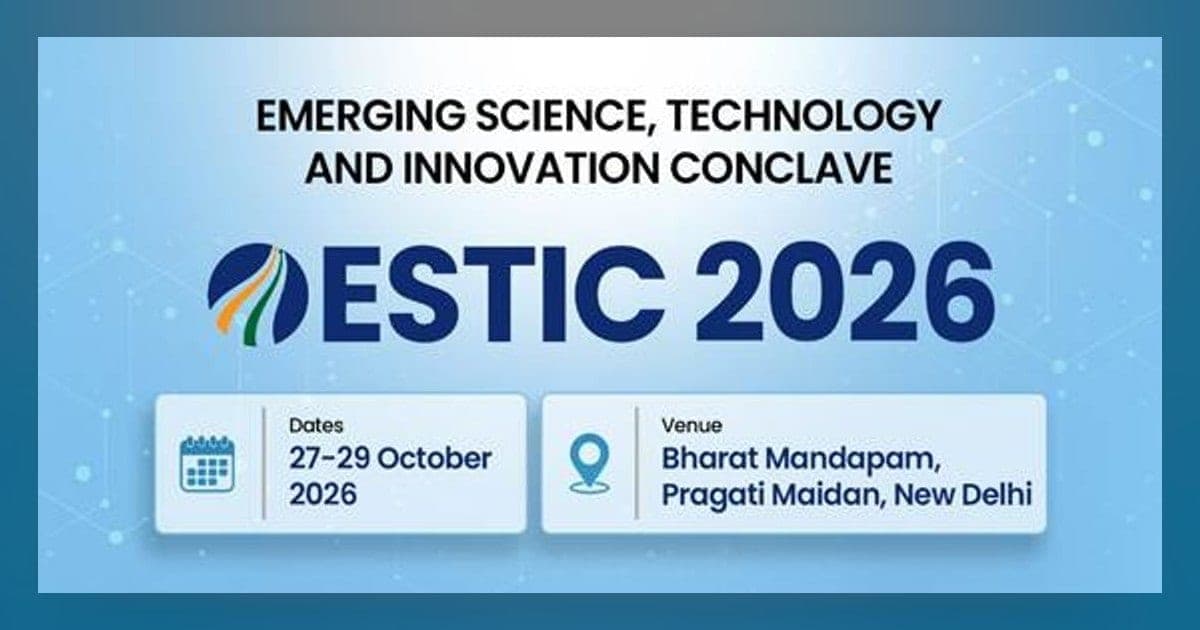
The world market for AM machines is projected at 149 billion US dollars by 2035, while the AM-electronics supply chain is seen growing from 18 billion to 112 billion US dollars. NSAM 2.0 proposes faster creation of intellectual property, an AM network tied together digitally, cheaper machines and materials through clusters, wider support to Indian defence, pilots driven by the Sustainable Development Goals, and cooperation abroad on standards and joint research. MeitY held the second National Additive Manufacturing Symposium (NAMS) on 13 March 2026 in New Delhi. The second Emerging Science, Technology and Innovation Conclave, ESTIC-2026, runs from 27 to 29 October 2026 at Bharat Mandapam, New Delhi, organised by the Council of Scientific and Industrial Research on the theme 'Creative Minds, Catalyzing Science, Empowering Technologies' across 12 thematic areas. At school level, each Atal Tinkering Lab gets a grant of 20 lakh rupees for a 1,200 to 1,500 sq ft innovation space fitted with 3D printers, robotics and IoT kits for students of Classes VI to XII.
Important Facts
| Technology | Additive Manufacturing (3D printing) |
|---|---|
| Strategy | National Strategy for Additive Manufacturing (NSAM) |
| Released by | Ministry of Electronics and Information Technology (MeitY), February 2022 |
| Market target | 5 per cent of the global AM market and about one billion US dollars to GDP |
| Trained so far | More than 1,54,000 persons |
| Start-ups supported | 56 |
| India-specific technologies | 65 |
| Development and Deployment Centres | Seven |
| Global AM machines market | 149 billion US dollars by 2035 |
| ESTIC-2026 | 27 to 29 October 2026, Bharat Mandapam, New Delhi, organised by CSIR |
| 2nd NAMS | 13 March 2026, New Delhi |
Exam Point of View
Remember that MeitY released NSAM in February 2022; its targets (5 per cent of the global market, one billion US dollars to GDP, 50 India-specific technologies, 100 start-ups, 500 products, one lakh trained workers, 10 sectors, seven centres); the progress figures (over 1,54,000 trained, 56 start-ups, 65 technologies); the second NAMS on 13 March 2026; and ESTIC-2026 at Bharat Mandapam from 27 to 29 October 2026 under CSIR.
Practice Questions
Which ministry released India's National Strategy for Additive Manufacturing (NSAM)?
- A.Ministry of Heavy Industries
- B.Ministry of Electronics and Information Technology
- C.Ministry of Science and Technology
- D.Ministry of Commerce and Industry
Show answer
Correct answer: B. Ministry of Electronics and Information Technology
Explanation
The correct answer is the Ministry of Electronics and Information Technology (MeitY). MeitY brought out the National Strategy for Additive Manufacturing in February 2022 as the guiding policy framework for 3D printing in India, keeping it aligned with Make in India and Atmanirbhar Bharat. The same ministry supports the specialised Development and Deployment Centres and organised the second National Additive Manufacturing Symposium in New Delhi. Option A, the Ministry of Heavy Industries, sounds plausible because additive manufacturing makes machine parts, but the strategy is not its document. Option C, the Ministry of Science and Technology, is wrong here, although the Council of Scientific and Industrial Research works under it and organises the ESTIC conclave where additive manufacturing features. Option D, the Ministry of Commerce and Industry, deals with trade and investment promotion and had no role in issuing this strategy.
What share of the global additive manufacturing market does NSAM aim to capture for India?
- A.2 per cent
- B.5 per cent
- C.10 per cent
- D.15 per cent
Show answer
Correct answer: B. 5 per cent
Explanation
The correct answer is 5 per cent. The national strategy sets a time-bound goal of capturing a twentieth of the world additive manufacturing market and of adding close to one billion US dollars to India's gross domestic product. Around that headline figure sit its other targets: 50 technologies built for Indian needs covering materials, machines, processes and software, 100 new start-ups, 500 new products, a skilled pool of one lakh workers and additive manufacturing capability in 10 existing and emerging manufacturing sectors. Option A understates the ambition, while options C and D overstate it; no such share appears in the strategy. The figure matters because progress is measured against it, and the next phase, NSAM 2.0, is being shaped to accelerate the market further.
ESTIC-2026, to be held at Bharat Mandapam in New Delhi from 27 to 29 October 2026, is being organised by which organisation?
- A.Indian Space Research Organisation
- B.Defence Research and Development Organisation
- C.Council of Scientific and Industrial Research
- D.Indian Council of Agricultural Research
Show answer
Correct answer: C. Council of Scientific and Industrial Research
Explanation
The correct answer is the Council of Scientific and Industrial Research (CSIR). ESTIC is India's Emerging Science, Technology and Innovation Conclave, and its second edition is organised by CSIR on the theme 'Creative Minds, Catalyzing Science, Empowering Technologies'. The conclave spans 12 thematic areas with plenary sessions, technical discussions and exhibitions, takes forward frontier fields such as additive manufacturing, and supports the vision of Viksit Bharat 2047. Option A, ISRO, is the space agency and is linked to additive manufacturing only through printed rocket hardware. Option B, DRDO, handles defence research and is not the organiser. Option D, ICAR, is the apex agricultural research body and has no role in this conclave. Note the venue, Bharat Mandapam in New Delhi, and the dates.
How many additive manufacturing start-ups have been supported so far under NSAM?
- A.26
- B.36
- C.46
- D.56
Show answer
Correct answer: D. 56
Explanation
The correct answer is 56. More than four years after the strategy was issued, the government reports that 56 additive manufacturing start-ups have been supported, strengthening the country's innovation and entrepreneurship base. Alongside that figure, more than 1,54,000 people have been trained in additive manufacturing skills, and the network of national centres has enabled 65 India-specific technologies covering materials, machines, Design for Additive Manufacturing and printed products, feeding work in aerospace, medical devices, electronics, energy, food processing and photonics. Options A, B and C are lower counts that do not match the reported progress. Remember also that the strategy's own target is 100 new start-ups, so the figure of 56 represents progress towards that goal rather than its completion.
Frequently Asked Questions
Which ministry released the National Strategy for Additive Manufacturing?
The Ministry of Electronics and Information Technology (MeitY) released NSAM in February 2022 as India's policy framework for 3D printing, aligned with Make in India and Atmanirbhar Bharat.
What are the main targets set under NSAM?
A 5 per cent share of the global additive manufacturing market, nearly one billion US dollars added to GDP, 50 India-specific technologies, 100 new start-ups, 500 new products, one lakh trained workers and AM capability across 10 manufacturing sectors.
What is ESTIC-2026?
The second edition of India's Emerging Science, Technology and Innovation Conclave, to be held from 27 to 29 October 2026 at Bharat Mandapam, New Delhi, by CSIR on the theme 'Creative Minds, Catalyzing Science, Empowering Technologies' across 12 thematic areas.
Sources
- https://pib.gov.in/PressReleaseIframePage.aspx?PRID=2319962 (opens in a new tab) — Press Information Bureau
Current Affairs 7 October 2026
- Pre-COP31 in Fiji: Bhupender Yadav Leads Indian DelegationEnvironment
- TRAI Drive Test Grades Mobile Networks in Balasore CityReports & Indices
Related Current Affairs
- Science & Technology
ARIES Study Tracks Blazar OJ 287 Twin Black Holes for a Decade
6 October 2026 · 2 min read
- Science & Technology
IMC 2026 Theme Scale Without Boundaries, 10th Edition at Yashobhoomi
5 October 2026 · 2 min read
- Science & Technology
ITRA Study: Ayurveda with Yoga Cuts Bedwetting by 70 Per Cent
5 October 2026 · 2 min read
- Science & Technology
Sanchar Saathi Portal Crosses 30 Crore Visits Against Telecom Fraud
5 October 2026 · 2 min read
- Science & Technology
TDB Backs Project VeerAI With Rs 130 Crore for AI Vision Chip
5 October 2026 · 2 min read

Related GK
- Arunachal Pradesh GK: Tawang, Tribes, Rivers and Exam Facts
7 October 2026 · Indian States & UTs
- Geographical Epithets of the World: Nicknames of Places
7 October 2026 · Static GK
- Cyber Security and Digital Public Infrastructure: Notes
7 October 2026 · Science & Technology
Take the Quiz
- Current Affairs Quiz
State Exams Current Affairs Quiz: 7 October 2026
11 questions11 minutesStart Quiz