
BSIP Study Finds Climate Clues in Himalayan Marmot Droppings
Scientists of the Birbal Sahni Institute of Palaeosciences studied pollen and fungal spores in Himalayan marmot faeces as a new biological archive of climate change.
Why in News
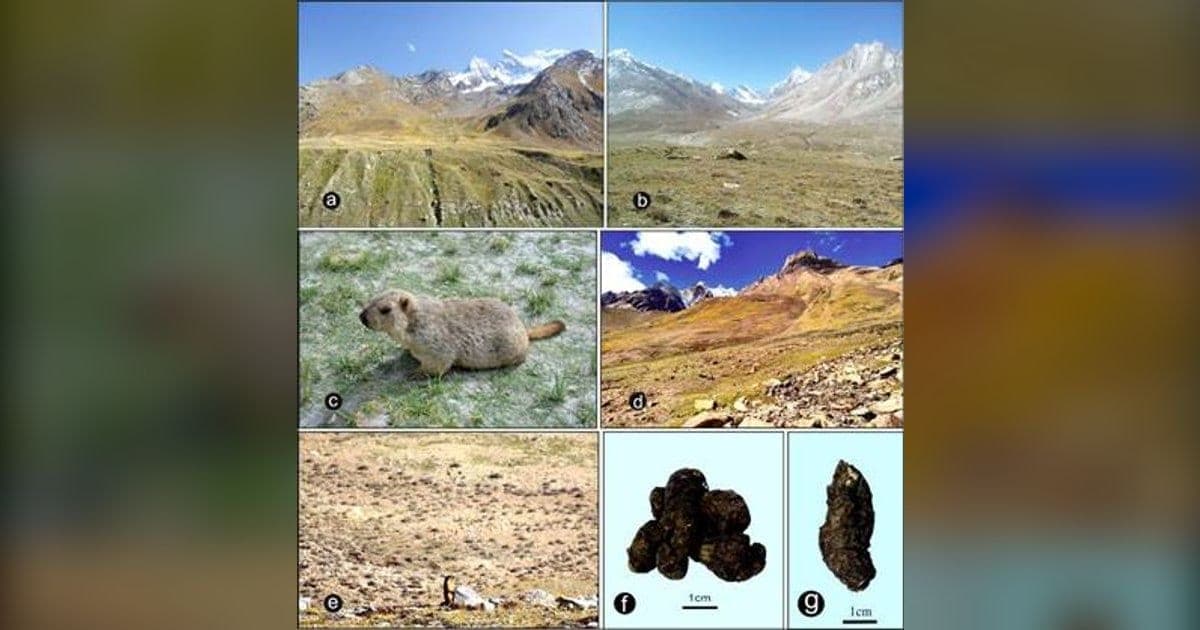
A study released on 19 November 2026 reported that droppings of the Himalayan marmot, examined by the Birbal Sahni Institute of Palaeosciences, can act as a biological archive of vegetation and climate change in the higher Himalaya.
A new study has examined pollen grains, fungal spores and elemental signatures preserved in the droppings of the Himalayan marmot, whose scientific name is Marmota himalayana, to read environmental conditions in the higher Himalaya and the way climate change has altered them. The work was carried out by scientists of the Birbal Sahni Institute of Palaeosciences, an autonomous institute of the Department of Science and Technology. It has been published in the journal PLOS ONE.
Why a new archive was needed
The Himalaya responds sharply to shifts in temperature, rainfall and snow cover, and those shifts tell on alpine plants and on the habitats of wildlife. Most work of this kind has until now relied on lake sediments, peat and soil. The team asked whether marmot faeces could serve instead as a biological record of environmental change. Such an alternative matters most in remote and dry mountain country, where sedimentary records of the usual sort are hard to find.
What the droppings revealed
The marmot is a plant-eating mammal of the cold, dry, high-altitude alpine belt, and it depends on local vegetation for both food and shelter. Pollen held in its droppings therefore carries the signature of the plants it ate and of the alpine-steppe plant community around it. The leading plant groups in its diet were found to be Artemisia, Asteroideae, Caryophyllaceae, Poaceae, Cyperaceae and Chenopodiaceae.
Methods and findings
| Institute | Birbal Sahni Institute of Palaeosciences, under the Department of Science and Technology |
| Species | Himalayan marmot, Marmota himalayana |
| Field areas | Pensila Pass and Rimkhim |
| Journal | PLOS ONE |
The researchers were Sadhan K Basumatary, Hukam Singh, Manish Mehta, Swati Tripathi, Mahesh G. Thakkar, H. Gregory McDonald, Eline N. van Asperen and Vinit Kumar. They used palynological analysis to identify pollen and fungal spores, statistical methods to compare samples from two Himalayan areas, and Field Emission Scanning Electron Microscopy with Energy-Dispersive X-ray Spectroscopy to work out elemental composition. Three pollen ratios were evaluated for reading vegetation and climate: Artemisia to Chenopodiaceae, Artemisia to Cyperaceae and Artemisia to Ephedra. The team concluded that the Himalayan marmot can act as a strong indicator species for vegetation and climate change in the higher Himalaya, and that changes in its habitat point to shifts in altitude as conditions alter. The study offers a modern reference for reconstructing past ecological change and for coprolite research, and may also aid biodiversity conservation.
Important Facts
| Institute | Birbal Sahni Institute of Palaeosciences (BSIP), Lucknow-based autonomous institute |
|---|---|
| Parent body | Department of Science and Technology |
| Species studied | Himalayan marmot, Marmota himalayana |
| Material | Faeces, examined for pollen grains, fungal spores and elemental signatures |
| Field areas | Pensila Pass and Rimkhim in the Himalaya |
| Techniques | Palynological analysis, statistical comparison and FESEM-EDS |
| Pollen ratios | Artemisia to Chenopodiaceae, Artemisia to Cyperaceae and Artemisia to Ephedra |
| Journal | PLOS ONE |
Exam Point of View
Remember the institute (Birbal Sahni Institute of Palaeosciences), its parent department (Department of Science and Technology), the species (Marmota himalayana), the field areas (Pensila Pass and Rimkhim), the journal (PLOS ONE) and the technique FESEM-EDS.
Practice Questions
Which institute studied Himalayan marmot droppings as an archive of climate change?
- A.Wadia Institute of Himalayan Geology
- B.Birbal Sahni Institute of Palaeosciences
- C.Indian Institute of Tropical Meteorology
- D.Zoological Survey of India
Show answer
Its scientists examined pollen grains, fungal spores and elemental signatures preserved in the faeces of the Himalayan marmot in order to read environmental conditions in the higher Himalaya, and published the work in the journal PLOS ONE.
Read the full explanation →What is the scientific name of the Himalayan marmot studied in this research?
- A.Marmota marmota
- B.Marmota himalayana
- C.Ochotona roylei
- D.Pantholops hodgsonii
Show answer
This is the herbivorous mammal of the cold and dry high-altitude alpine belt whose droppings were examined for pollen, fungal spores and elemental composition.
Read the full explanation →Which technique did the researchers use to identify the elemental composition of the samples?
- A.Radiocarbon dating
- B.Mass spectrometry of ice cores
- C.Field Emission Scanning Electron Microscopy with Energy-Dispersive X-ray Spectroscopy
- D.Nuclear magnetic resonance imaging
Show answer
The team paired it with palynological analysis, which identified the pollen grains and fungal spores, and with statistical methods used to compare samples from two Himalayan areas.
Read the full explanation →In which journal was the Himalayan marmot study published?
- A.Nature
- B.Current Science
- C.PLOS ONE
- D.Science
Show answer
The study was published there and is described as a modern reference for reconstructing past ecological change, for assessing the likely impact of climate change and for future coprolite research, besides helping biodiversity conservation by improving understanding of the habitat.
Read the full explanation →Frequently Asked Questions
Which institute carried out the Himalayan marmot study?
The Birbal Sahni Institute of Palaeosciences, an autonomous institute of the Department of Science and Technology, carried out the work. The findings were published in the journal PLOS ONE and explored marmot faeces as an alternative biological archive of environmental change.
Why are marmot droppings useful for studying climate?
The Himalayan marmot is a herbivore that depends on local plants, so pollen preserved in its droppings reflects the alpine-steppe vegetation around it. In remote and arid mountain areas, where lake sediments, peat and soil records are scarce, these droppings offer an alternative record of environmental conditions.
Which techniques did the researchers use?
They used palynological analysis to identify pollen grains and fungal spores, statistical methods to compare samples from two Himalayan areas, and Field Emission Scanning Electron Microscopy coupled with Energy-Dispersive X-ray Spectroscopy to determine elemental composition.
Sources
- https://pib.gov.in/PressReleasePage.aspx?PRID=2338533 (opens in a new tab) — Press Information Bureau
Current Affairs 19 November 2026
- Antimicrobials to Be Treated as New Drugs Under NDCT RulesNational
- Separate Wholesale Licence Proposed for Bulk Drugs in IndiaNational
- SVANidhi Samman Awards 2026 to Honour Street Vendor WorkGovernment Schemes
- CSIR Transfers Bio-Bitumen and UHPC Road Technologies to IndustryScience & Technology
- CMOT Brings 100 Young Film Talents to 57th IFFI in GoaNational
- CSIR-TKDL and IKS Division Sign MoU on Traditional KnowledgeNational
- BHASHINI Shows Voice-First Language AI at Dakshin Day 2026Science & Technology
- IAF Signs MoU With Central Sanskrit University for Yoga CoursesDefence
Related Current Affairs
- Science & Technology
BHASHINI Shows Voice-First Language AI at Dakshin Day 2026
19 November 2026 · 2 min read
- Science & Technology
CSIR Transfers Bio-Bitumen and UHPC Road Technologies to Industry
19 November 2026 · 2 min read
- Science & Technology
IISF 2026 Curtain Raiser Launched; Pune to Host 12th Edition
18 November 2026 · 2 min read
- Science & Technology
ICMR Crosses 100 Technology Transfer Deals at DHR Summit
18 November 2026 · 2 min read
- Science & Technology
ICAR-NIHSAD Develops India's First Indigenous H5N1 Vaccine
18 November 2026 · 2 min read
- Science & Technology
DST Releases Tribal Technology Compendium on Gaurav Divas
17 November 2026 · 2 min read




Related GK
- Famous Personalities of Rajasthan: Exam Notes
28 October 2026 · Rajasthan
- Districts and Divisions of Rajasthan: Exam Notes
28 October 2026 · Rajasthan
- Tourism and World Heritage Sites of Rajasthan Notes
27 October 2026 · Rajasthan
Take the Quiz
- Current Affairs Quiz
RRB JE Current Affairs Quiz: 19 November 2026
11 questions11 minutesStart Quiz