
Indian Scientists Identify Martian Analogue Sites in Tamil Nadu
University of Kerala researchers used a DST-FIST laser Raman spectrometer to establish Neyveli, the Tiruchirappalli Badlands and Chile's Atacama as Mars analogue sites.
Why in News
On 16 October 2026 the Ministry of Science and Technology announced that Indian scientists had identified melanterite and gypsum at sites in Tamil Nadu and in Chile's Atacama Desert, establishing them as Martian analogue sites.
Two minerals found in Tamil Nadu and in Chile's Atacama Desert have been used to establish those places as Martian analogue sites, in work announced by the Ministry of Science and Technology on 16 October 2026. An analogue site is a place on Earth whose geology, chemistry and physical conditions resemble those on Mars closely enough to be used as a stand-in for studying the planet.
The two minerals
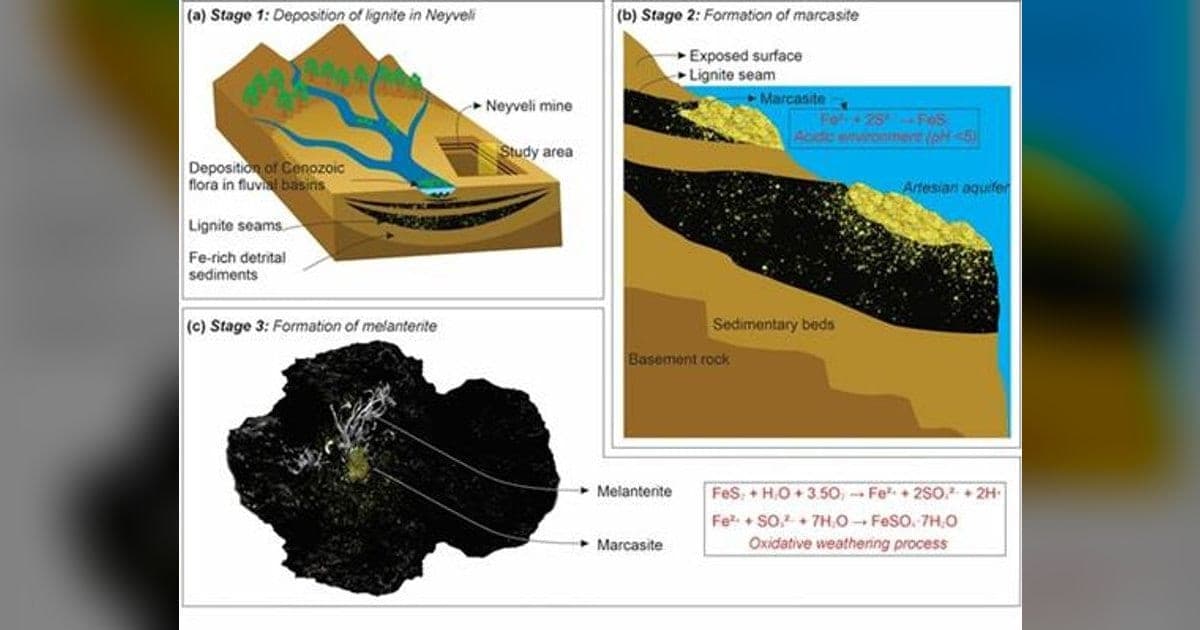
The study identified melanterite at Neyveli in Tamil Nadu, and gypsum in the Atacama Desert of Chile and in the Tiruchirappalli Badlands, a semi-arid geological and palaeoclimatic terrain in Tamil Nadu. Both are hydrous sulphates, which means they hold water in their crystal structure and therefore record how water and rock once interacted.
| Mineral | Where found | What it records |
| Melanterite | Neyveli, Tamil Nadu | Short-lived wet, acidic and oxidising conditions |
| Gypsum | Atacama Desert (Chile) and Tiruchirappalli Badlands | Past water activity; can preserve biosignatures |
Melanterite at Neyveli forms from marcasite in the lignite substratum through sulphide oxidation, a process similar to the one thought to create sulphates on Mars. Gypsum, on the other hand, preserves evidence of older water-rich environments and can trap biosignatures inside its mineral matrix, which makes it valuable in the search for traces of life.
Who did the work and how
The research team came from the University of Kerala and was led by Dr. Sajin Kumar K. S., Project Coordinator of DST-FIST. The key instrument was a laser Raman spectrometer supported under DST-FIST at the university's Department of Geology, which picks up the distinctive spectral fingerprint of each mineral and so confirms its identity. The findings were published as two research papers in the Journal of Geophysical Research: Planets.
Why analogue sites matter
Planetary scientists increasingly argue that data from orbit alone cannot fully describe Martian minerals, so high-precision laboratory study of look-alike terrain on Earth has become a pressing need. Minerals that record water activity and can preserve biosignatures help scientists judge which parts of Mars were once habitable, and can guide future missions towards the most promising landing sites. The Kerala team is now looking at rare analogue sites in extreme environments elsewhere in the world to study primitive life for astrobiology.
Important Facts
| Finding | Sites in Tamil Nadu and Chile established as Martian analogue sites |
|---|---|
| Minerals | Melanterite and gypsum, both hydrous sulphates |
| Melanterite site | Neyveli, Tamil Nadu (formed from marcasite in lignite substratum) |
| Gypsum sites | Atacama Desert, Chile, and the Tiruchirappalli Badlands, Tamil Nadu |
| Institution | Department of Geology, University of Kerala |
| Team leader | Dr. Sajin Kumar K. S., Project Coordinator, DST-FIST |
| Instrument | Laser Raman spectrometer supported by DST-FIST |
| Published in | Journal of Geophysical Research: Planets (two papers) |
Exam Point of View
Remember the two minerals (melanterite and gypsum), the three sites (Neyveli, Tiruchirappalli Badlands and the Atacama Desert in Chile), the institution (University of Kerala, Department of Geology), the team leader (Dr. Sajin Kumar K. S.), the instrument (laser Raman spectrometer under DST-FIST) and the journal.
Practice Questions
Which mineral identified at Neyveli in Tamil Nadu helped establish it as a Martian analogue site?
- A.Melanterite
- B.Gypsum
- C.Hematite
- D.Olivine
Show answer
At Neyveli the mineral forms from marcasite in the lignite substratum through sulphide oxidation, and it records short-lived wet, acidic and oxidising conditions of the kind believed to have produced sulphates on Mars.
Read the full explanation →Which institution's research team identified the Martian analogue sites using a laser Raman spectrometer?
- A.Physical Research Laboratory, Ahmedabad
- B.University of Kerala, Department of Geology
- C.Indian Institute of Astrophysics, Bengaluru
- D.National Centre for Earth Science Studies
Show answer
The laser Raman spectrometer used for the work is supported under the DST-FIST programme at that department, and the research team was led by Dr. Sajin Kumar K. S., who is the Project Coordinator of DST-FIST.
Read the full explanation →Which desert, identified as a gypsum-bearing Martian analogue site in this study, lies outside India?
- A.Atacama Desert, Chile
- B.Sahara Desert, Africa
- C.Gobi Desert, Mongolia
- D.Kalahari Desert, Botswana
Show answer
Gypsum was identified there and also in the Tiruchirappalli Badlands, a semi-arid geological and palaeoclimatic terrain in Tamil Nadu, and both places therefore qualify as Martian analogue sites for the study of past water activity.
Read the full explanation →Frequently Asked Questions
What is a Martian analogue site?
It is a place on Earth whose geological, chemical and physical characteristics resemble those of Mars. Studying such terrain with high-precision instruments helps scientists interpret Martian minerals, because data from orbit alone cannot fully characterise them.
Which minerals were identified and where?
Melanterite was identified at Neyveli in Tamil Nadu, and gypsum in the Atacama Desert of Chile and the Tiruchirappalli Badlands in Tamil Nadu. Both are hydrous sulphates that record water-rock interactions.
Which instrument and institution were involved?
A laser Raman spectrometer supported under DST-FIST at the Department of Geology, University of Kerala. The research team was led by Dr. Sajin Kumar K. S., Project Coordinator of DST-FIST, and the results were published in the Journal of Geophysical Research: Planets.
Sources
- https://www.pib.gov.in/PressReleasePage.aspx?PRID=2324335 (opens in a new tab) — Press Information Bureau
Current Affairs 16 October 2026
- India Builds Safer Navigation on 111 National WaterwaysNational
- APEDA Flags Off Maiden Palmyra Jaggery Export to BulgariaEconomy
- Polish Youth Delegation Ends Jamsaheb Memorial Exchange in IndiaInternational
- Ayush Patent Report Records 4,077 Filings Since 2014-15Reports & Indices
- First Kanda Express Takes 440 MT Onions to AgartalaEconomy
- BHASHINI and IISc Build Sourashtra Text-to-Speech ModelsScience & Technology
- Textiles Ministry Holds Special Campaign 6 Cyber WorkshopsNational
- INS Samarthak Joins Navy as First Indigenous Multi-Purpose VesselDefence
Related Current Affairs
- Science & Technology
TDB Signs Rs 150 Crore Quantum Security Deal With QNu Labs
16 October 2026 · 2 min read
- Science & Technology
BHASHINI and IISc Build Sourashtra Text-to-Speech Models
16 October 2026 · 2 min read
- Science & Technology
TDB Supports Development of Indigenous 32-Slice CT Scanner
15 October 2026 · 2 min read
- Science & Technology
ARCI Workshop Marks National Hydrogen and Fuel Cell Day
15 October 2026 · 2 min read
- Science & Technology
ESTIC 2026 Curtain-Raiser Highlights Physical AI, Robotics
15 October 2026 · 2 min read
- Science & Technology
BHASHINI Division and Manipur Sign MoU on Multilingual AI
15 October 2026 · 2 min read

Related GK
- Population and Tribes of MP: Bhil, Gond and Baiga
16 October 2026 · Madhya Pradesh
- Industries of Madhya Pradesh: Pithampur, Cement and Mills
16 October 2026 · Madhya Pradesh
- Industries and Minerals of Haryana: Towns and Products
16 October 2026 · Haryana
Take the Quiz
- Current Affairs Quiz
State Exams Current Affairs Quiz: 16 October 2026
25 questions25 minutesStart Quiz