
TDB Gives GalaxEye Rs 63.84 Crore for OptoSAR Satellite
TDB under DST signed an agreement with Bengaluru's GalaxEye for Rs 63.84 crore of RDI Fund support to build an OptoSAR multisensor satellite costing Rs 247.69 crore.
Why in News
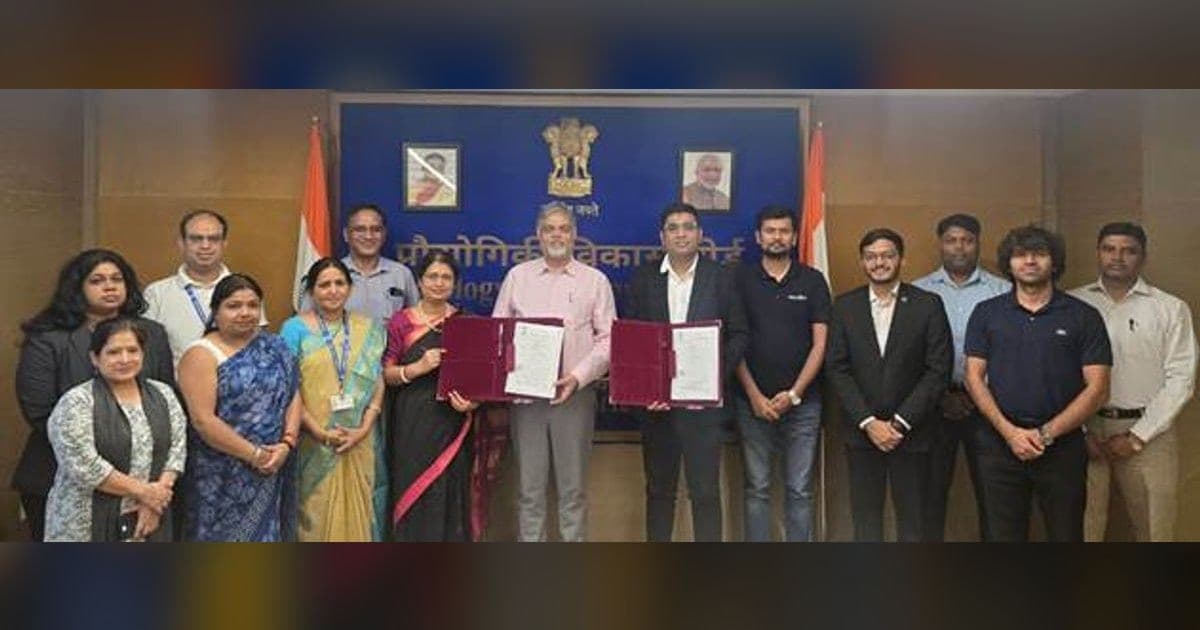
On 24 September 2026 the Ministry of Science and Technology announced that TDB-DST had signed an agreement giving GalaxEye Space Solutions Rs 63.84 crore under the RDI Fund to develop an indigenous OptoSAR multisensor satellite.
The Technology Development Board (TDB) of the Department of Science and Technology (DST) has signed an agreement with GalaxEye Space Solutions Private Limited of Bengaluru, the Ministry of Science and Technology said on 24 September 2026. The company will receive Rs 63.84 crore from the Research Development and Innovation (RDI) Fund towards a project whose approved cost is Rs 247.69 crore, and the money is to be routed through optionally convertible debentures rather than as a grant.
What OptoSAR does
The project is to build a multisensor satellite carrying the company's OptoSAR payload, which puts two unlike ways of looking at the earth on the same platform.
| Synthetic Aperture Radar (SAR) | Works without daylight and sees through cloud |
| Electro-optical (EO) imaging | Gives fine visual detail, but is hindered by cloud and poor light |
Each sensor fails where the other is strong, so fusing their data yields a fuller and less interrupted picture than either can give alone. The satellite is designed for imaging finer than half a metre, which is the resolution band at which individual objects on the ground can be separated.
Where such a satellite is used
The intended uses named in the announcement are surveillance over wide areas and at long range, detection of people and vehicles, and classification of targets, in weather and light of every kind. That combination explains why the field is treated as strategic and why the government wants the capability built at home.
From TRL-6 to TRL-9
The support is described as a technology-maturation exercise. A technology at TRL-6 has been demonstrated as a working model in conditions close to the real thing; at TRL-9 it is proven in service. The gap between the two is filled by engineering, testing and validation, and that is the stretch the funding covers, taking the payload towards deployment and eventual commercial sale. Rajesh Kumar Pathak, Secretary of the TDB, said India's space ecosystem is entering a phase in which the ability to build and deploy advanced technology within the country will matter more and more, and that the RDI Fund exists to carry such efforts through the difficult stages between advanced development and deployment.
Important Facts
| Agreement | TDB-DST with GalaxEye Space Solutions Private Limited, Bengaluru |
|---|---|
| Support | Rs 63.84 crore under the Research Development and Innovation (RDI) Fund |
| Total approved project cost | Rs 247.69 crore |
| Mode of support | Optionally convertible debentures |
| Technology | OptoSAR, fusing Synthetic Aperture Radar with electro-optical imaging |
| Resolution | Finer than half a metre |
| Technology readiness | TRL-6 to TRL-9 |
| TDB Secretary | Rajesh Kumar Pathak |
| Ministry | Science and Technology |
| Announced on | 24 September 2026 |
Exam Point of View
Remember the funding body (TDB under DST), the company (GalaxEye Space Solutions, Bengaluru), the support of Rs 63.84 crore under the RDI Fund, the total project cost of Rs 247.69 crore, the technology name OptoSAR, the two sensors it fuses (SAR and electro-optical), the sub-half-metre resolution, the TRL-6 to TRL-9 journey and the TDB Secretary's name.
Practice Questions
How much support has the Technology Development Board agreed to give GalaxEye under the RDI Fund?
- A.Rs 36.48 crore
- B.Rs 63.84 crore
- C.Rs 84.63 crore
- D.Rs 127.50 crore
Show answer
Correct answer: B. Rs 63.84 crore
Explanation
The correct answer is Rs 63.84 crore, the financial support agreed under the Research Development and Innovation Fund and routed through optionally convertible debentures rather than paid out as a simple grant. Keep it apart from the other money figure in the same announcement, the total approved cost of the project, which is far larger; a question will often place the two side by side to see whether a candidate has confused the support with the whole outlay. Options A and C are the same digits rearranged, a trap that works precisely because the figure carries two decimal places and is easy to garble under time pressure. Option D is a round-looking amount that appears nowhere in the announcement. The safest habit is to read such a figure once as a whole number of crore and once as its decimal part.
What is the total approved cost of the GalaxEye multisensor satellite project?
- A.Rs 147.69 crore
- B.Rs 247.69 crore
- C.Rs 347.69 crore
- D.Rs 447.69 crore
Show answer
Correct answer: B. Rs 247.69 crore
Explanation
The correct answer is Rs 247.69 crore. This is the approved cost of the whole project, of which the Technology Development Board is supporting a part from the Research Development and Innovation Fund, the rest being borne by the company. The distinction matters because a public fund of this kind is meant to share the risk of a costly technology programme rather than to pay for it outright, which is also why the support takes the form of optionally convertible debentures. Options A, C and D keep the decimal part and change only the leading digit, so a candidate who has memorised the figure loosely will not be able to separate them. Pair the two numbers in your notes as support and total cost, and the pair becomes easier to recall than either figure on its own.
The OptoSAR technology of GalaxEye brings together which two kinds of imaging?
- A.Synthetic Aperture Radar and electro-optical imaging
- B.LiDAR and thermal infrared imaging
- C.Hyperspectral imaging and radar altimetry
- D.Satellite navigation signals and sonar imaging
Show answer
Correct answer: A. Synthetic Aperture Radar and electro-optical imaging
Explanation
The correct answer is Synthetic Aperture Radar and electro-optical imaging, and the name of the technology is itself the clue, since Opto stands for the optical sensor and SAR for the radar. The two are put on one platform because their weaknesses do not overlap: optical imaging gives rich visual detail but is defeated by cloud cover and by darkness, while radar works irrespective of daylight and can image through cloud. Fusing the two data streams therefore yields a fuller and less interrupted view of the ground, which is what makes wide-area surveillance, detection of people and vehicles and classification of targets possible in all weather. Options B, C and D list real remote-sensing techniques, but none of them is the pair named here, and option D also includes sonar, which works in water rather than from orbit.
The RDI support is meant to take the OptoSAR technology through which readiness levels?
- A.TRL-1 to TRL-4
- B.TRL-3 to TRL-6
- C.TRL-6 to TRL-9
- D.TRL-4 to TRL-7
Show answer
Correct answer: C. TRL-6 to TRL-9
Explanation
The correct answer is TRL-6 to TRL-9. Technology Readiness Level is a scale for how far a technology has travelled from an idea towards routine use, and the stretch named here is the late one: a system already demonstrated in conditions close to the real environment has to be engineered, tested and validated until it is proven in actual service. The Board describes its role in exactly those terms, as support through the critical stages between advanced development and deployment, with commercialisation as the eventual aim. Options A and B describe earlier stages, where the work is closer to laboratory research than to flight hardware, and a candidate who assumes that public funding always goes to early research will be drawn to them. Option D stops short of the top of the scale and so does not match the stated goal of reaching deployment.
Frequently Asked Questions
What is OptoSAR?
It is GalaxEye's indigenous payload technology that fuses Synthetic Aperture Radar with electro-optical imaging on one satellite, so that high-resolution earth observation is possible in cloud, darkness and clear daylight alike.
How much support has TDB given GalaxEye and under which fund?
Rs 63.84 crore under the Research Development and Innovation Fund, through optionally convertible debentures. The whole project has an approved cost of Rs 247.69 crore.
Why is SAR combined with optical imaging?
Optical imaging gives very fine visual detail but is blocked by cloud and needs light, while SAR works regardless of daylight and sees through cloud, so together they give a fuller and more continuous picture.
Sources
Current Affairs 24 September 2026
- DDU-GKY 2.0 Raises Minimum Placement Period to Six MonthsGovernment Schemes
- PBSHABD: Prasar Bharati Free News Feed Serves 3,600 OutletsNational
- Special Campaign 6.0 to Run in Offices from 2 to 31 OctoberNational
- Roshibina Devi Takes Sanda Silver, Rowers Win Sculls BronzeSports
- Crude Sunflower Oil Import Duty Cut to Nil, Palm and Soybean to 5%Economy
- India Showcases UHC Gains at UNGA81, Co-launches OneSCDInternational
- INS Trishul Reaches Toulon for 24th Exercise VARUNADefence
Related Current Affairs
- Science & Technology
TDB Clears Rs 285 Crore for Ubifly's Indigenous ePlane e200X
23 September 2026 · 2 min read
- Science & Technology
WAVES OTT and MyWAVES Turn Viewers Into Content Creators
23 September 2026 · 2 min read
- Science & Technology
KAVACH 4.0 Goes Live First Time on South Central Railway
23 September 2026 · 2 min read
- Science & Technology
SEMICON India 2026: 'Silicon to Systems' Shows India's Chip Ecosystem
22 September 2026 · 2 min read
- Science & Technology
Office of PSA Holds First State Nodal Officers Meeting on I-STEM
21 September 2026 · 2 min read
- Science & Technology
India's 51st Doppler Weather Radar Inaugurated at Sambalpur, Odisha
17 September 2026 · 2 min read

Related GK
- Units and Measurements: SI Units, Dimensions and Instruments
24 September 2026 · General Science
- Indus Valley Civilisation: Sites, Town Planning and Decline
24 September 2026 · Indian History
- GDP and National Income: Concepts, Methods and Formulas
24 September 2026 · Indian Economy
Take the Quiz
- Current Affairs Quiz
Defence Current Affairs Quiz: 24 September 2026
10 questions10 minutesStart Quiz