
DDU-GKY 2.0 Raises Minimum Placement Period to Six Months
DDU-GKY 2.0 has doubled the minimum placement period to six months, and the rural skilling scheme of 25 September 2014 now runs in 31 States and UTs.
Why in News
On 24 September 2026 the Ministry of Rural Development detailed the DDU-GKY 2.0 framework as Deen Dayal Upadhyaya Grameen Kaushalya Yojana completed twelve years since its launch on 25 September 2014.
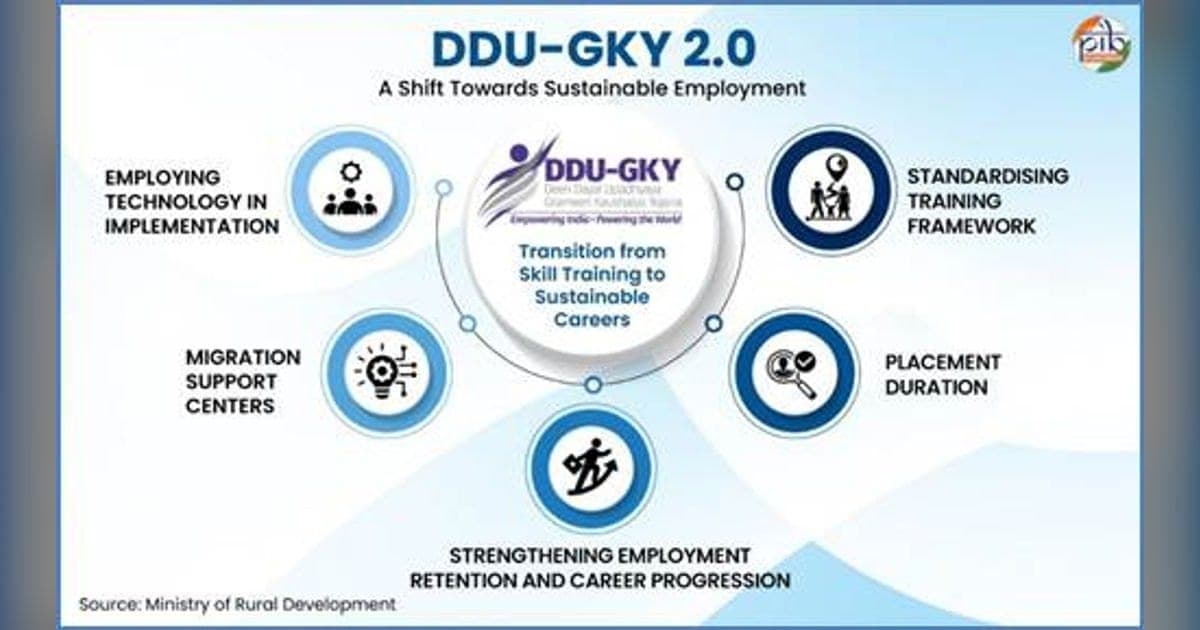
The Ministry of Rural Development has set out where Deen Dayal Upadhyaya Grameen Kaushalya Yojana (DDU-GKY) stands as the scheme completes twelve years, and what its upgraded framework, DDU-GKY 2.0, changes. The scheme began on 25 September 2014 under the National Rural Livelihoods Mission, and it pays for placement-linked skill training for youth aged 15 to 35 years from poor rural households.
What the 2.0 framework changes
The upgraded guidelines were notified in May 2025. The sharpest change is in what the scheme accepts as a placement. Earlier a candidate had to hold a job continuously for three months for the training to count; the floor is now six months, and wage employment, self-employment and gig work all qualify, whether the work is continuous or not. A candidate is then tracked for twelve months after joining.
Money that follows the trainee
- A placed candidate receives 7,620 rupees, paid at 1,270 rupees a month for six months.
- A candidate still in work after 365 days, with a break of not more than 60 days, receives a retention amount of 5,000 rupees.
- Upskilling and reskilling are offered once twelve months of placement are complete.
- Yearly funding for a Migration Support Centre has been raised from 10 lakh rupees to as much as 30 lakh rupees.
How a course is built
A course keeps its floor of 576 hours. In a three-month course, 396 hours are domain training and 180 hours are compulsory non-domain training, divided between English communication, employability and life skills, computer and digital literacy, and entrepreneurship.
The numbers behind the scheme
DDU-GKY runs in 31 States and Union Territories through 749 approved projects, 760 active training centres and more than 455 project implementing agencies. Since 2014-15 it has trained more than 18.47 lakh candidates for over 800 job roles and placed more than 12.43 lakh, among them 9.71 lakh women trained. The Union Budget for 2026-27 sets aside 750 crore rupees for it. Two special programmes sit inside the scheme: Roshni, for districts affected by Left-Wing Extremism, and Himayat, for Jammu and Kashmir and Ladakh.
Important Facts
| Scheme | Deen Dayal Upadhyaya Grameen Kaushalya Yojana (DDU-GKY) |
|---|---|
| Launched | 25 September 2014 |
| Ministry | Ministry of Rural Development |
| Parent mission | National Rural Livelihoods Mission (DAY-NRLM) |
| Age group | 15 to 35 years, poor rural households |
| 2.0 guidelines notified | May 2025 |
| Minimum placement | Six months, raised from three months |
| Course length | 576 hours (396 domain, 180 non-domain) |
| Budget 2026-27 | 750 crore rupees |
| Reach | 31 States and UTs, 749 projects, 760 training centres |
| Trained and placed | 18.47 lakh trained, 12.43 lakh placed since 2014-15 |
| Special programmes | Roshni (LWE districts) and Himayat (Jammu and Kashmir, Ladakh) |
Exam Point of View
Hold on to the launch date of 25 September 2014, the parent mission (National Rural Livelihoods Mission), the ministry (Rural Development), the age band of 15 to 35 years, the 2.0 guidelines of May 2025, the six-month placement floor, the 576-hour course, the 750 crore rupees of Budget 2026-27, and the two special programmes, Roshni and Himayat.
Practice Questions
Under the DDU-GKY 2.0 framework, what is the minimum placement duration for a trained candidate?
- A.Three months
- B.Six months
- C.Nine months
- D.Twelve months
Show answer
Correct answer: B. Six months
Explanation
The correct answer is six months. Under the earlier design of the scheme a placement counted only when the trained candidate held continuous employment for at least three months, so option A states the old rule and not the present one. The upgraded guidelines that the Government notified in May 2025 doubled that floor, so that training is judged by work that lasts rather than by a short spell of employment, and the revised rules recognise continuous as well as non-continuous employment, including wage work, self-employment and gig work. Option C names a period the guidelines do not use at any stage. Option D is the period for which a placed candidate is tracked after joining, and also the point at which upskilling and reskilling opportunities open up, but tracking is not the same thing as the placement test itself, so it does not answer the question.
DDU-GKY was launched on which date and under which mission?
- A.25 September 2014, under the National Rural Livelihoods Mission
- B.25 September 2015, under the Pradhan Mantri Kaushal Vikas Yojana
- C.2 October 2014, under MGNREGA
- D.15 August 2016, under the Skill India Mission
Show answer
Correct answer: A. 25 September 2014, under the National Rural Livelihoods Mission
Explanation
The correct answer is 25 September 2014, under the National Rural Livelihoods Mission. The Ministry of Rural Development started the scheme on that date to give placement-linked skill training to youth of 15 to 35 years from poor rural households, and the scheme is marking its twelfth anniversary this year. Option B moves the launch a year later and attaches the scheme to a different skilling programme, which the ministry does not name as its parent. Option C picks a date associated with cleanliness and rural employment programmes rather than with this scheme, and MGNREGA is a wage employment law, not the mission under which rural skilling sits. Option D names neither the right date nor the right parent mission. The pairing to remember is DDU-GKY with the National Rural Livelihoods Mission, also written as DAY-NRLM.
What financial assistance is given to a candidate placed under DDU-GKY 2.0?
- A.10,000 rupees paid as a single grant on joining
- B.7,620 rupees, at 1,270 rupees a month for six months
- C.15,000 rupees, at 2,500 rupees a month for six months
- D.No assistance is given after placement
Show answer
Correct answer: B. 7,620 rupees, at 1,270 rupees a month for six months
Explanation
The correct answer is 7,620 rupees, at 1,270 rupees a month for six months. The support is deliberately paid month by month over the same six months that now make up the minimum placement period, so that the money helps a candidate stay in a new job and a new city rather than arriving as one lump sum. Option A is wrong because the assistance is not a single grant on joining. Option C invents both the total and the monthly rate. Option D is wrong because post-placement support is one of the features that the upgraded framework strengthened: besides the monthly assistance, a candidate who remains employed for 365 days, with an employment break of no more than 60 days, receives a retention amount of 5,000 rupees, and upskilling opportunities follow twelve months of placement.
Frequently Asked Questions
When was DDU-GKY launched and under which mission?
It was launched on 25 September 2014 by the Ministry of Rural Development under the National Rural Livelihoods Mission, for rural youth aged 15 to 35 years from poor households.
What is the minimum placement duration under DDU-GKY 2.0?
Six months. The earlier framework counted a placement after three months of continuous work; the guidelines notified in May 2025 doubled that floor and also count gig and self-employment.
What financial support does a placed candidate receive?
A placed candidate gets 7,620 rupees, at 1,270 rupees a month for six months, and a retention amount of 5,000 rupees for remaining in work for 365 days.
Sources
- Deen Dayal Upadhyaya Grameen Kaushalya Yojana 2.0 (opens in a new tab) — Press Information Bureau
- Deen Dayal Upadhyaya Grameen Kaushalya Yojana (DDU-GKY) (opens in a new tab) — Press Information Bureau
Current Affairs 24 September 2026
- PBSHABD: Prasar Bharati Free News Feed Serves 3,600 OutletsNational
- Special Campaign 6.0 to Run in Offices from 2 to 31 OctoberNational
- Roshibina Devi Takes Sanda Silver, Rowers Win Sculls BronzeSports
Related Current Affairs
- Government Schemes
MY Bharat Crosses 3 Crore Registered Youth in Under Three Years
23 September 2026 · 2 min read
- Government Schemes
Ayushman Bharat Completes Eight Years, 60 Crore Beneficiaries
23 September 2026 · 2 min read
- Government Schemes
NAMASTE Scheme: 90,186 Sewer Workers Validated in 36 States, UTs
22 September 2026 · 2 min read
- Government Schemes
Ayushman Bharat PM-JAY at 8: 48.51 Crore Cards, ₹2.03 Lakh Crore Care
22 September 2026 · 2 min read
- Government Schemes
Jal Jeevan Mission 2.0: Nal Jal Mitra and Sujalam Shakti Push
21 September 2026 · 2 min read
- Government Schemes
Swachhata Hi Seva 2026: Theme, Dates and ODF Plus Progress
20 September 2026 · 3 min read

Related GK
- Units and Measurements: SI Units, Dimensions and Instruments
24 September 2026 · General Science
- Indus Valley Civilisation: Sites, Town Planning and Decline
24 September 2026 · Indian History
- GDP and National Income: Concepts, Methods and Formulas
24 September 2026 · Indian Economy
Take the Quiz
- Current Affairs Quiz
State Exams Current Affairs Quiz: 24 September 2026
12 questions12 minutesStart Quiz