
PRAGATI-50 Launched to Build 50 Model Cities for Swachhata
Union Minister Manohar Lal launched the PRAGATI-50 initiative under which 50 model cities across 24 states will demonstrate higher benchmarks of cleanliness.
Why in News
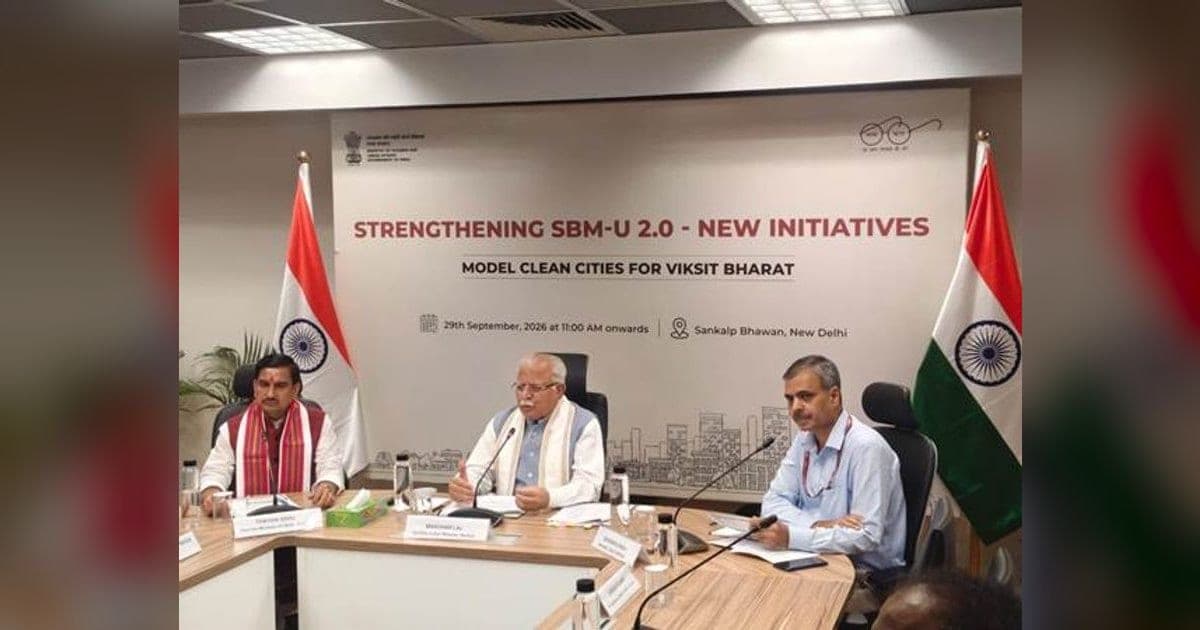
On 29 September 2026 Union Minister Shri Manohar Lal launched the PRAGATI-50 initiative in New Delhi, identifying 50 model cities across 24 states for higher Swachhata benchmarks, and also launched the Swachh Bharat Test Bed at Durgapur and the third cohort of Swachhata startups.
Union Minister for Housing and Urban Affairs Shri Manohar Lal launched the PRAGATI-50 initiative in New Delhi, under which the Ministry has picked 50 model cities to set a higher benchmark of Swachhata. The selection follows the Prime Minister's directions at the 51st PRAGATI meeting, and the work will be carried out within the framework of Swachh Bharat Mission-Urban 2.0 through targeted, KPI-based action and technology-enabled monitoring.
How the 50 cities were chosen
The chosen cities are spread across 24 states, and the list deliberately mixes large cities, places of cultural importance, leading tourist destinations and economic centres. The Minister said these cities would go beyond routine sanitation work and emerge as clean role models for the rest of the country, with visible gains expected in urban cleanliness, solid waste management, used water management, sanitation and citizen participation. He added that he would personally chair review meetings once every two months to track progress. A PRAGATI-style digital review mechanism has been set up on the Swachhatam Portal, and ministry officers will be assigned specific cities for supervision and handholding. Minister of State Shri Tokhan Sahu said the initiative would help cities reach the Garbage Free Cities goal within a fixed timeframe, and asked states and urban local bodies to draw up micro-level action plans.
Other launches at the event
- Swachh Bharat Test Bed and Innovation Centre at Durgapur, set up with CSIR-CMERI as a national facility for research, product development, testing, validation, certification and capacity building in sanitation technologies
- The third cohort of Swachhata startups, launched with the Startup Incubation and Innovation Centre at IIT Kanpur, adding 13 startups and completing the Mission's national target of onboarding 75 startups
- The Swachhata Behaviour Change Digital Kosh, a digital repository of ideas, creatives, campaigns and communication resources for states and urban local bodies
- A Reduce, Reuse and Recycle (RRR) Centre at Sankalp Bhawan, New Delhi, described as the first such centre in a Union Ministry office, opened as part of Swachhata Hi Seva 2026
- A dedicated WhatsApp channel to make complaint filing on the Swachhata App easier for citizens
Documents released
The Ministry also released a Standard Operating Procedure for setting up secondary collection centres for construction and demolition waste, and guidelines for source segregation of municipal solid waste as mandated under the Solid Waste Management Rules, 2026. Secretary, Department of Urban Development, Shri Satendra Singh said the initiative follows a City as a Whole approach so that every stakeholder, partner and urban local body is part of the planning and the delivery. The Ministry framed the exercise as a step towards garbage-free cities as India moves towards Viksit Bharat 2047.
Important Facts
| Initiative | PRAGATI-50 |
|---|---|
| Launched by | Union Minister for Housing and Urban Affairs Shri Manohar Lal |
| Cities and states | 50 model cities across 24 states |
| Parent mission | Swachh Bharat Mission-Urban 2.0 |
| Origin | Directions of the Prime Minister at the 51st PRAGATI meeting |
| Test Bed and Innovation Centre | Durgapur, with CSIR-CMERI |
| Startup cohort | Third cohort with IIT Kanpur, 13 startups, taking the total to 75 |
| RRR Centre | Sankalp Bhawan, New Delhi, first in a Union Ministry office |
| Review mechanism | PRAGATI-style digital review on the Swachhatam Portal |
Exam Point of View
Remember the name of the initiative (PRAGATI-50), the number of cities (50) and states (24), the parent mission (Swachh Bharat Mission-Urban 2.0), the PRAGATI meeting number (51st), the Test Bed location (Durgapur) and its partner (CSIR-CMERI), the startup partner (IIT Kanpur) and the startup numbers (13 in Cohort 3, 75 in all).
Practice Questions
Under the PRAGATI-50 initiative, how many model cities have been identified and across how many states?
- A.25 cities across 18 states
- B.50 cities across 24 states
- C.75 cities across 28 states
- D.100 cities across 24 states
Show answer
Correct answer: B. 50 cities across 24 states
Explanation
The correct answer is 50 cities across 24 states. The Ministry of Housing and Urban Affairs has identified 50 model cities under PRAGATI-50 to demonstrate a higher benchmark of Swachhata, and the Union Minister stated at the launch that these cities are spread across 24 states. The list was framed to include major cities, places of cultural importance, leading tourism destinations and economic centres. Option A understates both figures. Option C uses the startup target of the Mission rather than the number of cities, which makes it a plausible trap. Option D doubles the number of cities while keeping the correct number of states, so it too is wrong. The initiative takes its name from the number of cities chosen, which is a useful memory aid.
The Swachh Bharat Test Bed and Innovation Centre launched by the Ministry of Housing and Urban Affairs is located at which place?
- A.Durgapur
- B.Kanpur
- C.Indore
- D.Pune
Show answer
Correct answer: A. Durgapur
Explanation
The correct answer is Durgapur. The Ministry set up the Swachh Bharat Test Bed and Innovation Centre at Durgapur in collaboration with CSIR-CMERI, and it is meant to serve as a national facility for research, product development, testing, validation, certification and capacity building in sanitation technologies. Option B, Kanpur, is a plausible distractor because the third cohort of Swachhata startups was launched with the Startup Incubation and Innovation Centre at IIT Kanpur, but that is a separate activity from the Test Bed. Option C, Indore, is widely associated with urban cleanliness rankings but was not named as the Test Bed site. Option D, Pune, was not mentioned at all. The centre was created because the Mission has consistently placed research and innovation at the heart of its Swachhata work. Hence option A is correct.
The third cohort of Swachhata startups was launched in collaboration with which institution?
- A.IIT Delhi
- B.IIT Kanpur
- C.IIT Madras
- D.IISc Bengaluru
Show answer
Correct answer: B. IIT Kanpur
Explanation
The correct answer is IIT Kanpur. The Ministry launched the third cohort of startups working on sanitation and waste management in collaboration with the Startup Incubation and Innovation Centre at IIT Kanpur. With 13 startups joining this cohort, the Mission completed its national target of onboarding and incubating 75 startups across the waste value chain. The Minister of State also used the occasion to note that India has emerged as the world's third-largest startup ecosystem. Options A, C and D name other leading technical institutions of the country, each of which runs its own incubation facilities, which makes them plausible; however, none of them was named as the partner for this cohort. The cohort is focused on pioneering solutions in sanitation and waste management. So option B is the answer.
The Reduce, Reuse and Recycle Centre inaugurated in New Delhi is notable because it is the first such centre set up where?
- A.In a railway station
- B.In a Union Ministry office
- C.In a municipal corporation building
- D.In a central university campus
Show answer
Correct answer: B. In a Union Ministry office
Explanation
The correct answer is in a Union Ministry office. As part of Swachhata Hi Seva 2026 the Union Minister inaugurated a Reduce, Reuse and Recycle Centre at Sankalp Bhawan in New Delhi, and it has been described as the first such centre in a Union Ministry office. The purpose is to promote sustainable consumption, reuse, resource recovery and circularity within government workplaces, so that the offices framing the policy also practise it. Option A, a railway station, and options C and D, a municipal corporation building and a central university campus, are all places where such collection points are plausible, and RRR centres have been popularised widely, but the distinction claimed here relates specifically to a Union Ministry office. Hence option B is correct.
Frequently Asked Questions
What is the PRAGATI-50 initiative?
It is an initiative of the Ministry of Housing and Urban Affairs under which 50 model cities across 24 states will demonstrate a higher benchmark of Swachhata through KPI-based action and technology-enabled monitoring within Swachh Bharat Mission-Urban 2.0.
Where has the Swachh Bharat Test Bed and Innovation Centre been set up?
At Durgapur, in collaboration with CSIR-CMERI. It is a national facility for research, product development, testing, validation, certification and capacity building in sanitation technologies.
How many startups are in the third Swachhata cohort?
13 startups joined Cohort 3, launched with the Startup Incubation and Innovation Centre at IIT Kanpur. With this the Mission completed its national target of onboarding and incubating 75 startups.
Sources
Current Affairs 29 September 2026
- Literacy Rate Reaches 81.1% as Ten States Declare Full LiteracyReports & Indices
- India's First PRAMAAN Forest Certificates Handed Over in DelhiEnvironment
- NIFT Wins Two Silver Medals at WorldSkills Shanghai 2026Awards & Honours
- Special Campaign 6.0 to Run from 2 to 31 October 2026National
- PM-RKVY: Rs 1200 Crore Sanctioned to 10 States at Rabi MeetGovernment Schemes
- VB-G RAM G Act Guarantees 125 Days of Rural Wage WorkGovernment Schemes
- Two Officials Held for Bribery over FCRA RegistrationNational
- Indian Railways Clears Two New MEMU Services for Meerut CityNational
Related Current Affairs
- Government Schemes
Jal Shakti Ministry Holds 11th Sujal Gram Samvad on Rural Water
29 September 2026 · 2 min read
- Government Schemes
VB-G RAM G Act Guarantees 125 Days of Rural Wage Work
29 September 2026 · 2 min read
- Government Schemes
PM-RKVY: Rs 1200 Crore Sanctioned to 10 States at Rabi Meet
29 September 2026 · 2 min read
- Government Schemes
PM-MKSSY Bears 40% of Aquaculture Insurance Premium Cost
28 September 2026 · 2 min read
- Government Schemes
PM-AJAY: 18,093 Villages Declared Adarsh Gram by September 2026
28 September 2026 · 2 min read
- Government Schemes
Nasha Mukt Yuva Abhiyan Runs 100 Weeks for Viksit Bharat
27 September 2026 · 2 min read
Related GK
- Famous Personalities and Their Nicknames: Exam List
29 September 2026 · Static GK
- Missile Systems of India: Agni, BrahMos and IGMDP
29 September 2026 · Science & Technology
- Maharashtra GK: Districts, Rivers, Forts and Exam Facts
29 September 2026 · Indian States & UTs
Take the Quiz
- Current Affairs Quiz
RRB Group D Current Affairs Quiz: 29 September 2026
10 questions10 minutesStart Quiz