
NAMASTE Scheme Raises Puducherry Sanitation Worker's Income 50%
A Puducherry sanitation worker's monthly income rose from Rs 8,000 to Rs 12,000 after protective gear and safety training under the NAMASTE Scheme.
Why in News
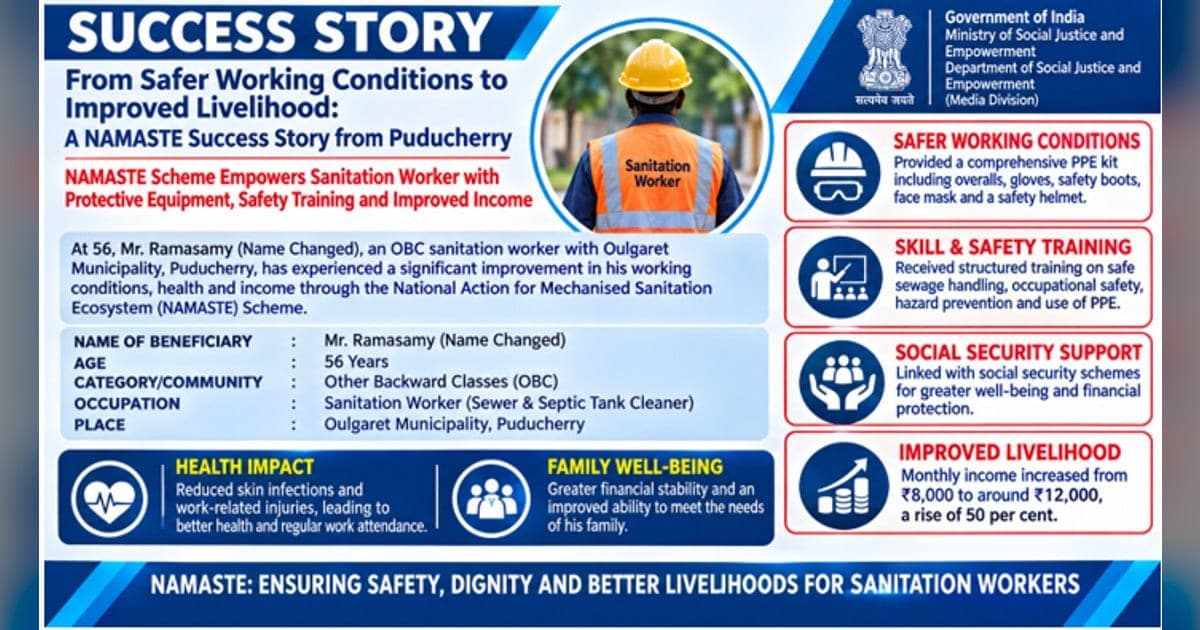
The Ministry of Social Justice and Empowerment on 13 November 2026 highlighted a NAMASTE Scheme case from Puducherry in which a sanitation worker's monthly income rose from about Rs 8,000 to about Rs 12,000 after protective equipment and safety training.
The Ministry of Social Justice and Empowerment has described the outcome of its NAMASTE Scheme through the case of a sanitation worker employed with Oulgaret Municipality in Puducherry, whose monthly earnings rose by half after he was equipped and trained under the programme.
What NAMASTE stands for
NAMASTE is short for National Action for Mechanised Sanitation Ecosystem. The scheme is run by the Ministry of Social Justice and Empowerment and works on the safety, dignity and economic security of sanitation workers. It does this by supplying personal protective equipment, running structured safety training and linking workers to institutional and social security support, with the larger aim of moving the country towards mechanised sanitation in which no worker has to enter a sewer or a septic tank unprotected.
The worker's situation before the scheme
- He is 56 years old, belongs to the Other Backward Classes, and worked for years cleaning sewers and septic tanks.
- He often worked without proper protective equipment and was exposed to occupational hazards.
- Long exposure brought repeated skin infections, injuries and physical discomfort.
- Illness kept him away from work, cost him wages and strained a household of four that depended on his earnings.
- He also faced the social stigma attached to sanitation work.
What the scheme provided
The turning point came in 2025, when he was covered under NAMASTE. He received a full protective kit made up of overalls, gloves, safety boots, a face mask and a safety helmet. He was put through structured training on safe handling of sewage, occupational safety, prevention of hazards and the correct use of protective gear. He was also linked to social security support.
The result
| Indicator | Before | After |
| Monthly income | About Rs 8,000 | About Rs 12,000 |
| Change | A rise of 50 per cent | |
Fewer skin infections and injuries meant he could attend work more regularly, and that regularity is what pushed his monthly income from roughly eight thousand rupees to about twelve thousand rupees. The Ministry presented the case as evidence that protective equipment, training and social security together change both health outcomes and household finances for sanitation workers.
Important Facts
| Scheme | NAMASTE Scheme |
|---|---|
| Full form | National Action for Mechanised Sanitation Ecosystem |
| Ministry | Ministry of Social Justice and Empowerment |
| Place in the case | Oulgaret Municipality, Puducherry |
| Year of coverage | 2025 |
| Protective kit | Overalls, gloves, safety boots, face mask and safety helmet |
| Income before | About Rs 8,000 a month |
| Income after | About Rs 12,000 a month |
| Rise | 50 per cent |
Exam Point of View
Remember the full form of NAMASTE (National Action for Mechanised Sanitation Ecosystem), the ministry that runs it (Social Justice and Empowerment), the three kinds of support it gives (protective equipment, safety training, social security linkage), the State or UT in the case (Puducherry) and the income change from Rs 8,000 to Rs 12,000, a rise of 50 per cent.
Practice Questions
What does NAMASTE stand for in the sanitation scheme of the Ministry of Social Justice and Empowerment?
- A.National Mission for Safe Town Ecosystems
- B.National Action for Mechanised Sanitation Ecosystem
- C.National Agency for Municipal Sanitation and Training
- D.National Assistance for Manual Scavengers and Technical Education
Show answer
The scheme carries that expansion and is run by the Ministry of Social Justice and Empowerment with the aim of making sanitation work safer, more dignified and more secure in income terms.
Read the full explanation →In the Puducherry case cited by the Ministry, how did the sanitation worker's monthly income change?
- A.From Rs 6,000 to Rs 9,000
- B.From Rs 8,000 to Rs 12,000
- C.From Rs 10,000 to Rs 15,000
- D.From Rs 12,000 to Rs 18,000
Show answer
The correct answer is from Rs 8,000 to Rs 12,000, which works out to a rise of fifty per cent.
Read the full explanation →Which of the following was NOT part of the protective kit given to the worker under NAMASTE?
- A.Safety helmet
- B.Safety boots
- C.Oxygen cylinder
- D.Face mask
Show answer
The kit described was made up of protective overalls, gloves, safety boots, a face mask and a safety helmet, so options A, B and D are all wrong answers to a question asking what was left out.
Read the full explanation →Frequently Asked Questions
What is the full form of the NAMASTE Scheme?
National Action for Mechanised Sanitation Ecosystem. It is run by the Ministry of Social Justice and Empowerment and works on the safety, dignity and economic well being of sanitation workers.
What support does NAMASTE give a sanitation worker?
It provides personal protective equipment, structured training on safe sewage handling and occupational safety, and linkage with social security support, so that work can be done with less risk of injury and infection.
How much did the worker's income rise in the Puducherry case?
From about Rs 8,000 a month to about Rs 12,000 a month, a rise of 50 per cent, because better protection cut his infections and injuries and let him attend work more regularly.
Sources
- https://www.pib.gov.in/PressReleasePage.aspx?PRID=2335988 (opens in a new tab) — Press Information Bureau
Current Affairs 13 November 2026
- DIPAM Completes Special Campaign 6 for Swachhata and PendencyNational
- WHO Global TB Report 2026: India's TB Deaths Fall 38%Reports & Indices
- 57th IFFI in Goa to Open on Stories Without Borders ThemeNational
- India and Italy Plan New Joint Research Call in 2027International
- CCPA Fines Ola Rs 10 Lakh Over Pre-Ride Tip PromptsNational
- NPPA Orders Price Monitoring on 137 Anti-Cancer DrugsEconomy
- India's Non-Fossil Power Capacity Reaches 308 GWEnvironment
- PM Modi Launches Rs 15,600 Crore Projects in BengaluruNational
Related Current Affairs
- Government Schemes
NFSC Fellowship Funds PhD, Scholar Joins Utkal University
13 November 2026 · 2 min read
- Government Schemes
Jal Jeevan Mission 2.0: First Regional Conference in Tiruchirappalli
12 November 2026 · 2 min read
- Government Schemes
Jal Sanchay Jan Bhagidari 2.0 Feedback Open Till 30 November
12 November 2026 · 2 min read
- Government Schemes
Nasha Mukt Bharat Abhiyaan Reaches 35.88 Crore People
12 November 2026 · 2 min read

Related GK
- Famous Personalities of Rajasthan: Exam Notes
28 October 2026 · Rajasthan
- Districts and Divisions of Rajasthan: Exam Notes
28 October 2026 · Rajasthan
- Tourism and World Heritage Sites of Rajasthan Notes
27 October 2026 · Rajasthan
Take the Quiz
- Current Affairs Quiz
SSC CHSL Current Affairs Quiz: 13 November 2026
25 questions25 minutesStart Quiz