
VB-G RAM G Act Guarantees 125 Days of Rural Wage Work
VB-G RAM G, in force since 1 July 2026 in place of MGNREGA, guarantees 125 days of wage work a year and has 10.88 crore active workers, a PIB backgrounder says.
Why in News
A PIB backgrounder dated 29 September 2026 detailed the working of VB-G RAM G, the rural employment framework that came into force on 1 July 2026 in place of Mahatma Gandhi NREGA and guarantees 125 days of wage work each financial year.
A PIB backgrounder issued on 29 September 2026 sets out how the Viksit Bharat – Guarantee for Rozgar and Ajeevika Mission (Gramin), shortened to VB-G RAM G, is working in the countryside. The VB-G RAM G Act, 2025 came into force on 1 July 2026 and now covers every rural area of the country. The move away from Mahatma Gandhi NREGA was made without a break in work, because the digital systems behind the new framework were running from day one.
What the law promises
The statute gives a legal guarantee of 125 days of wage employment in each financial year to every rural household whose adult members come forward for unskilled manual work. Work is organised around four themes: water security, core rural infrastructure, livelihood-related infrastructure and protection against extreme weather events. The Act builds in a whole-of-government method, with planning driven by convergence and saturation.
Viksit Gram Panchayat Plans
At the centre of the framework sit the Viksit Gram Panchayat Plans (VGPPs), prepared with the Gram Sabha's participation and approval. A panchayat first takes stock of the assets and services it already has, including those built under central and state schemes, then finds the gaps. Planning uses GIS along with Yuktdhara and PM Gati Shakti so that works are not duplicated. The VGPP framework lists 318 kinds of permissible works across the four themes, and the plans are stacked up at block, district, state and national level to feed the Viksit Bharat National Rural Infrastructure Stack.
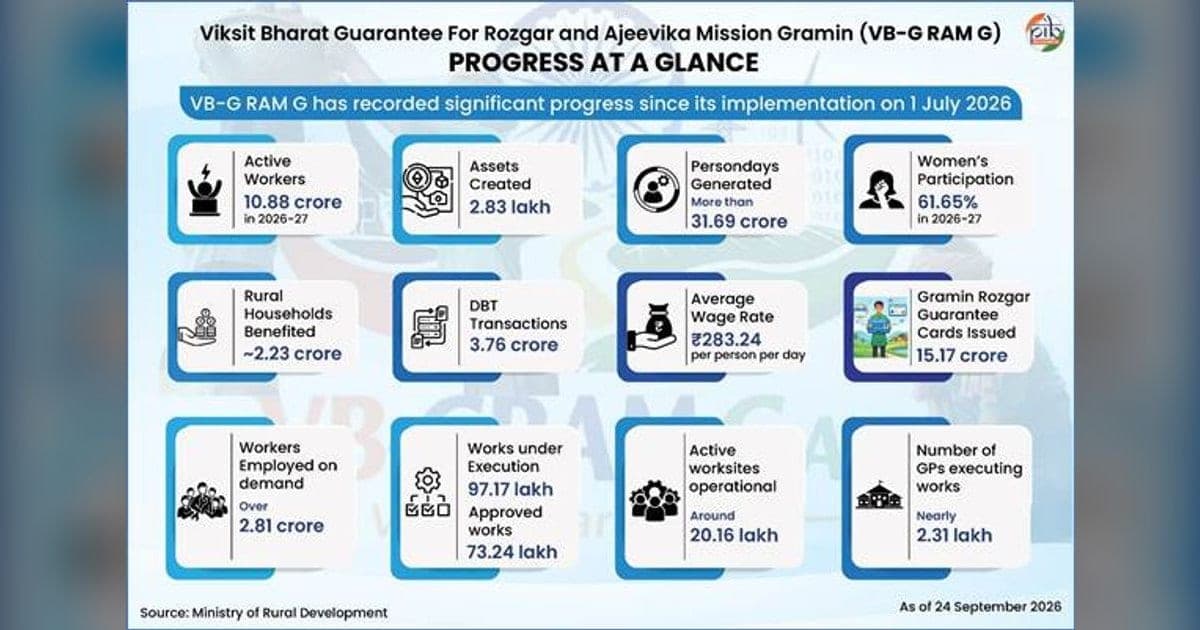
Where it stands on 24 September 2026
| Indicator | Figure |
| Active workers (2026-27) | 10.88 crore |
| Person-days generated | More than 31.69 crore |
| Assets created | 2.83 lakh |
| Women's participation | 61.65 per cent |
| Works under execution | 97.17 lakh |
| Active worksites | About 20.16 lakh |
| Average wage | Rs 283.24 per person per day |
| Rozgar Guarantee Cards issued | 15.17 crore |
Employment on demand has reached over 2.81 crore workers from about 2.23 crore households, 73.24 lakh sanctioned works are ready for future demand, and nearly 2.31 lakh gram panchayats are executing works. DBT transactions stand at 3.76 crore for the year.
Money and technology
States and union territories have an interim allocation of Rs 93,841 crore for 2026-27, of which a mother sanction of Rs 25,880 crore has gone out as the first instalment. Attendance and e-KYC run on face and biometric authentication, works are geo-tagged and measured through electronic Measurement Books, wages move by Direct Benefit Transfer, and real-time dashboards with AI-based analytics support oversight.
Important Facts
| Full form | Viksit Bharat - Guarantee for Rozgar and Ajeevika Mission (Gramin) |
|---|---|
| Law | VB-G RAM G Act, 2025 |
| In force from | 1 July 2026 |
| Replaced | Mahatma Gandhi NREGA |
| Guarantee | 125 days of wage employment in every financial year |
| Thematic areas | Water security, core rural infrastructure, livelihood infrastructure, extreme weather mitigation |
| Planning unit | Viksit Gram Panchayat Plan (VGPP), approved by the Gram Sabha |
| Permissible works | 318 types |
| Active workers | 10.88 crore in 2026-27 |
| Women participation | 61.65 per cent |
| Average wage | Rs 283.24 per person per day |
| Allocation 2026-27 | Rs 93,841 crore interim, first instalment Rs 25,880 crore |
Exam Point of View
Learn the full form of VB-G RAM G, the Act year (2025) and the date it came into force (1 July 2026), the guarantee of 125 days, the four thematic areas, the 318 permissible works under VGPP, and the headline figures: 10.88 crore active workers, 61.65 per cent women, Rs 283.24 average wage and Rs 93,841 crore interim allocation for 2026-27.
Practice Questions
How many days of wage employment does the VB-G RAM G Act guarantee to an eligible rural household in a financial year?
- A.100 days
- B.125 days
- C.150 days
- D.200 days
Show answer
Correct answer: B. 125 days
Explanation
The correct answer is 125 days. The law provides a statutory guarantee of wage employment for 125 days in every financial year, and the guarantee is available to every rural household whose adult members volunteer for unskilled manual work. Option A is the figure people remember from the older rural employment law that this framework has replaced, which makes it the commonest wrong choice in the paper. Option C and option D are higher than anything the statute promises and appear in no official statement about the mission. Along with the number of days, remember that the guarantee is tied to four thematic areas: water security, core rural infrastructure, livelihood-related infrastructure and protection against extreme weather events. The framework also aims at empowerment, growth, convergence and saturation, and it works through plans prepared at the gram panchayat level and approved by the Gram Sabha.
From which date did the VB-G RAM G Act, 2025 come into force across rural India?
- A.1 April 2026
- B.1 July 2026
- C.2 October 2026
- D.1 January 2026
Show answer
Correct answer: B. 1 July 2026
Explanation
The correct answer is 1 July 2026. The Act was passed in 2025 and was brought into force on that date, after which it was rolled out in every rural area of the country. The changeover from the earlier rural employment guarantee law was described as seamless, because the digital systems that support verification, monitoring and payment were already working when the new framework began. Option A is the start of the financial year and is a natural guess, but it is not the commencement date. Option C is a date associated with several government campaigns and anniversaries, not with this statute. Option D is the start of the calendar year and has no connection with the mission. Candidates should pair the commencement date with the progress cut-off used in the backgrounder, which reports figures as they stood on 24 September 2026.
How many types of permissible works are identified under the Viksit Gram Panchayat Plan framework?
- A.186
- B.262
- C.318
- D.404
Show answer
Correct answer: C. 318
Explanation
The correct answer is 318. The VGPP framework identifies that many types of permissible works, spread over the four thematic areas of the mission. A Viksit Gram Panchayat Plan is prepared with the participation of the Gram Sabha, which also recommends and approves it. The process starts with an inventory of assets, infrastructure and service gaps in the panchayat, including assets built under central and state schemes, and then uses GIS along with Yuktdhara and PM Gati Shakti so that spending is not duplicated. Options A, B and D are plausible-looking counts but none of them is the figure given for permissible works. Remember also that these plans are consolidated at block, district, state and national level, and that the consolidated version feeds the Viksit Bharat National Rural Infrastructure Stack.
Frequently Asked Questions
How many days of employment does VB-G RAM G guarantee?
125 days of wage employment in every financial year, for rural households whose adult members volunteer for unskilled manual work. The VB-G RAM G Act, 2025 came into force on 1 July 2026.
Which scheme did VB-G RAM G replace?
Mahatma Gandhi NREGA. The backgrounder says the change was seamless, with digital systems for worker verification, monitoring and payments working from the start of the new framework.
What is a Viksit Gram Panchayat Plan?
It is the bottom-up plan a Gram Panchayat prepares with the Gram Sabha, mapping existing assets, finding gaps and prioritising works. GIS, Yuktdhara and PM Gati Shakti support it, and 318 types of works are permissible.
Sources
- Viksit Bharat- G RAM G (opens in a new tab) — Press Information Bureau
Current Affairs 29 September 2026
- Literacy Rate Reaches 81.1% as Ten States Declare Full LiteracyReports & Indices
- India's First PRAMAAN Forest Certificates Handed Over in DelhiEnvironment
- NIFT Wins Two Silver Medals at WorldSkills Shanghai 2026Awards & Honours
- Special Campaign 6.0 to Run from 2 to 31 October 2026National
- PM-RKVY: Rs 1200 Crore Sanctioned to 10 States at Rabi MeetGovernment Schemes
- Two Officials Held for Bribery over FCRA RegistrationNational
Related Current Affairs
- Government Schemes
PM-RKVY: Rs 1200 Crore Sanctioned to 10 States at Rabi Meet
29 September 2026 · 2 min read
- Government Schemes
PM-MKSSY Bears 40% of Aquaculture Insurance Premium Cost
28 September 2026 · 2 min read
- Government Schemes
PM-AJAY: 18,093 Villages Declared Adarsh Gram by September 2026
28 September 2026 · 2 min read
- Government Schemes
Nasha Mukt Yuva Abhiyan Runs 100 Weeks for Viksit Bharat
27 September 2026 · 2 min read
- Government Schemes
Mission Yuva Raksha Drive Reaches Jaora Polytechnic Students
26 September 2026 · 2 min read
- Government Schemes
She-Mart Shops Launched from Keralam to Link Women to Markets
26 September 2026 · 2 min read


Related GK
- Famous Personalities and Their Nicknames: Exam List
29 September 2026 · Static GK
- Missile Systems of India: Agni, BrahMos and IGMDP
29 September 2026 · Science & Technology
- Maharashtra GK: Districts, Rivers, Forts and Exam Facts
29 September 2026 · Indian States & UTs
Take the Quiz
- Current Affairs Quiz
SSC CHSL Current Affairs Quiz: 29 September 2026
11 questions11 minutesStart Quiz