
National Green Hydrogen Mission: Targets, Outlay and Progress
A PIB backgrounder on green hydrogen sets out the National Green Hydrogen Mission's Rs 19,744 crore outlay, its 5 MMT target for 2030 and progress so far.
Why in News
On 28 October 2026 the Press Information Bureau released a backgrounder on green hydrogen, setting out the National Green Hydrogen Mission's outlay of Rs 19,744 crore, its target of 5 MMT a year by 2030 and the progress made on manufacturing, pilots, hubs, certification and skilling.
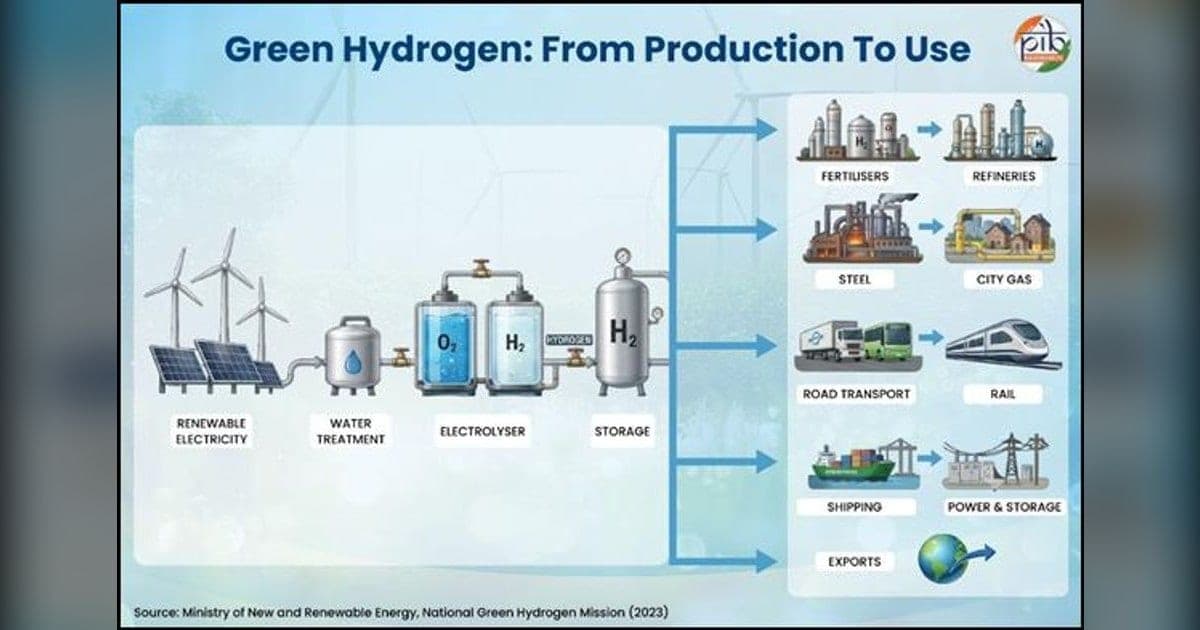
On 28 October 2026 the Press Information Bureau put out a backgrounder on green hydrogen, described as an emerging pillar of India's clean energy transition. Green hydrogen is made by splitting water with renewable electricity, and it matters most in sectors where emissions are hard to cut: fertiliser, petroleum refining, iron and steel, heavy-duty road transport and shipping.
What makes hydrogen green
Hydrogen gives off no carbon dioxide when it is used, so everything depends on how it is produced. In August 2023 the Ministry of New and Renewable Energy notified India's Green Hydrogen Standard. Hydrogen counts as green only if emissions stay within 2 kg of carbon dioxide equivalent for every kilogram of hydrogen, measured well-to-gate as a 12-month average. India thus became one of the first countries to define the term formally. Production runs on electrolysis, in which renewable power splits water into hydrogen and oxygen inside an electrolyser with a cathode, an anode and an electrolyte.
The Mission and its money
| Approval | Union Cabinet, January 2023 |
| Total outlay | Rs 19,744 crore |
| Production target | At least 5 MMT a year by 2030, up to 10 MMT with export demand |
| SIGHT programme | Rs 17,490 crore up to 2029-30 |
The SIGHT programme, short for Strategic Interventions for Green Hydrogen Transition, pays incentives on both sides of the market, for making electrolysers at home and for producing the gas. Fifteen companies have been awarded support for 3,000 MW a year of electrolyser manufacturing, incentives cover 8,62,000 tonnes a year of production capacity, and about 8,000 tonnes a year had been commissioned by February 2026.
Pilots, hubs and clusters
Money set aside for pilots runs to Rs 455 crore for low-carbon steel, Rs 496 crore for mobility and Rs 115 crore for shipping. Twelve mobility projects will put 70 hydrogen vehicles on the road, 27 buses and 43 trucks, with 16 refuelling stations across 21 routes. Three ports have been recognised as hubs: Deendayal Port at Kandla, V.O. Chidambaranar Port at Tuticorin and Paradip Port. Four Hydrogen Valley Innovation Clusters have been awarded, at Jodhpur, in Odisha, at Pune and in Kerala.
Skills, states and the road ahead
Training has covered 8,149 candidates, of whom 7,248 were certified, across 14 States and Union Territories. Six States, namely Gujarat, Andhra Pradesh, Maharashtra, Uttar Pradesh, Rajasthan and West Bengal, have notified dedicated green hydrogen policies. By 2030 the Mission is expected to cut fossil fuel imports by about Rs 1 lakh crore, draw over Rs 8 lakh crore in investment, create more than 6 lakh jobs and avoid nearly 50 MMT of carbon dioxide emissions a year, feeding into the goals of Viksit Bharat by 2047 and net zero by 2070.
Important Facts
| Mission | National Green Hydrogen Mission (NGHM), Ministry of New and Renewable Energy |
|---|---|
| Cabinet approval | January 2023 |
| Outlay | Rs 19,744 crore |
| Production target | At least 5 MMT a year by 2030; up to 10 MMT with export demand |
| SIGHT programme outlay | Rs 17,490 crore up to 2029-30 |
| Green Hydrogen Standard | Maximum 2 kg CO2 equivalent per kg of hydrogen, well-to-gate, 12-month average (notified August 2023) |
| Port hubs | Deendayal Port (Kandla), V.O. Chidambaranar Port (Tuticorin), Paradip Port |
| Hydrogen Valley Innovation Clusters | Jodhpur, Odisha, Pune and Kerala |
| Electrolyser manufacturing incentives | 15 companies for 3,000 MW per annum |
| Expected impact by 2030 | Over Rs 8 lakh crore investment, more than 6 lakh jobs, nearly 50 MMT CO2 avoided a year |
Exam Point of View
Remember the Mission's approval (January 2023), outlay (Rs 19,744 crore), target (5 MMT by 2030, 10 MMT with exports), the SIGHT outlay of Rs 17,490 crore, the Green Hydrogen Standard of 2 kg CO2 equivalent per kg, the three port hubs and the four Hydrogen Valley Innovation Clusters.
Practice Questions
What is the outlay approved by the Union Cabinet for the National Green Hydrogen Mission?
- A.Rs 8,240 crore
- B.Rs 17,490 crore
- C.Rs 19,744 crore
- D.Rs 24,500 crore
Show answer
The Union Cabinet approved the Mission in January 2023 with that outlay, and set the goal of making India a global hub for green hydrogen and its derivatives, with production capacity of at least 5 MMT a year by 2030.
Read the full explanation →Under India's Green Hydrogen Standard, what is the maximum permitted emission for hydrogen to qualify as green?
- A.2 kg of CO2 equivalent per kg of hydrogen
- B.5 kg of CO2 equivalent per kg of hydrogen
- C.9 kg of CO2 equivalent per kg of hydrogen
- D.12 kg of CO2 equivalent per kg of hydrogen
Show answer
The Ministry of New and Renewable Energy notified the Standard in August 2023, and the ceiling applies on a well-to-gate basis, measured as an average over twelve months; with it India became one of the first few countries to define green hydrogen formally.
Read the full explanation →Which of the following ports has been recognised as a green hydrogen hub by the MNRE?
- A.Mormugao Port
- B.Paradip Port
- C.Visakhapatnam Port
- D.Mumbai Port
Show answer
The Ministry of New and Renewable Energy has recognised three ports as green hydrogen hubs, namely Deendayal Port at Kandla in Gujarat, V.O.
Read the full explanation →Frequently Asked Questions
What is green hydrogen?
Hydrogen produced by splitting water using renewable electricity, so that very little carbon is emitted. In India it qualifies as green only if emissions stay within 2 kg of CO2 equivalent per kg of hydrogen on a well-to-gate basis, averaged over 12 months.
What is the outlay and target of the National Green Hydrogen Mission?
The Union Cabinet approved it in January 2023 with an outlay of Rs 19,744 crore. It targets at least 5 MMT of annual production capacity by 2030, which could rise to 10 MMT with export demand.
Which ports have been recognised as green hydrogen hubs?
Deendayal Port at Kandla in Gujarat, V.O. Chidambaranar Port at Tuticorin in Tamil Nadu and Paradip Port in Odisha.
What is the SIGHT programme?
Strategic Interventions for Green Hydrogen Transition, a key component of the Mission with an outlay of Rs 17,490 crore up to 2029-30, offering incentives for domestic electrolyser manufacturing and for green hydrogen production.
Sources
- https://www.pib.gov.in/PressReleasePage.aspx?PRID=2329321 (opens in a new tab) — Press Information Bureau
Current Affairs 28 October 2026
- Kuno Cheetah KNG22 Dies of Pellet Injuries; Centre Sends TeamEnvironment
- PM Modi Opens ESTIC 2026 Conclave at Bharat MandapamSummits & Conferences
- 14th International Tourism Mart to Open at TawangNational
- India and Mexico Begin Preferential Trade Agreement TalksInternational
- Jal Shakti Ministry Launches Punah Bharan Mobile ApplicationGovernment Schemes
- NHRC Advisory on Rights of Female Inmates and ChildrenNational
- DRI Seizes 55,000 E-Cigarettes at Kolkata's SMP PortNational
- India's New-Age Space Technologies: NGLV, SpaDeX, NavICScience & Technology
Related Current Affairs
- Environment
Kuno Cheetah KNG22 Dies of Pellet Injuries; Centre Sends Team
28 October 2026 · 2 min read
- Environment
Great Indian Bustard Rewilding Begins at Desert National Park
24 October 2026 · 3 min read
Related GK
- Famous Personalities of Rajasthan: Exam Notes
28 October 2026 · Rajasthan
- Districts and Divisions of Rajasthan: Exam Notes
28 October 2026 · Rajasthan
- Tourism and World Heritage Sites of Rajasthan Notes
27 October 2026 · Rajasthan
Take the Quiz
- Current Affairs Quiz
Banking Current Affairs Quiz: 28 October 2026
25 questions25 minutesStart Quiz