
India's New-Age Space Technologies: NGLV, SpaDeX, NavIC
A PIB backgrounder traces India's new space technologies, from the Rs 8,240 crore NGLV and SpaDeX docking to a US$44 billion space economy target for 2033.
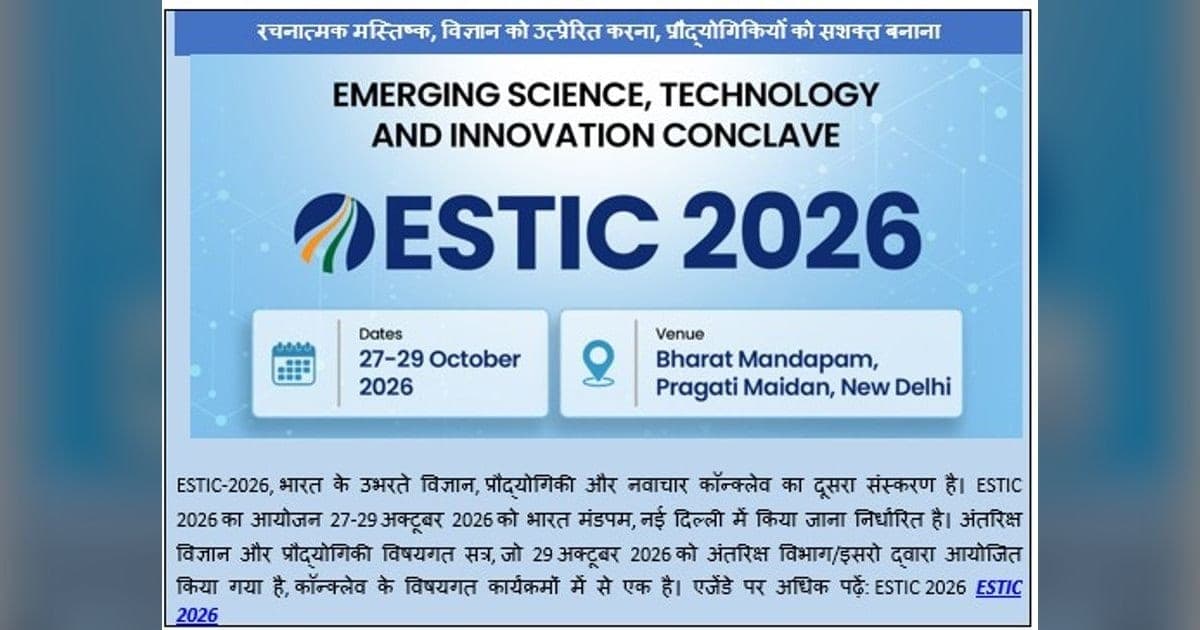
Why in News
On 28 October 2026 the Press Information Bureau released a backgrounder on India's new-age space technologies, covering the Next Generation Launch Vehicle, reusable launch systems, electric and green propulsion, SpaDeX docking, NavIC, NISAR and the space economy target.
A backgrounder issued on 28 October 2026 sets out the technologies carrying India's space programme towards self-reliance. The story starts with a sounding rocket flown from Thumba in Kerala on 21 November 1963 and runs up to the planned Bharatiya Antariksh Station.
How the programme began
Organised space work in India began in 1962 with the Indian National Committee for Space Research, set up on the vision of Dr Vikram A. Sarabhai. The Indian Space Research Organisation took its place on 15 August 1969 and was brought under the Department of Space in 1972.
Launch vehicles, old and new
PSLV can place up to 1,750 kg in a Sun-synchronous polar orbit; GSLV, with the indigenous cryogenic upper stage, carries satellites of the two-tonne class; LVM3 lifts the four-tonne class to geosynchronous transfer orbit and the ten-tonne class to low Earth orbit; SSLV weighs about 120 tonnes at lift-off. In September 2024 the Union Cabinet cleared the Next Generation Launch Vehicle with an outlay of Rs 8,240 crore, covering development, three developmental flights and facilities. It is designed for 30 tonnes to low Earth orbit, three times what LVM3 manages, and a partly reusable version of 14 tonnes is also being built.
Reusability and propulsion
ISRO has flown its winged technology demonstrator Pushpak in three landing experiments, on 2 April 2023, 22 March 2024 and 23 June 2024. India flight-tested a scramjet on 28 August 2016, reaching Mach 6 and becoming the fourth country to demonstrate the technology. On 27 March 2025 a 1,000-hour life test of an indigenous 300 mN stationary plasma thruster was completed for electric propulsion.
Docking, navigation and new satellites
Through SpaDeX, India became the fourth country to demonstrate space docking, after the United States, Russia and China. Its satellites first docked on 16 January 2025, repeated the feat with full autonomy from 15 m on 20 April 2025 and transferred power between the docked craft the next day. NavIC, the country's regional navigation system, serves India and up to 1,500 kilometres beyond the mainland. GSAT-N2, launched on 19 November 2024, offers about 48 Gbps, while CMS-03, also called GSAT-7R, went up on 2 November 2025 for the Indian Navy. The NISAR mission, launched on 30 July 2025 aboard GSLV-F16, is the first to use two radar frequencies together and observes land and ice every 12 days.
The space economy
The Department of Space has set a target of US$44 billion for India's space economy by 2033. NewSpace India Limited has signed 118 technology transfer agreements covering 83 ISRO technologies, and cumulative investment in Indian space start-ups stood at about US$618.5 million as on 31 March 2026.
Important Facts
| First sounding rocket | Thumba, Kerala, 21 November 1963 |
|---|---|
| ISRO formed | 15 August 1969, under the Department of Space from 1972 |
| NGLV | Approved September 2024, outlay Rs 8,240 crore, 30 tonnes to LEO; reusable variant of 14 tonnes |
| RLV demonstrator | Pushpak, landing experiments on 2 April 2023, 22 March 2024 and 23 June 2024 |
| Scramjet | Flight-tested on 28 August 2016 at Mach 6; India the fourth country to demonstrate it |
| SpaDeX | First docking 16 January 2025; autonomous docking from 15 m on 20 April 2025; India the fourth docking nation |
| NavIC | Regional navigation up to 1,500 km beyond the Indian mainland |
| NISAR | Launched 30 July 2025 on GSLV-F16; NASA's L-band with ISRO's S-band; 12-day revisit |
| Space economy target | US$44 billion by 2033 |
| NSIL technology transfer | 118 agreements covering 83 ISRO technologies |
Exam Point of View
Remember the NGLV approval (September 2024, Rs 8,240 crore, 30 tonnes to LEO), SpaDeX making India the fourth docking nation, the Pushpak landing experiments, the scramjet test of 2016, NISAR on GSLV-F16, NavIC's 1,500 km reach and the US$44 billion space economy target for 2033.
Practice Questions
Through which mission did India become the fourth country to demonstrate docking of two spacecraft in orbit?
- A.Gaganyaan
- B.SpaDeX
- C.Chandrayaan-3
- D.Aditya-L1
Show answer
Its two satellites docked for the first time on 16 January 2025, then repeated the manoeuvre with full autonomy from an inter-satellite distance of 15 m on 20 April 2025, and the following day power was transferred between the docked spacecraft.
Read the full explanation →What is the approved outlay for the Next Generation Launch Vehicle cleared by the Union Cabinet?
- A.Rs 4,120 crore
- B.Rs 8,240 crore
- C.Rs 12,400 crore
- D.Rs 19,744 crore
Show answer
The Union Cabinet approved the development of the vehicle in September 2024, and the amount covers development costs, three developmental flights, the essential facilities, programme management and the launch campaign.
Read the full explanation →India's space economy is targeted to reach what size, and by which year?
- A.US$20 billion by 2030
- B.US$44 billion by 2033
- C.US$60 billion by 2035
- D.US$100 billion by 2040
Show answer
This is the target set by the Department of Space, and emerging technologies such as reusable launch vehicles, air-breathing propulsion, electric propulsion and in-space docking are expected to support that growth.
Read the full explanation →Frequently Asked Questions
Which mission made India the fourth country to achieve space docking?
SpaDeX. Its two satellites first docked on 16 January 2025 and achieved a fully autonomous docking from a distance of 15 m on 20 April 2025, placing India after the United States, Russia and China.
What is the payload capacity of the Next Generation Launch Vehicle?
It is designed for a maximum of 30 tonnes to low Earth orbit, three times the ten-tonne capability of LVM3. A partially reusable variant with a 14-tonne capability is also being developed.
What is India's space economy target?
The Department of Space has set a target of US$44 billion by 2033. Cumulative investment in Indian space start-ups was about US$618.5 million as on 31 March 2026.
What is special about the NISAR mission?
Launched on 30 July 2025 aboard GSLV-F16, it is the first satellite mission to use two radar frequencies together, NASA's L-band and ISRO's S-band, and it observes land and ice surfaces every 12 days.
Sources
- भारत के नये युग की अंतरिक्ष प्रौद्योगिकियां (opens in a new tab) — Press Information Bureau
Current Affairs 28 October 2026
- Kuno Cheetah KNG22 Dies of Pellet Injuries; Centre Sends TeamEnvironment
- PM Modi Opens ESTIC 2026 Conclave at Bharat MandapamSummits & Conferences
- 14th International Tourism Mart to Open at TawangNational
- India and Mexico Begin Preferential Trade Agreement TalksInternational
- Jal Shakti Ministry Launches Punah Bharan Mobile ApplicationGovernment Schemes
- NHRC Advisory on Rights of Female Inmates and ChildrenNational
- DRI Seizes 55,000 E-Cigarettes at Kolkata's SMP PortNational
- National Green Hydrogen Mission: Targets, Outlay and ProgressEnvironment
Related Current Affairs
- Science & Technology
India-France Space Ties Widen to Gaganyaan, TRISHNA and Start-ups
28 September 2026 · 2 min read
- Summits & Conferences
PM Modi Addresses First International Space Summit in Paris
10 September 2026 · 2 min read
- International
India-France Space Talks Ahead of Paris International Space Summit
4 September 2026 · 2 min read
- Science & Technology
ISRO Launches EOS-05 on GSLV-F17: A Geosynchronous First
4 September 2026 · 2 min read


Related GK
- Maps, Map Projections and Remote Sensing for Exams
12 October 2026 · Geography
- Satellite Orbits and Space Debris: LEO, GEO, SSO and Kessler
11 October 2026 · Science & Technology
- Research Institutes of India and Their Locations
11 October 2026 · Static GK
Take the Quiz
- Current Affairs Quiz
Banking Current Affairs Quiz: 28 October 2026
25 questions25 minutesStart Quiz