
Ramsar Sites in India Reach 103 With Sukhna and Sauj Jheel
India's Ramsar Site network reached 103 wetlands on 15 October 2026 as Sukhna Wetland in Chandigarh and Sauj Jheel in Uttar Pradesh joined the list.
Why in News
India's network of Wetlands of International Importance grew to 103 sites on 15 October 2026, when Sukhna Wetland in Chandigarh and Sauj Jheel in Uttar Pradesh were designated, nearly four times the 26 sites the country had in 2014.
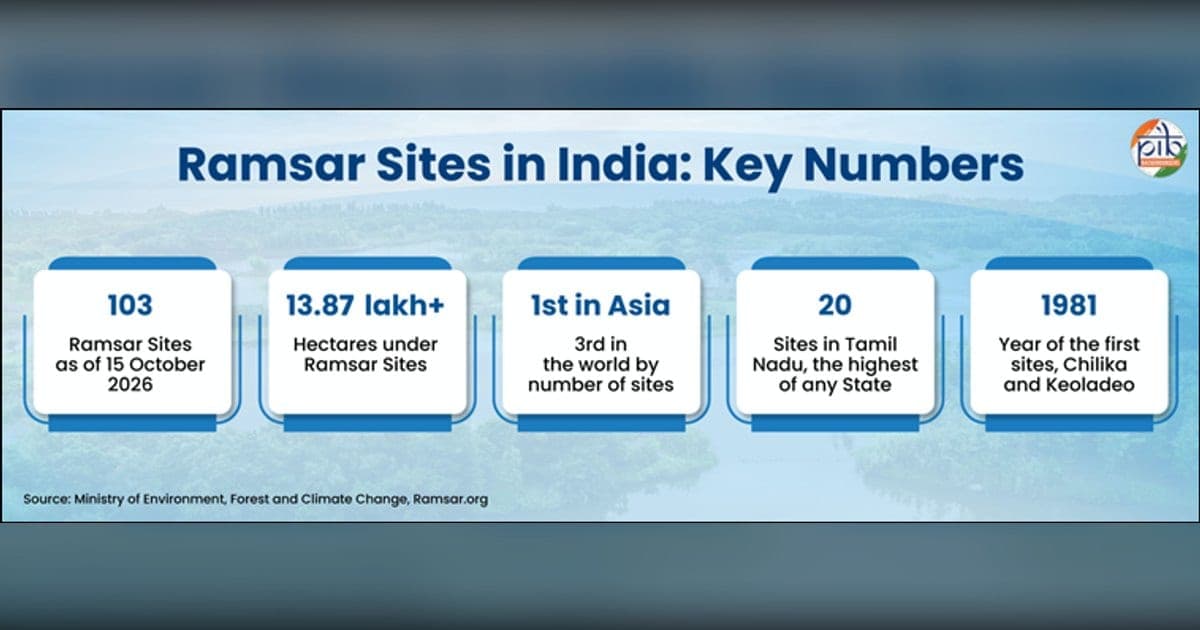
India's list of Wetlands of International Importance now runs to 103 Ramsar Sites. The figure was reached on 15 October 2026, when Sukhna Wetland in Chandigarh and Sauj Jheel in Uttar Pradesh were added. The count stood at 26 in 2014, so the network is close to four times its earlier size. The sites together spread over more than 13.87 lakh hectares in 28 States and Union Territories, which puts India first in Asia and third among all countries by number of sites.
What makes a wetland a Ramsar Site
A wetland earns the label when it is listed under the Convention on Wetlands, a treaty between governments that was agreed at the Iranian town of Ramsar on 2 February 1971 and took effect in 1975. The treaty today has 172 Contracting Parties and more than 2,536 listed sites around the world. India came on board on 1 February 1982. A wetland has to satisfy at least one of nine tests, which are grouped under wetland type and biological diversity; holding 20,000 waterbirds in a normal year is one of them. The proposal starts with the State or Union Territory, after which the Ministry of Environment, Forest and Climate Change forwards it to the Ramsar Secretariat.
The two newest sites
Sukhna Wetland is a rain-fed reservoir built in 1958 below the Shivalik hills. Threatened birds and reptiles such as the Pallas's fish eagle, the common pochard and the black pond turtle live there, and migrants on the Central Asian Flyway use it to feed and to spend the winter. Sauj Jheel is a shallow floodplain lake in the Mainpuri district of Uttar Pradesh that draws over 30,000 waterbirds in a normal year and gives nesting and feeding ground to the sarus crane and the greater spotted eagle.
The spread of the network
| Total Ramsar Sites | 103 |
| Sites in 2014 | 26 |
| Tamil Nadu | 20 sites, the most of any State |
| Uttar Pradesh | 14 sites |
| Area covered | Over 13.87 lakh hectares |
Chilika Lake in Odisha and Keoladeo National Park in Rajasthan were the first pair to be named, on 1 October 1981. Chilika was later taken off the Montreux Record, the register of listed wetlands whose ecological character is changing for the worse, in 2002, and the Chilika Development Authority went on to win the Ramsar Wetland Conservation Award. Surha Tal in Uttar Pradesh had been the 100th site, in June 2026, and Glaw Lake in Arunachal Pradesh the 101st, in August.
Laws and schemes behind the sites
The Wetlands (Conservation and Management) Rules, 2017, notified under the Environment (Protection) Act, 1986, bar encroachment, waste dumping and untreated effluent, and set up wetland authorities in the States. Science and money come through the National Plan for Conservation of Aquatic Ecosystems, whose revised guidelines were issued in 2024. Amrit Dharohar pays for species inventories and wetland carbon work, Mission Sahbhagita runs the Save Wetlands Campaign, and MISHTI aims at mangrove repair across 540 square kilometres. Indore and Udaipur became the first Indian cities with Ramsar Wetland City accreditation in 2025.
Important Facts
| Ramsar Sites in India | 103, as on 15 October 2026 |
|---|---|
| Area covered | Over 13.87 lakh hectares in 28 States and Union Territories |
| Rank | First in Asia, third in the world by number of sites |
| Convention adopted | Ramsar, Iran, on 2 February 1971; in force from 1975 |
| India joined | 1 February 1982 |
| Newest sites | Sukhna Wetland (Chandigarh) and Sauj Jheel (Uttar Pradesh) |
| State with most sites | Tamil Nadu with 20, then Uttar Pradesh with 14 |
| First Indian sites | Chilika Lake (Odisha) and Keoladeo National Park (Rajasthan), 1 October 1981 |
| Worldwide | 172 Contracting Parties and over 2,536 Ramsar Sites |
| Governing rules | Wetlands (Conservation and Management) Rules, 2017 |
Exam Point of View
Remember 103 Ramsar Sites over 13.87 lakh hectares in 28 States and Union Territories, first in Asia and third in the world; the Convention agreed at Ramsar in Iran on 2 February 1971 and in force from 1975; India a Party from 1 February 1982; Tamil Nadu 20 sites and Uttar Pradesh 14; and the two newest sites, Sukhna Wetland and Sauj Jheel.
Practice Questions
How many Ramsar Sites did India have after the designations of 15 October 2026?
- A.96
- B.101
- C.103
- D.110
Show answer
India reached this figure on 15 October 2026, when Sukhna Wetland in Chandigarh and Sauj Jheel in Uttar Pradesh were added to the list of Wetlands of International Importance.
Read the full explanation →Which two wetlands were added to the Ramsar list in October 2026 as the newest Indian sites?
- A.Surha Tal and Glaw Lake
- B.Sukhna Wetland and Sauj Jheel
- C.Chilika Lake and Keoladeo National Park
- D.Kolleru Lake and Deepor Beel
Show answer
Sukhna Wetland lies in Chandigarh and is a rain-fed reservoir created in 1958 at the foot of the Shivalik hills; it shelters threatened species such as the Pallas's fish eagle, the common pochard and the black pond turtle, and migratory birds of the Central Asian Flyway winter there.
Read the full explanation →The Convention on Wetlands, known as the Ramsar Convention, was adopted in 1971 in which country?
- A.India
- B.Iran
- C.Switzerland
- D.Japan
Show answer
The treaty takes its name from Ramsar, the Iranian town where it was adopted on 2 February 1971, and it entered into force in 1975.
Read the full explanation →Which State has the largest number of Ramsar Sites in India?
- A.Uttar Pradesh
- B.Gujarat
- C.Tamil Nadu
- D.Kerala
Show answer
The correct answer is Tamil Nadu, which accounts for 20 of the Ramsar Sites in the country, the highest for any State.
Read the full explanation →Frequently Asked Questions
How many Ramsar Sites does India have?
India has 103 Ramsar Sites as on 15 October 2026, covering more than 13.87 lakh hectares in 28 States and Union Territories. The number was 26 in 2014. The network is the largest in Asia and the third largest in the world.
Which wetlands are India's latest Ramsar Sites?
Sukhna Wetland in Chandigarh and Sauj Jheel in Uttar Pradesh, both designated on 15 October 2026. Sukhna is a rain-fed reservoir created in 1958 below the Shivalik hills, while Sauj Jheel, in Mainpuri district, hosts more than 30,000 waterbirds.
What is the Montreux Record?
It is a register of Ramsar Sites where the ecological character has changed, is changing or is likely to change, marking wetlands that need priority attention. A site can be removed once remedial work succeeds, as Chilika Lake was in 2002.
Sources
- भारत में रामसर स्थल (opens in a new tab) — Press Information Bureau
Current Affairs 25 October 2026
Read the full edition →Related Current Affairs
- Environment
Great Indian Bustard Rewilding Begins at Desert National Park
24 October 2026 · 3 min read





Related GK
- Major Schemes of Madhya Pradesh: Ladli Behna and Ladli Laxmi
25 October 2026 · Madhya Pradesh
- Economy and State Budget of Haryana: Facts and Articles
25 October 2026 · Haryana
- Major Schemes of the Uttar Pradesh Government: Facts and Figures
25 October 2026 · Uttar Pradesh