
India's Solar Capacity Touches 175 GW, 62-Fold Rise Since 2014
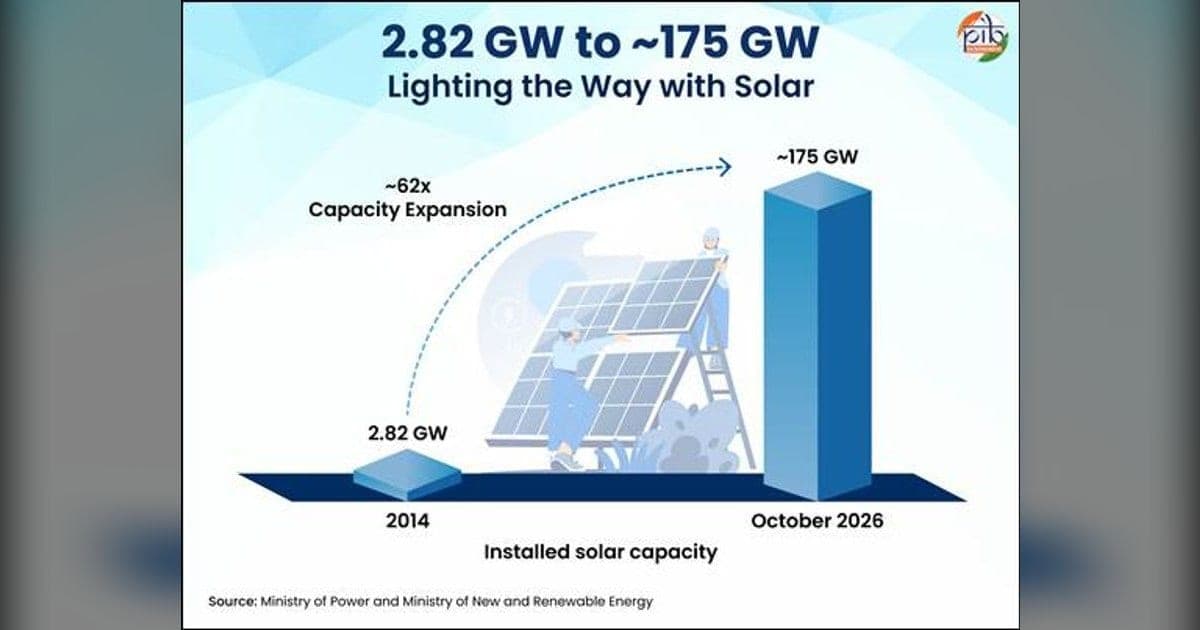
A PIB backgrounder of 17 November 2026 put India’s solar capacity near 175 GW by 31 October 2026, about 62 times the 2.82 GW standing in 2014.
Why in News
A PIB backgrounder released on 17 November 2026 reviewed a decade of solar growth in India, placing installed capacity at about 175 GW on 31 October 2026 against 2.82 GW in 2014, and set out the schemes, tariffs and manufacturing numbers behind that rise.
A backgrounder issued on 17 November 2026 set out how solar power has moved from a thin slice of India’s electricity mix to the largest block of its renewable capacity. Installed solar capacity was 2.82 GW in 2014. By 31 October 2026 it stood at roughly 175 GW, a rise of about 62 times in a little over ten years. Much of the discussion came out of the Bharat Renewable Energy Summit and Expo (BRESE) 2026, held at Bharat Mandapam, New Delhi, from 2 to 5 November on the theme Invest. Innovate. Inspire., with takers from more than 130 countries and an exhibition of over 400 organisations; 13 states joined as Partner States.
Where the capacity stands
Large projects, counting the solar part of hybrid plants, carry 133 GW. Grid-tied rooftop systems add 34.97 GW, and off-grid installations account for the balance. Rajasthan, Gujarat, Karnataka, Tamil Nadu, Andhra Pradesh and Maharashtra hold the bulk of the base. Under the Solar Parks Scheme, 56 parks of a sanctioned 39,461 MW had been cleared by October 2026. Bhadla in Rajasthan, built between 2015 and 2020, covers close to 5,700 hectares and carries 2,245 MW.
The numbers of the last three years
| Solar added in FY 2025-26 | 44.61 GW, against 23.83 GW in FY 2024-25 |
| Added so far in FY 2026-27 | 24.29 GW |
| Module making capacity | 192 GW by June 2026, from 2.3 GW in 2014 |
| Non-fossil capacity on 30 September 2026 | 308.03 GW, including 8.78 GW of nuclear |
| Record non-fossil addition | 55.29 GW in FY 2025-26 |
| Lowest tariff discovered | ₹1.99 a unit, by GUVNL in 2020 |
What pulled the cost down
Bidding through e-reverse auctions, run largely by the Solar Energy Corporation of India, took tariffs from about ₹18 a unit in 2010 to a record ₹1.99. Utility-scale solar in India had a levelised cost of USD 35 per MWh in 2025 against a world average of USD 44. Demand is held up by Renewable Purchase Obligations, now notified to 2029-30 with 35.95 per cent set for 2026-27, and by the Panchamrit pledges of 500 GW of non-fossil capacity by 2030 and net zero by 2070. Manufacturing is backed by the PLI scheme for high-efficiency modules, ₹4,500 crore in 2021 and ₹19,500 crore more in 2022, and by the ALMM quality list of 2019.
Rooftops, farms and reservoirs
PM Surya Ghar: Muft Bijli Yojana, launched on 13 February 2024 with an outlay of ₹75,021 crore, had solarised about 65 lakh households by November 2026, with ₹28,024 crore released as central assistance till July 2026 and over 21 lakh homes on a nil bill. PM-KUSUM, of 2019, aims at about 34,800 MW by 2026-27 with central support of ₹34,422 crore; it has put up 11.91 lakh off-grid pumps and covered 17.18 lakh pumps through feeder solarisation. Together the two gave 16.3 GW, or 36 per cent, of the 44.61 GW added in FY 2025-26. The newest step is the Pradhan Mantri Surya Sarovar Yojana, cleared on 31 July 2026 with ₹5,070 crore for 5,000 MW of floating solar paired with storage.
Important Facts
| Solar capacity, 31 October 2026 | About 175 GW, up from 2.82 GW in 2014 |
|---|---|
| Added in FY 2025-26 | 44.61 GW of solar; 55.29 GW of non-fossil capacity in all |
| Module manufacturing | 192 GW by June 2026 |
| Solar parks sanctioned | 56 parks, 39,461 MW, as of October 2026 |
| Largest park | Bhadla, Rajasthan: 2,245 MW over nearly 5,700 hectares |
| Record low tariff | ₹1.99 per unit, discovered by GUVNL in 2020 |
| RPO for 2026-27 | 35.95 per cent, with the trajectory notified to 2029-30 |
| PM Surya Ghar | Launched 13 February 2024, outlay ₹75,021 crore, about 65 lakh homes solarised |
| PM Surya Sarovar Yojana | Approved 31 July 2026, ₹5,070 crore for 5,000 MW of floating solar |
Exam Point of View
Fix the capacity jump (2.82 GW in 2014 to about 175 GW on 31 October 2026, roughly 62 times), the FY 2025-26 addition of 44.61 GW, module capacity of 192 GW by June 2026, 56 solar parks of 39,461 MW, Bhadla at 2,245 MW, the record tariff of ₹1.99 a unit by GUVNL in 2020, the 2026-27 RPO of 35.95 per cent, and the two newest schemes: PM Surya Ghar of 13 February 2024 and PM Surya Sarovar Yojana of 31 July 2026.
Practice Questions
What was India’s installed solar power capacity as of 31 October 2026, according to the PIB backgrounder of 17 November 2026?
- A.About 133 GW
- B.About 175 GW
- C.About 192 GW
- D.About 308 GW
Show answer
Solar capacity stood at 2.82 GW in 2014 and reached roughly 175 GW by 31 October 2026, an expansion of about 62 times, which makes solar the largest single component of the country’s renewable fleet.
Read the full explanation →Which entity discovered India’s record-low solar tariff of ₹1.99 per unit, and in which year?
- A.NTPC, in 2018
- B.Solar Energy Corporation of India, in 2019
- C.Gujarat Urja Vikas Nigam Ltd, in 2020
- D.NHPC, in 2021
Show answer
The record tariff of ₹1.99 a unit was reached in a competitive bid run by that state utility, down from around ₹18 a unit in 2010, and it is the lowest figure quoted for solar power in India.
Read the full explanation →The Pradhan Mantri Surya Sarovar Yojana, approved on 31 July 2026, supports how much floating solar capacity?
- A.2,000 MW
- B.5,000 MW
- C.10,000 MW
- D.20,000 MW
Show answer
The scheme was cleared on 31 July 2026 with an outlay of ₹5,070 crore to build floating solar photovoltaic projects of that size, each with a co-located energy storage system of at least two hours, so that states can meet evening peaks.
Read the full explanation →Frequently Asked Questions
What is India’s installed solar capacity as of 31 October 2026?
About 175 GW, against 2.82 GW in 2014, which works out to a rise of roughly 62 times. Large projects, including the solar share of hybrid plants, hold 133 GW and grid-connected rooftop systems 34.97 GW.
What is the Pradhan Mantri Surya Sarovar Yojana?
A scheme approved on 31 July 2026 with an outlay of ₹5,070 crore to support 5,000 MW of floating solar photovoltaic projects with co-located storage of at least two hours. It runs from FY 2026-27 to FY 2030-31 and draws on a NISE estimate of about 102.18 GWp of floating solar potential.
Which agency discovered India’s lowest solar tariff and when?
Gujarat Urja Vikas Nigam Ltd discovered ₹1.99 per unit in 2020, down from about ₹18 per unit in 2010. The fall came through e-reverse auction bidding scaled up by agencies such as the Solar Energy Corporation of India.
Sources
- भारत के सौर ऊर्जा क्षेत्र में नए युग की शुरुआत (opens in a new tab) — Press Information Bureau
Current Affairs 17 November 2026
- Horticulture Output Set at 3869.15 Lakh Tonnes for 2025-26Economy
- Buddha Relics Draw 12,000 to Golden Pagoda at NamsaiNational
- India Pitches Big Cat Conservation as Climate Action at COP31Summits & Conferences
- 9th National Naturopathy Day at Nagamangala on 18 NovemberImportant Days
- 23rd ASEAN-India Summit Theme: Navigating Our Future, TogetherSummits & Conferences
- India-Egypt Trade Target of USD 12 Billion Set at 7th JTCEconomy
- 4th India-Japan 2+2 Ministerial Dialogue to Be Held in TokyoDefence
- DHTI Starts First Global Leadership Programme for Fiji OfficersDefence
Related Current Affairs
- Government Schemes
Watershed Guidelines: 3rd National Consultation in Nagpur
5 November 2026 · 2 min read
- International
Sitharaman Attends 114th World Bank Development Committee Meet
15 October 2026 · 2 min read
- Reports & Indices
World Development Report 2026 on AI Launched in New Delhi
8 October 2026 · 3 min read




Related GK
- BIS, ADB, AIIB and NDB: Institutions for Bank Exams
6 October 2026 · Banking & Financial Awareness
- G20, BRICS and Economic Groupings: Exam Notes
4 October 2026 · Indian Economy
- IMF, World Bank and WTO: Functions and Facts
3 October 2026 · Indian Economy
Take the Quiz
- Current Affairs Quiz
Banking Current Affairs Quiz: 17 November 2026
25 questions25 minutesStart Quiz