
Kutch Earthquake 2001: Rebuilding, GSDMA and Key Figures
A PIB backgrounder recalls the Kutch earthquake of 26 January 2001, in which 13,805 lives were lost, and the rebuilding drive that followed under GSDMA.
Why in News
On 16 November 2026 the Press Information Bureau issued a backgrounder on the Kutch earthquake of 2001, setting out the losses, the creation of GSDMA and the owner-driven reconstruction that rebuilt about 1.87 lakh houses.
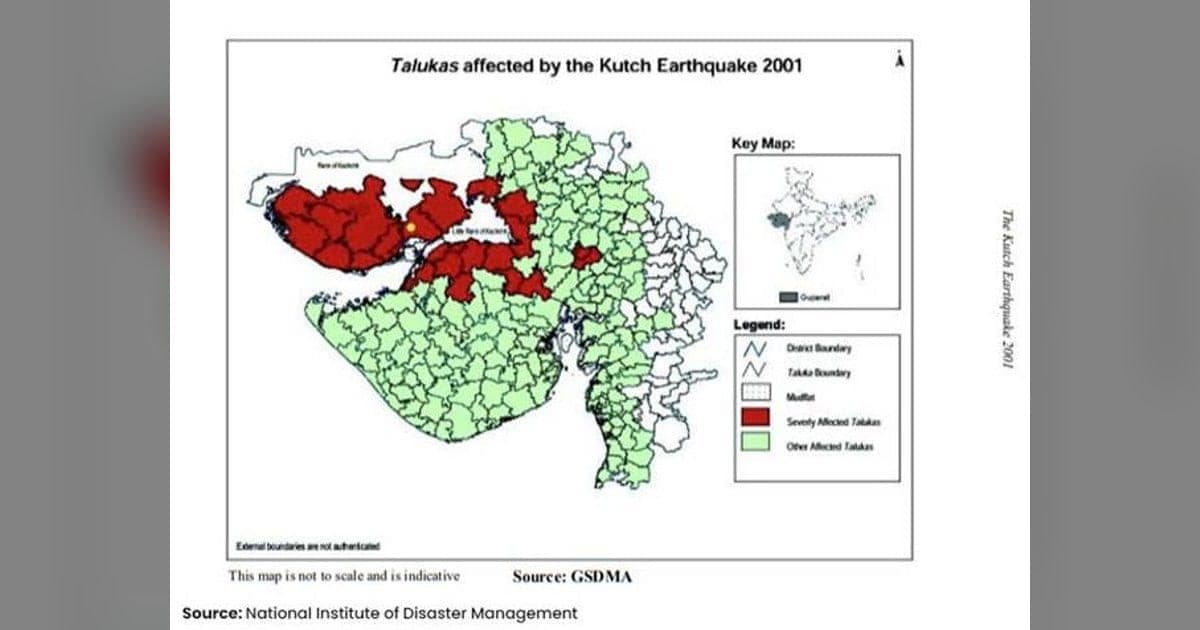
A backgrounder issued by the Press Information Bureau revisits the Kutch earthquake of 26 January 2001 and the recovery that followed. The quake struck at 8:46 in the morning with a magnitude of 6.9 and its epicentre in Kutch, Gujarat. It reached about 7,633 villages spread over 181 talukas, affected close to one crore people and took 13,805 lives, of which 12,221 were in Kutch alone. About 1.67 lakh people were hurt, more than two lakh houses collapsed and around nine lakh were damaged. Over 10,000 small and medium industrial units halted work and about 50,000 artisans lost their trade. Gujarat had plans ready for cyclones and floods but none for an earthquake.
The first response
Landline and mobile networks around the capital region went down within an hour, leaving satellite phones and police wireless as the main links. In Bhuj the Superintendent of Police led search and rescue while the Collector handled relief. The National Crisis Management Committee met under the Prime Minister the same day and Rs 500 crore was sanctioned for immediate relief.
A new authority
On 8 February 2001 Gujarat set up the Gujarat State Disaster Management Authority (GSDMA) by a government resolution, with the Chief Minister as chairman of its governing body. The model was borrowed from the Orissa State Disaster Management Authority, created after the super cyclone of 1999. GSDMA began as a registered society and was given statutory footing by the Gujarat State Disaster Management Act, 2003. At the national level a National Committee on Disaster Management was constituted on 13 February 2001.
Counting and funding the loss
| Damage, World Bank and ADB estimate | Rs 9,909 crore |
| Reconstruction cost estimate | Rs 10,575 crore |
| State government estimate | Rs 8,496 crore |
| Met from state resources | About 30 per cent, roughly Rs 2,603 crore |
Owner-driven rebuilding
Housing followed an owner-driven approach in which families rebuilt their own homes with money, safe designs and technical help from the government rather than through contractors. Damage was graded on a G1 to G5 scale by 2,051 survey teams of 4,592 persons, among them 1,794 revenue officers. The District Judge of each district served as Ombudsman and had received 47,156 petitions by October 2003, nearly all of them settled. Material banks numbering 1,082 supplied cement, masons and engineers were trained, and rebuilt houses were registered in the joint names of husband and wife.
What was achieved and what it left behind
By January 2004 about 1.87 lakh houses had been rebuilt against a target of about 2.15 lakh, that is 87 per cent. All 42,678 primary schoolrooms marked for repair were repaired, and 7,469 of the 8,212 destroyed rooms were rebuilt. The district civil hospital at Bhuj, rebuilt with help from the Prime Minister's National Relief Fund at a cost of about Rs 114 crore using base isolation technology, opened on 14 January 2004. Urban works covered about 403 km of roads, 546 km of water pipelines and 504 km of sewerage. By March 2004 Kutch had drawn 151 new industrial projects with proposed investment of about Rs 4,785 crore. Gujarat adopted a disaster management policy in 2002, set up the Gujarat Institute of Disaster Management and raised village teams called Afat Sajjat Senas in 484 villages. The work won the United Nations Sasakawa Award in 2003 and a Commonwealth association gold award for governance innovation in 2004, and it preceded the national Disaster Management Act, 2005.
Important Facts
| Event | Kutch earthquake, 26 January 2001, 8:46 am, magnitude 6.9 |
|---|---|
| Epicentre | Kutch, Gujarat |
| Lives lost | 13,805, of which 12,221 in Kutch |
| Reach | About 7,633 villages in 181 talukas; nearly one crore people affected |
| Immediate central relief | Rs 500 crore sanctioned the same day |
| Authority created | Gujarat State Disaster Management Authority on 8 February 2001, Chief Minister as chairman |
| Damage estimate | Rs 9,909 crore by the World Bank and Asian Development Bank |
| Houses rebuilt | About 1.87 lakh by January 2004 against a target of about 2.15 lakh |
| Awards | United Nations Sasakawa Award in 2003; Commonwealth gold award for governance in 2004 |
Exam Point of View
Remember the date and time (26 January 2001, 8:46 am), the magnitude (6.9), the death toll (13,805, with 12,221 in Kutch), villages and talukas affected (7,633 and 181), GSDMA set up on 8 February 2001, the Gujarat Act of 2003, the Sasakawa Award of 2003 and the national Disaster Management Act, 2005.
Practice Questions
What was the magnitude of the earthquake that struck Kutch in Gujarat on 26 January 2001?
- A.5.9
- B.6.9
- C.7.6
- D.8.1
Show answer
The earthquake struck on the morning of 26 January 2001 at 8:46 am with that magnitude and with its epicentre in Kutch, and it became an unprecedented test of governance and institutional strength in Gujarat.
Read the full explanation →On which date was the Gujarat State Disaster Management Authority constituted?
- A.26 January 2001
- B.8 February 2001
- C.13 February 2001
- D.23 February 2001
Show answer
The correct answer is 8 February 2001, when the Gujarat government constituted the authority by a government resolution to oversee rebuilding, with the Chief Minister as chairman of its governing body.
Read the full explanation →At what amount did the World Bank and the Asian Development Bank jointly assess the damage from the Kutch earthquake?
- A.Rs 8,496 crore
- B.Rs 9,909 crore
- C.Rs 10,575 crore
- D.Rs 2,603 crore
Show answer
The correct answer is Rs 9,909 crore, the damage figure from the joint assessment by the two international lending institutions.
Read the full explanation →Which award of the United Nations was conferred in 2003 in recognition of Gujarat's disaster management work?
- A.Sasakawa Award
- B.Champions of the Earth Award
- C.Public Service Award
- D.Global Health Leaders Award
Show answer
In the following year the state also received the gold award of the Commonwealth association for public administration and management for innovation in governance.
Read the full explanation →Frequently Asked Questions
When did the Kutch earthquake strike and what was its magnitude?
It struck Gujarat on the morning of 26 January 2001 at 8:46 am with a magnitude of 6.9, the epicentre lying in Kutch. About 7,633 villages across 181 talukas were affected and 13,805 lives were lost.
Which authority was created to lead the recovery?
The Gujarat State Disaster Management Authority, constituted on 8 February 2001 with the Chief Minister as chairman of its governing body. It began as a registered society and was given a legal basis by the Gujarat State Disaster Management Act, 2003.
What was the owner-driven approach to housing?
Families rebuilt their own houses with financial assistance, safe designs and technical guidance from the government instead of using contractors. Payments were staged against an engineer's certification and rebuilt homes were registered jointly in the names of husband and wife.
What international recognition did the Gujarat recovery receive?
The United Nations Sasakawa Award for disaster reduction in 2003, and in 2004 the gold award of the Commonwealth association for public administration and management for innovation in governance.
Sources
- Damage assessment (opens in a new tab) — Press Information Bureau
Current Affairs 16 November 2026
- India-Egypt 7th Joint Trade Committee Meets at Ministerial LevelInternational
- Modi Departs for 23rd ASEAN-India Summit in ManilaSummits & Conferences
- WPI Inflation Climbs to 12.29 Per Cent in October 2026Economy
- 31st CII Partnership Summit 2026 Held in VisakhapatnamSummits & Conferences
- Vice-President Opens 17th Odisha Assembly Orientation ProgrammeState News
- COVID-19 Response: 22.89 Crore Precaution Doses AdministeredNational
Related Current Affairs
- Government Schemes
Watershed Guidelines: 3rd National Consultation in Nagpur
5 November 2026 · 2 min read
- International
Sitharaman Attends 114th World Bank Development Committee Meet
15 October 2026 · 2 min read
- Reports & Indices
World Development Report 2026 on AI Launched in New Delhi
8 October 2026 · 3 min read



Related GK
- BIS, ADB, AIIB and NDB: Institutions for Bank Exams
6 October 2026 · Banking & Financial Awareness
- G20, BRICS and Economic Groupings: Exam Notes
4 October 2026 · Indian Economy
- IMF, World Bank and WTO: Functions and Facts
3 October 2026 · Indian Economy
Take the Quiz
- Current Affairs Quiz
State Exams Current Affairs Quiz: 16 November 2026
25 questions25 minutesStart Quiz