
India Approves Accession to Fisheries Pact SIOFA
The Centre approved India’s accession to the Southern Indian Ocean Fisheries Agreement, moving it from a cooperating non-contracting party to a full contracting party.
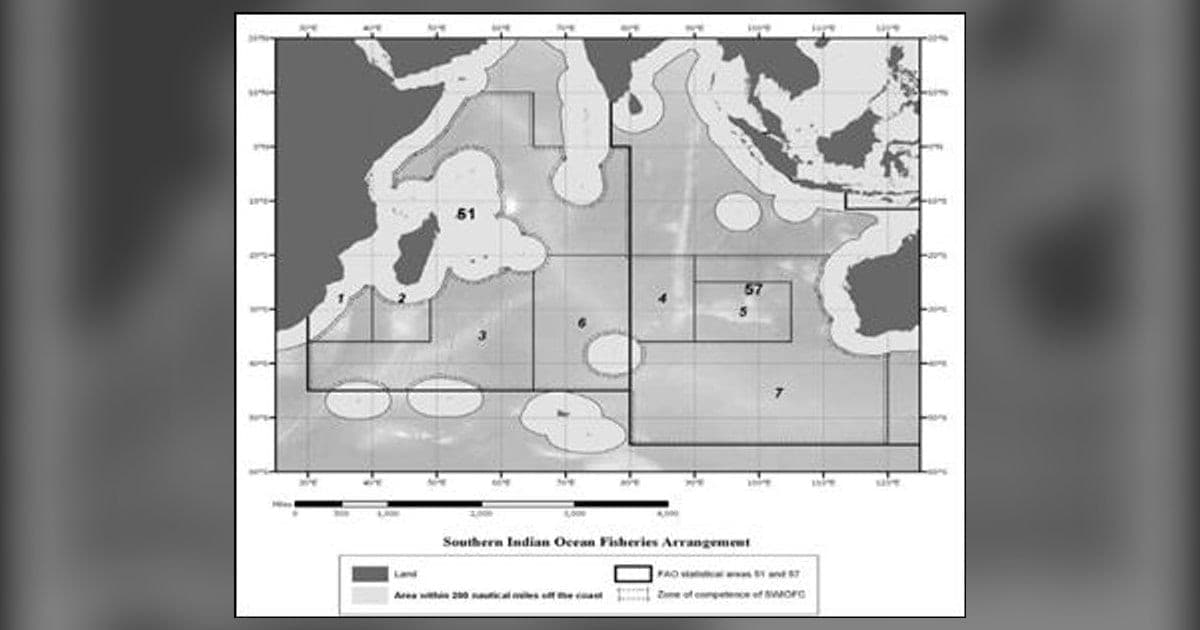
Why in News
The Central Government has approved India’s accession to the Southern Indian Ocean Fisheries Agreement (SIOFA), making the country a contracting party instead of a cooperating non-contracting party and opening authorised high seas fishing for Indian-flagged vessels.
The Central Government has approved India's accession to the Southern Indian Ocean Fisheries Agreement (SIOFA), one of the two regional fisheries management organisations that govern the Indian Ocean. India has been only a Cooperating Non-Contracting Party (CNCP) of the agreement since 2022; as a full Contracting Party it gains a seat and a vote in the bodies that run the pact.
What India gains
- Indian-flagged vessels and enterprises may fish, with authorisation, for squid, toothfish, alfonsino and other non-migratory stocks inside SIOFA waters.
- Full membership of the Scientific Committee and the Compliance Committee, where India's say was limited so far, along with access to scientific data, research programmes and stock assessments.
- Legitimate fishing rights on the high seas and a recognised presence beside the fleets already operating there.
- A role in the High Seas Boarding and Inspection (HSBI) Scheme adopted under SIOFA, which also helps coastal security.
- A stronger hand against illegal, unreported and unregulated (IUU) fishing.
The decision follows the Guidelines for High Sea Fisheries that the Government issued in December 2025, and gives the country's fleet a regional framework for moving into international waters. It is placed within India's Blue Economy goals.
Who holds the high seas today
The high seas make up roughly 65 per cent of the global ocean, and five countries or regions dominate fishing there.
| Country/region | Share of high seas fishing |
| China | 21 per cent |
| Taiwan | 13 per cent |
| Japan | 11 per cent |
| South Korea | 11 per cent |
| Spain | 8 per cent |
The two Indian Ocean bodies
The Indian Ocean has two major regional fisheries management organisations. The Indian Ocean Tuna Commission (IOTC), of which India has been a contracting party since 1996, looks after highly migratory tuna and tuna-like species. SIOFA covers the rest: fish, molluscs, crustaceans and sedentary species in its area, while leaving out the highly migratory species listed in Annex I of UNCLOS and the sedentary species that fall under a coastal state's own fishery jurisdiction under Article 77(4) of UNCLOS.
Why it matters for fishers
Indian fishing boats today work mostly within 60 to 80 nautical miles of the exclusive economic zone. Membership is meant to push that limit outward, open fresh grounds for fishers and entrepreneurs, support the livelihoods of fishing communities and add to the national exchequer, including through access agreements in the exclusive economic zones of other countries. India's participation is also expected to help conserve marine resources and keep them viable in the long run.
Important Facts
| Decision | Approval of India’s accession to the Southern Indian Ocean Fisheries Agreement (SIOFA) |
|---|---|
| Earlier status | Cooperating Non-Contracting Party (CNCP) since 2022 |
| Ministry | Ministry of Fisheries, Animal Husbandry and Dairying |
| Species opened | Squid, toothfish, alfonsino and other non-migratory stocks |
| Key bodies joined | Scientific Committee and Compliance Committee of SIOFA |
| Enforcement scheme | High Seas Boarding and Inspection (HSBI) Scheme |
| High seas share | About 65 per cent of the global ocean |
| Top high seas fishing nations | China 21 per cent, Taiwan 13 per cent, Japan 11 per cent, South Korea 11 per cent, Spain 8 per cent |
| Other Indian Ocean RFMO | Indian Ocean Tuna Commission (IOTC); India a contracting party since 1996 |
| Related policy | Guidelines for High Sea Fisheries issued in December 2025 |
Exam Point of View
Remember the agreement (SIOFA), the change in status (cooperating non-contracting party since 2022 to contracting party), the species opened up (squid, toothfish, alfonsino), the two committees India now joins, the HSBI Scheme, the high seas share of about 65 per cent with China at 21 per cent, and the other Indian Ocean body IOTC, which India joined in 1996.
Practice Questions
India’s accession has been approved to which fisheries agreement?
- A.Southern Indian Ocean Fisheries Agreement
- B.Indian Ocean Tuna Commission
- C.Western and Central Pacific Fisheries Convention
- D.Bay of Bengal Fisheries Compact
Show answer
The Central Government has approved India moving from the position of a cooperating non-contracting party, which it has held since 2022, to that of a full contracting party, which brings voting rights in the bodies that run the agreement.
Read the full explanation →Which country has the largest share of high seas fishing?
- A.Japan
- B.Spain
- C.China
- D.South Korea
Show answer
The high seas themselves account for roughly 65 per cent of the global ocean and five countries or regions dominate fishing in that space.
Read the full explanation →Which scheme adopted under SIOFA will India take part in to strengthen coastal security?
- A.Deep Ocean Surveillance Programme
- B.High Seas Boarding and Inspection Scheme
- C.Marine Stock Certification Scheme
- D.Blue Flag Vessel Scheme
Show answer
It has been adopted under the agreement and is to be put in place, and active involvement in it is expected to advance India’s strategic regional priorities while strengthening national coastal security.
Read the full explanation →Frequently Asked Questions
What is SIOFA and what has India decided about it?
SIOFA is the Southern Indian Ocean Fisheries Agreement, a regional fisheries management organisation. The Central Government has approved India’s accession to it as a contracting party, in place of its earlier cooperating non-contracting party status held since 2022.
Which fish can Indian vessels target under SIOFA?
Indian-flagged fishing vessels and enterprises may undertake authorised fishing of squid, toothfish, alfonsino and other non-migratory stocks within the agreement’s area of competence.
Which are the two major regional fisheries bodies in the Indian Ocean?
The Indian Ocean Tuna Commission, which regulates highly migratory tuna and tuna-like species and which India joined in 1996, and the Southern Indian Ocean Fisheries Agreement, which covers other fishery resources.
How much of the global ocean is high seas?
About 65 per cent. Fishing there is dominated by five countries and regions: China with 21 per cent, Taiwan with 13 per cent, Japan and South Korea with 11 per cent each, and Spain with 8 per cent.
Sources
- https://pib.gov.in/PressReleasePage.aspx?PRID=2323370 (opens in a new tab) — Press Information Bureau
Current Affairs 14 October 2026
- Coir Exports Up 305% in Ten Years to ₹6,614.40 CroreEconomy
- WPI Inflation Rises to 11.39 Per Cent in September 2026Economy
- First ASEAN-India Defence Think Tank Forum Opens in DelhiDefence
- BHAVYA Scheme: Rs 33,660 Crore for 100 Industrial ParksGovernment Schemes
- Indian Navy Hands Over Command of Combined Task Force 154Defence
- TDB Signs Rs 151 Crore RDI Deal With ideaForge for YETI UAVScience & Technology
- North East Bankers' Conclave 3.0 Held at Mizoram UniversityBanking & Finance
- Cabinet Clears Rs 53,428 Crore for Renamed NSAP Pension SchemeGovernment Schemes
Related Current Affairs
- International
Milton Dick of Australia Elected President of the IPU at Arusha
10 October 2026 · 2 min read
Related GK
- Haryana National Parks and Wildlife Sanctuaries Notes
14 October 2026 · Haryana
- Haryana Climate, Soils and Forests: Complete GK Notes
14 October 2026 · Haryana
- UP Agriculture, Crops and Livestock: Notes with PYQs
14 October 2026 · Uttar Pradesh
Take the Quiz
- Current Affairs Quiz
State Exams Current Affairs Quiz: 14 October 2026
25 questions25 minutesStart Quiz