
CAPEX Scheme Backs Lithium, Nickel Units with Rs 2,814 Crore
The Union Cabinet cleared the Rs 2,814 crore CAPEX Support Scheme on 4 November 2026 to set up two lithium and two nickel processing plants in India.
Why in News
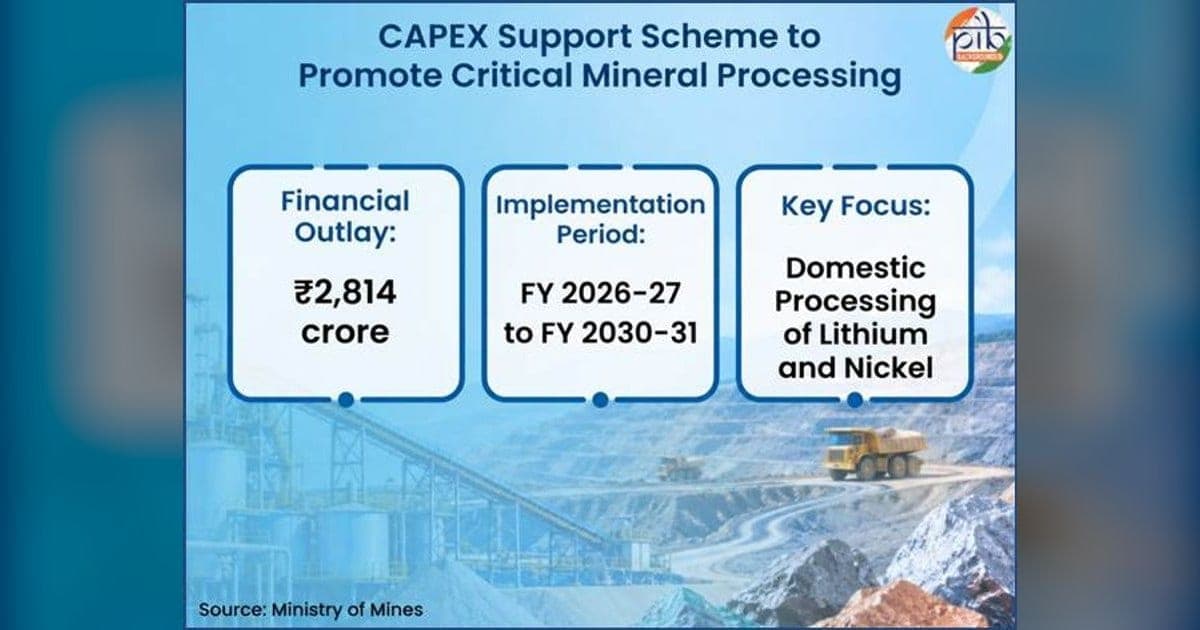
The Union Cabinet approved the CAPEX Support Scheme to Promote Critical Mineral Processing on 4 November 2026, with an outlay of Rs 2,814 crore for two lithium and two nickel processing plants.
India now has a dedicated capital subsidy window for refining critical minerals at home. The CAPEX Support Scheme to Promote Critical Mineral Processing, cleared by the Union Cabinet on 4 November 2026, carries an outlay of Rs 2,814 crore and runs for five financial years, from FY 2026-27 to FY 2030-31. It is administered by the Ministry of Mines.
What the scheme pays for
The window offers a capital subsidy of 30 per cent of eligible investment for four plants: two for lithium and two for nickel. Every lithium unit must have a capacity of at least 30 kt, and every nickel unit at least 50 kt. Lithium plants will convert ores and concentrates, with brines left out, into battery-grade material. Nickel plants will make Class-1 nickel or battery-grade nickel sulphate and recover cobalt as a by-product.
How the money is split
| Mineral | Cap per beneficiary | Total |
| Lithium (2 plants) | Rs 500 crore | Rs 1,000 crore |
| Nickel (2 plants) | Rs 900 crore | Rs 1,800 crore |
| Administration | 0.5 per cent of outlay | Rs 14 crore |
Choosing the four winners
Selection happens in two stages. The first screens every applicant on technical grounds; those who clear it file financial bids in the second, and the lowest subsidy asked for wins. Two firms are picked for each mineral. Money moves in three tranches tied to milestones, rising to a quarter of the bid, then half, and the whole of it once the plant is commissioned. A winner must commission within three years of the Letter of Award, and in no case beyond five years, with a tapering cut if it slips past the third year.
Why it matters
India has identified 24 critical minerals, among them lithium, nickel, cobalt, graphite and the rare earths, yet buys most of its refined intermediates abroad. The scheme is expected to anchor about Rs 10,000 crore of investment and build 60 kt of lithium and 100 kt of nickel processing capacity against demand projected by 2030. A Governing Council chaired by the Secretary, Ministry of Mines, makes the final choice; a Techno-Financial Committee evaluates bids and a Project Management Agency handles execution. The window sits beside the National Critical Mineral Mission of January 2025 and a Rs 1,500 crore recycling scheme.
Important Facts
| Scheme | CAPEX Support Scheme to Promote Critical Mineral Processing |
|---|---|
| Approved by | Union Cabinet, on 4 November 2026 |
| Outlay | Rs 2,814 crore |
| Period | FY 2026-27 to FY 2030-31 (five years) |
| Subsidy | 30 per cent of eligible investment |
| Plants | Two lithium (at least 30 kt each) and two nickel (at least 50 kt each) |
| Caps | Rs 500 crore per lithium beneficiary, Rs 900 crore per nickel beneficiary |
| Administration | Rs 14 crore, or 0.5 per cent of the outlay |
| Investment expected | About Rs 10,000 crore |
| Apex body | Governing Council chaired by the Secretary, Ministry of Mines |
Exam Point of View
Remember the outlay (Rs 2,814 crore), the period (FY 2026-27 to FY 2030-31), the subsidy rate (30 per cent), the four plants and their minimum sizes, the caps of Rs 500 crore and Rs 900 crore per beneficiary, the Rs 14 crore kept for administration, the Rs 10,000 crore of investment expected, and the Governing Council chaired by the Secretary, Ministry of Mines.
Practice Questions
What is the total outlay of the CAPEX Support Scheme to Promote Critical Mineral Processing?
- A.Rs 1,500 crore
- B.Rs 2,800 crore
- C.Rs 2,814 crore
- D.Rs 10,000 crore
Show answer
The Union Cabinet cleared the CAPEX Support Scheme to Promote Critical Mineral Processing on 4 November 2026 with exactly this outlay, spread over five financial years running from FY 2026-27 to FY 2030-31, and funded wholly from budgetary support.
Read the full explanation →For which two minerals does the CAPEX Support Scheme fund processing plants?
- A.Lithium and cobalt
- B.Lithium and nickel
- C.Nickel and graphite
- D.Cobalt and rare earths
Show answer
The scheme funds four plants in all, two for lithium with a capacity of at least 30 kt each and two for nickel with a capacity of at least 50 kt each.
Read the full explanation →Who chairs the Governing Council, the apex body of the CAPEX Support Scheme for critical mineral processing?
- A.The Cabinet Secretary
- B.The Secretary, Ministry of Mines
- C.The Vice-Chairman of NITI Aayog
- D.The Secretary, Department of Public Enterprises
Show answer
The scheme has a three-tier governance structure. At the apex sits the Governing Council, chaired by the Secretary, Ministry of Mines, which gives strategic guidance, reviews progress, makes the final selection of beneficiaries and sanctions the capital support; it may also approve changes to the scheme guidelines with the Union…
Read the full explanation →Frequently Asked Questions
What is the outlay of the CAPEX Support Scheme to Promote Critical Mineral Processing?
Rs 2,814 crore. Of this, Rs 2,800 crore is subsidy, made up of Rs 1,000 crore for lithium and Rs 1,800 crore for nickel, while Rs 14 crore, or 0.5 per cent of the outlay, is kept for administrative expenses.
How are beneficiaries chosen under the scheme?
Through a two-stage process. Applicants are first assessed on technical criteria, and those who qualify then file financial bids. Selection follows the least-cost rule, that is, the lowest CAPEX support sought. Two beneficiaries are picked for each mineral, four in all.
How much processing capacity will the scheme create?
It is expected to support 60 kt of lithium and 100 kt of nickel processing capacity to meet demand projected by 2030, and to anchor about Rs 10,000 crore of investment in the sector.
Sources
- https://www.pib.gov.in/PressReleasePage.aspx?PRID=2332964 (opens in a new tab) — Press Information Bureau
Current Affairs 5 November 2026
- VB-G RAM G: Centre Marks 22 Fodder and Livestock WorksGovernment Schemes
- 4th Conference of Mining Ministers Begins in GoaSummits & Conferences
- Watershed Guidelines: 3rd National Consultation in NagpurGovernment Schemes
- NHRC Push Sets Up Gender-Neutral Cell in Hyderabad JailNational
- BIS Hallmarking: 65 Crore Gold Articles Carry HUID CodeNational
- Railways Wins PM Surya Ghar Excellence Award from VPAwards & Honours
- AIIMS Awantipora OPD to Open Before December 2026National
- SRI Fund Has Backed 824 MSMEs with Rs 21,330 CroreEconomy
Related Current Affairs
- Government Schemes
Watershed Guidelines: 3rd National Consultation in Nagpur
5 November 2026 · 2 min read
- Government Schemes
VB-G RAM G: Centre Marks 22 Fodder and Livestock Works
5 November 2026 · 2 min read
- Government Schemes
Vayo Samman Rashtriya Abhiyan Launched for Senior Citizens
4 November 2026 · 3 min read
- Government Schemes
National SARAS Mela Ends With Rs 12.8 Crore Sales at Vijayawada
4 November 2026 · 2 min read
- Government Schemes
Cabinet Clears Rs 2,814 Crore Critical Mineral Capex Scheme
4 November 2026 · 2 min read
Related GK
- Famous Personalities of Rajasthan: Exam Notes
28 October 2026 · Rajasthan
- Districts and Divisions of Rajasthan: Exam Notes
28 October 2026 · Rajasthan
- Tourism and World Heritage Sites of Rajasthan Notes
27 October 2026 · Rajasthan
Take the Quiz
- Current Affairs Quiz
Banking Current Affairs Quiz: 5 November 2026
25 questions25 minutesStart Quiz