
CHIME Telescope Makes First Solo Detection of Hydrogen Glow
The CHIME radio telescope, with Indian researchers from RRI, made its first standalone detection of hydrogen glow from when the universe was five billion years old.
Why in News
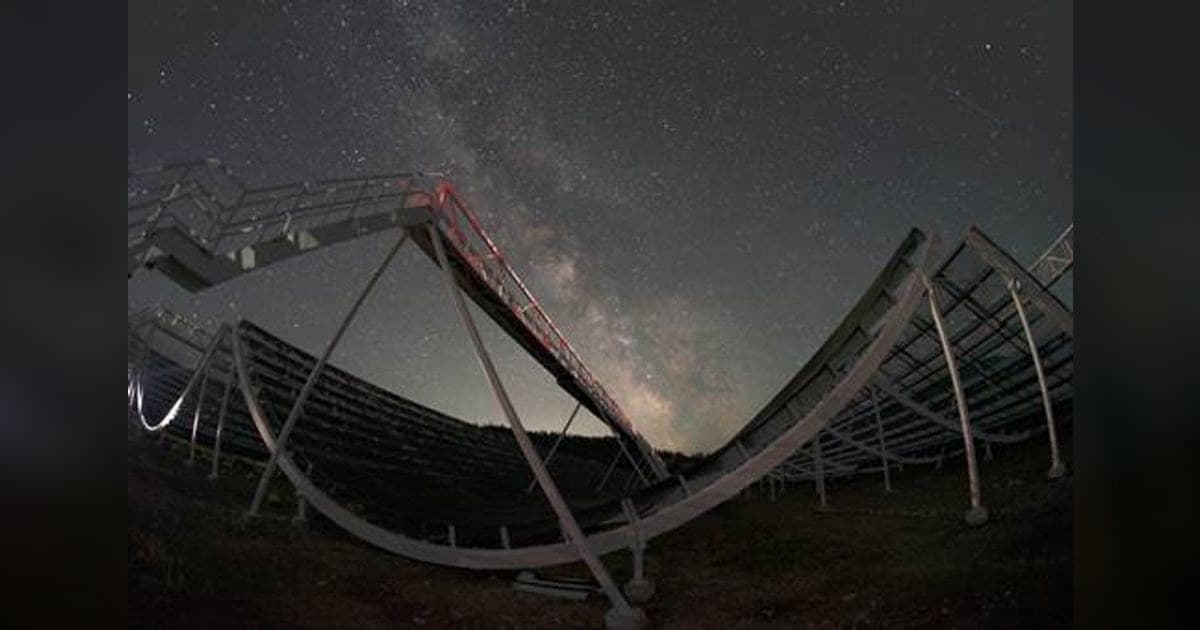
The Department of Science and Technology announced that the CHIME radio telescope, with collaborators from the Raman Research Institute, made its first standalone detection of the glow of hydrogen from when the universe was about five billion years old.
The Canadian Hydrogen Intensity Mapping Experiment, known as the CHIME telescope, has made its first standalone detection of the faint radio glow of hydrogen gas from a time when the universe was about five billion years old. Researchers from India were part of the international collaboration behind the result, which opens a new route for studying cosmic expansion and dark energy.
The Indian link
The study included CHIME collaborators at the Raman Research Institute (RRI), an autonomous institute of the Department of Science and Technology. Saurabh Singh, associate professor at RRI and a co-author, described CHIME as an instrument that scans a large fraction of the cosmos as the sky drifts over it, with no moving parts, delivering a daily snapshot of the radio sky.
What is new about it
CHIME is an interferometric radio telescope in Canada, built to map how hydrogen gas is spread through the early universe so that astronomers can measure the universe's expansion and probe dark energy. Until now it had to cross-correlate its observations with galaxy survey data from other telescopes. This time it found the signal using only its own data. Because galaxy surveys cost far more and look only at the parts of the universe hot and dense enough to form stars, the standalone method promises a faster and cheaper way to study dark energy, which is one of the largest open questions in physics.
What the signal shows
An accompanying paper examined what the observed signal says about how hydrogen is spread through the universe. Shabbir Shaikh of Arizona State University, a co-author, said the data indicate that roughly two per cent of the universe's hydrogen was in neutral atomic form at that time, broadly in line with other measurements. Hydrogen, the most common element in the universe and the raw material of stars, acts as a cosmic tracer through its faint radio emission.
How the result was reached
This was not a sudden discovery. New data analysis and processing techniques were applied to pull the faint signal out of the noise of the background universe, of human technology and of the instrument itself, and the team then spent more than a year testing the finding. The measurement rests on 94 nights of observation data collected in 2019, a small fraction of what CHIME has gathered. The findings are published in The Astrophysical Journal. Researchers now have nearly seven years of observations and are extending the analysis to when the universe was only about three billion years old.
Important Facts
| Telescope | Canadian Hydrogen Intensity Mapping Experiment (CHIME), an interferometric radio telescope in Canada |
|---|---|
| Achievement | First standalone detection of the radio glow of hydrogen using only its own data |
| Epoch observed | When the universe was about five billion years old |
| Indian institute | Raman Research Institute (RRI), an autonomous institute of the Department of Science and Technology |
| Purpose | Mapping hydrogen distribution to measure cosmic expansion and study dark energy |
| Neutral hydrogen | Roughly two per cent of the universe's hydrogen was in neutral atomic form at that time |
| Data used | 94 nights of observations collected in 2019 |
| Published in | The Astrophysical Journal |
| Next step | Extending the analysis to when the universe was about three billion years old |
Exam Point of View
Remember the telescope's full name (Canadian Hydrogen Intensity Mapping Experiment), the country it is in (Canada), the Indian institute involved (Raman Research Institute under the Department of Science and Technology), what was detected (the faint radio glow of hydrogen), the age of the universe at that time (about five billion years), the neutral hydrogen share (roughly two per cent), the 94 nights of data from 2019, and the journal.
Practice Questions
CHIME, the telescope that made the first standalone detection of the hydrogen glow, stands for which of the following?
- A.Cosmic Hydrogen Imaging and Mapping Experiment
- B.Canadian Hydrogen Intensity Mapping Experiment
- C.Combined Hydrogen Interferometric Measurement Endeavour
- D.Cosmological High-energy Infrared Mapping Experiment
Show answer
Correct answer: B. Canadian Hydrogen Intensity Mapping Experiment
Explanation
The correct answer is Canadian Hydrogen Intensity Mapping Experiment. CHIME is an interferometric radio telescope in Canada, built to map the distribution of hydrogen gas in the early universe so that astronomers can calculate how the universe expands and thereby study dark energy. Options A, C and D are invented expansions assembled from similar astronomical vocabulary, which is the usual way such distractors are framed. Note that the first letter stands for the country that conceived, built and funded the instrument, a point its principal investigator emphasised. Candidates should also register that CHIME works at radio wavelengths and has no moving parts, scanning the sky as it drifts overhead, which is what lets it deliver a daily view of the radio sky.
Which Indian institute's researchers were part of the CHIME collaboration behind this detection?
- A.Indian Institute of Astrophysics
- B.Physical Research Laboratory
- C.Raman Research Institute
- D.Tata Institute of Fundamental Research
Show answer
Correct answer: C. Raman Research Institute
Explanation
The correct answer is the Raman Research Institute. The study that reported the first standalone detection included CHIME collaborators at RRI, an autonomous institute of the Department of Science and Technology, and its associate professor Saurabh Singh is among the co-authors quoted on the result. Options A, B and D name other well known Indian research bodies working in astronomy, space and fundamental physics, and they are placed here precisely because a candidate who remembers only that an Indian institute was involved may pick any of them. The safe approach is to link the institute to its parent department as well, since questions often ask which ministry or department the institute falls under, and here the answer is the Department of Science and Technology.
Roughly what share of the universe's hydrogen was in neutral atomic form at the epoch CHIME observed?
- A.About two per cent
- B.About twenty per cent
- C.About half
- D.Almost all of it
Show answer
Correct answer: A. About two per cent
Explanation
The correct answer is about two per cent. An accompanying paper examined what the observed signal reveals about the distribution of hydrogen, and co-author Shabbir Shaikh of Arizona State University said the data indicate that roughly this share of the universe's hydrogen was in neutral atomic form at that time, broadly consistent with other measurements. Options B, C and D overstate the neutral fraction by a wide margin and are wrong. The wider point for an aspirant is why this matters: by measuring how that hydrogen is distributed and clustered, CHIME offers a new way to test our understanding of how galaxies form and evolve, which is a separate payoff from its main goal of probing dark energy. Candidates should also note that hydrogen is described as the most common element in the universe and the raw material from which stars form, which is why its faint radio emission works as a cosmic tracer.
The CHIME detection was based on observation data collected in which year?
- A.2015
- B.2019
- C.2022
- D.2024
Show answer
Correct answer: B. 2019
Explanation
The correct answer is 2019. The measurement rests on 94 nights of observation data collected in that year, which is only a small fraction of everything the telescope has recorded since operations began. Options A, C and D are nearby years offered as distractors and do not match the announcement. Two related details are worth carrying alongside the year. First, the finding was not immediate: new analysis and processing techniques were needed to pull the faint signal out of the noise, and the team spent more than a year testing it before publishing in The Astrophysical Journal. Second, researchers now have nearly seven years of observations and are extending the work to when the universe was about three billion years old.
Frequently Asked Questions
What does CHIME stand for?
The Canadian Hydrogen Intensity Mapping Experiment. It is an interferometric radio telescope in Canada, built to map the distribution of hydrogen gas in the early universe so astronomers can measure cosmic expansion and investigate dark energy.
Which Indian institute was part of the CHIME result?
The Raman Research Institute, an autonomous institute of the Department of Science and Technology. Its associate professor Saurabh Singh is among the co-authors of the study.
Why does the standalone detection matter?
Earlier CHIME had to cross-correlate its observations with galaxy survey data from other telescopes. Using only its own data allows a faster and less expensive way to study dark energy, and lets it look further back in time and at a greater scale.
How much data was the detection based on?
94 nights of observation collected in 2019, a small fraction of what CHIME has gathered. The team has nearly seven years of observations available and plans to extend the analysis to earlier cosmic epochs.
Sources
- Scientists map earliest glow of hydrogen, opening a new window to the universe (opens in a new tab) — Press Information Bureau
Current Affairs 30 September 2026
- CAFE Norms 2027-32 Notified, Fuel Use to Fall 16.7 Per CentEnvironment
- UPSC Completes 100 Years of Merit-Based RecruitmentNational
- Second Naval Commanders Conference 2026 Opens in New DelhiDefence
- MHI Industry Accelerator Impact Report Released at NavigyaanScience & Technology
- SBM 2.0: Rs 11,785 Crore Approved for Sewage Treatment PlantsEnvironment
- TRAI Releases Mobile Network Drive Test Findings for SonitpurScience & Technology
- Special Campaign 6 to Run from 2 to 31 October 2026National
- PSS Buying of Rs 5,547.99 Crore Cleared for Kharif 2026-27Government Schemes
Related Current Affairs
- Science & Technology
CAG and BHASHINI Launch AI Translation Tool for Audit Papers
30 September 2026 · 2 min read
- Science & Technology
TRAI Releases Mobile Network Drive Test Findings for Sonitpur
30 September 2026 · 2 min read
- Science & Technology
MHI Industry Accelerator Impact Report Released at Navigyaan
30 September 2026 · 2 min read
- Science & Technology
UIDAI Launches Five Initiatives at Aadhaar Samvaad Kolkata
29 September 2026 · 2 min read
- Science & Technology
TDB Backs Indigenous Multi-Gas Sensor With Rs 37.51 Crore
29 September 2026 · 2 min read
- Science & Technology
Ashwagandha Extract Safe Over 24 Weeks in 1,200-Adult Trial
28 September 2026 · 2 min read


Related GK
- Punjab GK: Formation, Rivers, History and Exam Facts
30 September 2026 · Indian States & UTs
- Indian Defence Forces and Missiles: Static GK and PYQs
30 September 2026 · Static GK
- Biotechnology in Agriculture and Health: Notes and PYQs
30 September 2026 · Science & Technology
Take the Quiz
- Current Affairs Quiz
State Exams Current Affairs Quiz: 30 September 2026
25 questions25 minutesStart Quiz