
India Commits 7 Million Euros to Elettra 2.0 Synchrotron, Italy
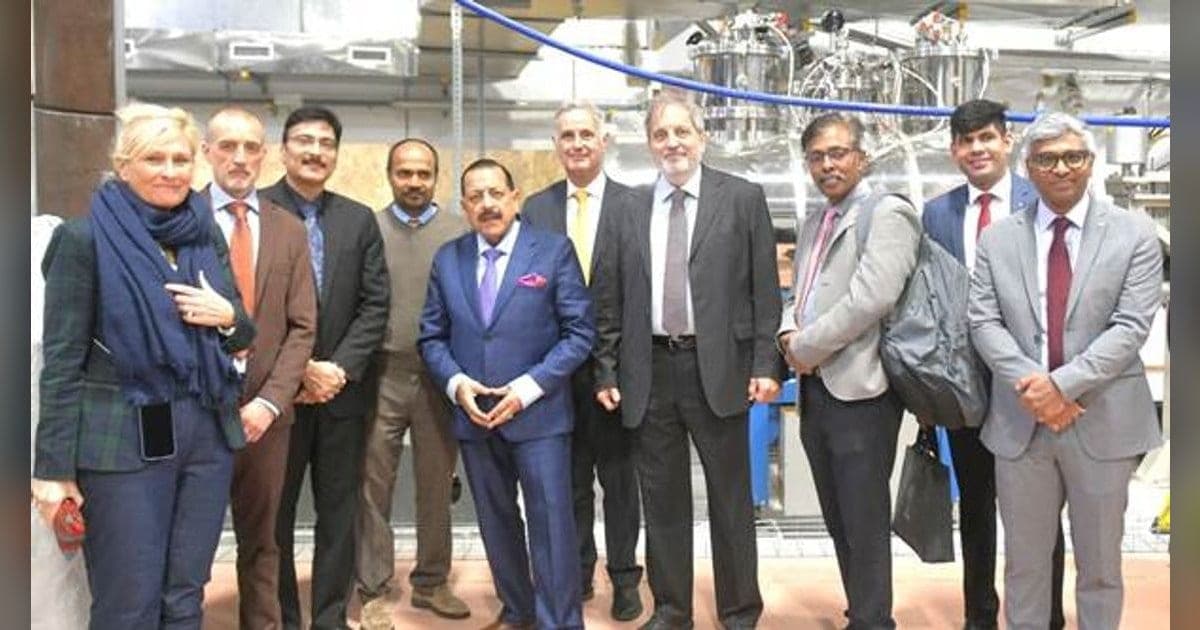
India will invest over 7 million Euros across five years from 2026-27 as co-partner in Italy's Elettra 2.0 programme, Dr Jitendra Singh announced.
Why in News
On 14 November 2026 the Ministry of Science and Technology announced that India will join Italy's Elettra 2.0 programme as a co-partner with an investment of more than 7 million Euros over five years from 2026-27, for next-generation synchrotron beamlines.
India has taken a larger share in one of Europe's working synchrotron laboratories. On 14 November 2026 the Ministry of Science and Technology said that India will join as a co-partner in rebuilding research beamlines at Elettra Sincrotrone Trieste in Italy under the Elettra 2.0 programme, putting in more than 7 million Euros over five years beginning 2026-27. The announcement was made by Dr Jitendra Singh, Union Minister of State (Independent Charge) for Science and Technology and Earth Sciences, during his visit to the laboratory on 13 November 2026.
What a synchrotron does
A synchrotron drives electrons around a ring at very high speed and taps the intense light they shed. That light is led down channels called beamlines, where samples are examined far more finely than an ordinary laboratory allows. The rebuilt facility is expected to widen work in Chemistry, Physics, Advanced Materials and Structural Biology, and researchers from India and other countries will be able to use it.
The two new beamlines
Under Elettra 2.0 the two India-linked beamlines now in service, XRD2 and Xpress, will be taken out and replaced by a pair with greater reach. One is a microfocus beamline for macromolecular crystallography, to be named micro-XRD, and the other a high-pressure diffraction beamline, to be named Xpress Superbend. The Department of Science and Technology had earlier helped build XRD2 and XPRESS with about Rs 22 crore alongside the Italian side, and the two were inaugurated together on 20 October 2016.
How deep the partnership runs
Indian scientists have been running experiments at Elettra since 1998, so the tie is more than twenty-five years old. India is now the second-largest user of Elettra after Italy. The scale shows in the proposal count: Indian research groups have sent in more than 1,100 experimental proposals, which places India second behind Italy with 54,140 and ahead of France with 1,098. Roughly 50 to 60 Indian scientists travel to Trieste each year for experiments.
Support for Indian researchers
Access has also been paid for through the Indo-Italian Executive Programme of Cooperation. Under EPOC 2022-2024 the Department sanctioned Rs 2 crore over three years so that 50 Indian researchers a year, 25 in each semester, could work at the beamlines. EPOC 2025-2027 carries a proposal of about Rs 1.5 crore over three years for the same purpose. A Letter of Intent on the redevelopment had already been signed before this visit, and the figure of more than 7 million Euros is the firm commitment behind it.
Important Facts
| Programme | Elettra 2.0, at Elettra Sincrotrone Trieste, Italy |
|---|---|
| India's commitment | More than 7 million Euros over five years from 2026-27 |
| Announced by | Dr Jitendra Singh, Minister of State (Independent Charge) for Science and Technology and Earth Sciences |
| Beamlines being replaced | XRD2 and Xpress |
| New beamlines | micro-XRD (macromolecular crystallography) and Xpress Superbend (high-pressure diffraction) |
| India's rank as user | Second-largest user of Elettra after Italy |
| Proposals submitted | India more than 1,100; Italy 54,140; France 1,098 |
| Indian participation since | 1998 |
| Research fields | Chemistry, Physics, Advanced Materials and Structural Biology |
Exam Point of View
Remember the amount (over 7 million Euros), the period (five years from 2026-27), the facility (Elettra Sincrotrone Trieste, Italy), the programme name (Elettra 2.0), the minister (Dr Jitendra Singh), the two old beamlines (XRD2 and Xpress) and the two new ones (micro-XRD and Xpress Superbend), and that India is the second-largest user of Elettra after Italy.
Practice Questions
How much has India committed as a co-partner in Italy's Elettra 2.0 synchrotron programme?
- A.More than 3 million Euros
- B.More than 7 million Euros
- C.More than 12 million Euros
- D.More than 20 million Euros
Show answer
India announced this commitment for the redevelopment of research beamlines at Elettra Sincrotrone Trieste under the Elettra 2.0 programme, spread over five years beginning 2026-27, and covering both research infrastructure and human resource capacity.
Read the full explanation →India is the second-largest user of the Elettra synchrotron facility after which country?
- A.France
- B.Germany
- C.Italy
- D.Japan
Show answer
Elettra Sincrotrone Trieste is an Italian facility, so Italy is naturally its largest user, and India stands immediately behind it.
Read the full explanation →Under Elettra 2.0, which new beamline will handle high-pressure diffraction?
- A.micro-XRD
- B.Xpress Superbend
- C.XRD2
- D.Elettra Macro
Show answer
Under the Elettra 2.0 programme the two India-centric beamlines in service will be decommissioned and replaced by two with enhanced capabilities, and of the pair it is Xpress Superbend that is meant for high-pressure diffraction.
Read the full explanation →Frequently Asked Questions
How much has India committed to the Elettra 2.0 programme?
More than 7 million Euros, to be invested over five years beginning 2026-27. The money supports the redevelopment of India-centric research beamlines at Elettra Sincrotrone Trieste in Italy and also human resource development.
Which new beamlines will replace XRD2 and Xpress at Elettra?
A microfocus beamline for macromolecular crystallography named micro-XRD, and a high-pressure diffraction beamline named Xpress Superbend. The two existing beamlines will be decommissioned under Elettra 2.0.
What is India's position among users of the Elettra facility?
India is the second-largest user after Italy. Indian research groups have submitted more than 1,100 experimental proposals, placing India second behind Italy with 54,140 and ahead of France with 1,098, and Indian scientists have been working there since 1998.
Sources
- https://www.pib.gov.in/PressReleasePage.aspx?PRID=2336192 (opens in a new tab) — Press Information Bureau
Current Affairs 14 November 2026
- Pradhan Mantri Janjatiya Vikas Mission Backs 4,172 Van Dhan KendrasGovernment Schemes
- India-Egypt: Piyush Goyal to Co-Chair 7th Joint Trade CommitteeInternational
- National Tribal Literary Festival Ends With 27 LanguagesSummits & Conferences
- DRI Seizes 10.8 kg Amphetamine Hidden In Postal ParcelNational
- Consent Manager Registration Under DPDP Act Comes Into EffectScience & Technology
- Delhi-NCR Air Pollution Review Orders 191 Polluting Units SealedEnvironment
- Janakpur Dham-Ayodhya Weekly Train Cleared by Indian RailwaysInternational
- Odisha to Get 5 Lakh PMAY-Gramin Houses, Chouhan AnnouncesGovernment Schemes
Related Current Affairs
- Science & Technology
Consent Manager Registration Under DPDP Act Comes Into Effect
14 November 2026 · 2 min read
- Science & Technology
COSMOS Planetarium Mysuru: India's First LED Dome Opened
13 November 2026 · 2 min read
- Science & Technology
TDB Gives Rs 64.05 Crore for Astrome AI-ELINT Satellite Project
12 November 2026 · 2 min read
- Science & Technology
India Showcases BharatNet at ITU PP-26 Conference in Doha
11 November 2026 · 2 min read
- Science & Technology
Villages Without 4G Fall to 11,372 Under Saturation Project
11 November 2026 · 2 min read
- Science & Technology
CSIR and SINTEF Hold India-Norway Waste to Resource Dialogue
11 November 2026 · 2 min read

Related GK
- Famous Personalities of Rajasthan: Exam Notes
28 October 2026 · Rajasthan
- Districts and Divisions of Rajasthan: Exam Notes
28 October 2026 · Rajasthan
- Tourism and World Heritage Sites of Rajasthan Notes
27 October 2026 · Rajasthan
Take the Quiz
- Current Affairs Quiz
State Exams Current Affairs Quiz: 14 November 2026
25 questions25 minutesStart Quiz