
BSIP Study Reconstructs 4,600 Years of Monsoon History
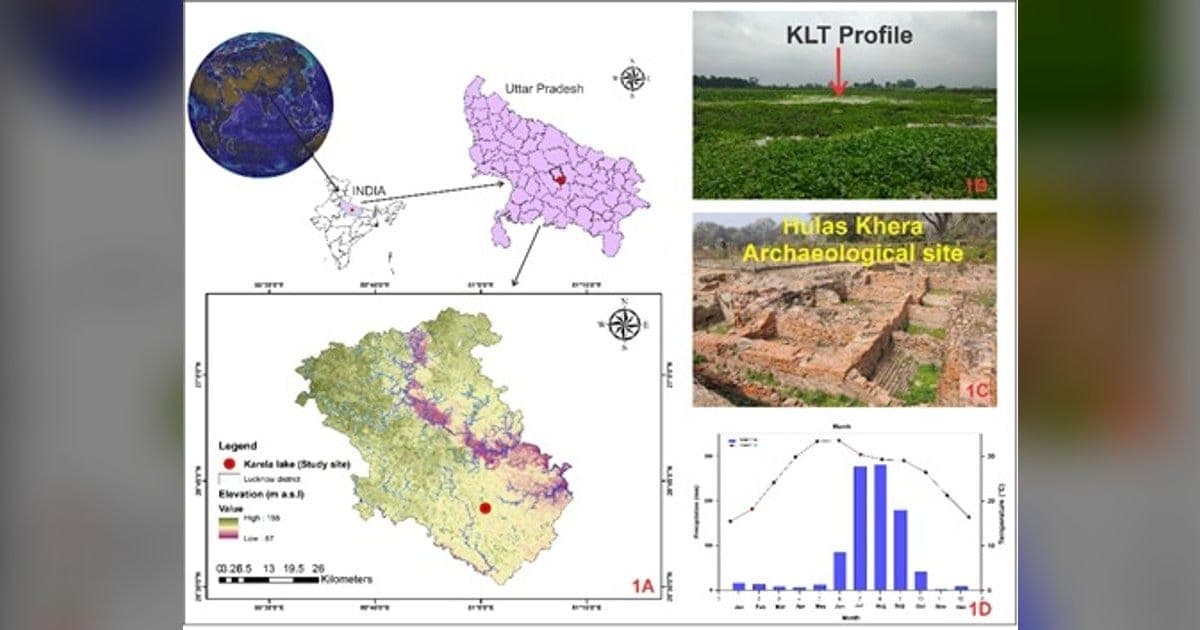
Scientists of the Birbal Sahni Institute of Palaeosciences used Karela Lake near Lucknow to reconstruct 4,600 years of monsoon and farming history in the Ganga Plain.
Why in News
On 16 October 2026 the Department of Science and Technology reported a BSIP study that reconstructed 4,600 years of Indian Summer Monsoon history from Karela Lake near Lucknow in the Central Ganga Plain.
Scientists of the Birbal Sahni Institute of Palaeosciences (BSIP), an autonomous institute of the Department of Science and Technology, have pieced together 4,600 years of climate and environmental history from a single lake in the Central Ganga Plain. Their work, announced on 16 October 2026, shows how swings in the Indian Summer Monsoon shaped lake water levels, the movement of sediment, plant cover, microbial life and the way the earliest farmers of the region adapted.
Where the record came from
The team worked on Karela Lake, an oxbow lake at Hulas Khera in Mohanlal Ganj near Lucknow, Uttar Pradesh. Sediment at the bottom of such a lake traps a layered record of the Late Holocene. The lake also sits beside the Hulas Khera archaeological site, a Kushan-period settlement, so the natural record and the human record could be read side by side.
How the study was done
- Radiocarbon dating by the accelerator mass spectrometry method to fix the timeline
- Stable isotopes of carbon and nitrogen to track vegetation and organic matter
- Grain-size analysis and end-member modelling to trace how sediment moved
- Palynology, the study of pollen, to reconstruct plant cover
What was found
Researchers Biswajeet Thakur, Anand Rajoriya and Maneesha M, with the radiocarbon dating laboratory team, identified four major environmental phases tied to well-known climate events, among them the 4.2 ka arid event, the Roman Warm Period and the Little Ice Age. Moisture brought by westerly winds during the colder stretch of the Little Ice Age left clear signs of flooding in the region. Monsoon swings also drove shifts between C3 and C4 vegetation and changed the kind of organic matter settling in the lake bed.
Why it matters
The rise and fall of the Indus Valley Civilization has long been linked to monsoon change, but far less was known about how later communities of the Ganga Plain coped. Several migrations are recorded in the region between 4500 and 1000 calibrated years before present, which makes it a natural laboratory for studying climate and human interaction. The study, published in the Journal of Asian Earth Sciences, establishes that small oxbow lakes of the plain are sensitive natural archives, and the long baseline it provides can feed into climate modelling, water security, wetland conservation, disaster risk reduction and land-use planning.
Important Facts
| Institute | Birbal Sahni Institute of Palaeosciences (BSIP), Lucknow |
|---|---|
| Parent department | Department of Science and Technology |
| Site studied | Karela Lake, an oxbow lake at Hulas Khera, Mohanlal Ganj, near Lucknow |
| Period reconstructed | 4,600 years of climate and environmental history |
| Climate events identified | 4.2 ka arid event, Roman Warm Period, Little Ice Age |
| Journal | Journal of Asian Earth Sciences |
| Region | Central Ganga Plain, Uttar Pradesh |
Exam Point of View
Remember the institute (BSIP, under DST), the lake (Karela, an oxbow lake at Hulas Khera near Lucknow), the span of 4,600 years, the four phases with the 4.2 ka arid event, Roman Warm Period and Little Ice Age, and the journal.
Practice Questions
Which institute reconstructed 4,600 years of monsoon and environmental history from Karela Lake?
- A.Wadia Institute of Himalayan Geology
- B.Birbal Sahni Institute of Palaeosciences
- C.National Institute of Oceanography
- D.Indian Institute of Tropical Meteorology
Show answer
Its scientists traced past environmental conditions at Karela Lake using stable isotopes, vegetation changes and archaeological and sedimentary records, and built a record stretching back about four thousand six hundred years.
Read the full explanation →Karela Lake, the site of the study, is located near which city?
- A.Patna
- B.Prayagraj
- C.Lucknow
- D.Kanpur
Show answer
Karela Lake is an oxbow lake at Hulas Khera in Mohanlal Ganj, near Lucknow in Uttar Pradesh, and lies in the Central Ganga Plain.
Read the full explanation →Which of these climate events was identified among the four major phases in the study?
- A.The Little Ice Age
- B.The Carboniferous glaciation
- C.The Cretaceous thermal maximum
- D.The Permian extinction
Show answer
The researchers identified four major environmental phases in the lake record, associated with key climate events that include the arid event of about four point two thousand years ago, the Roman Warm Period and the Little Ice Age.
Read the full explanation →Frequently Asked Questions
Which lake did the BSIP scientists study?
Karela Lake, an oxbow lake at Hulas Khera in Mohanlal Ganj near Lucknow, in the Central Ganga Plain. Its sediments preserve a record of Late Holocene environmental change.
How many years of climate history were reconstructed?
About 4,600 years, using stable isotopes, pollen, sedimentary and archaeological records. Four major environmental phases were identified within that span.
Which institute carried out the study and under which department does it work?
The Birbal Sahni Institute of Palaeosciences in Lucknow, an autonomous institute of the Department of Science and Technology. The findings were published in the Journal of Asian Earth Sciences.
Sources
Current Affairs 16 October 2026
- India Builds Safer Navigation on 111 National WaterwaysNational
- APEDA Flags Off Maiden Palmyra Jaggery Export to BulgariaEconomy
- Polish Youth Delegation Ends Jamsaheb Memorial Exchange in IndiaInternational
- Ayush Patent Report Records 4,077 Filings Since 2014-15Reports & Indices
- First Kanda Express Takes 440 MT Onions to AgartalaEconomy
- BHASHINI and IISc Build Sourashtra Text-to-Speech ModelsScience & Technology
- Textiles Ministry Holds Special Campaign 6 Cyber WorkshopsNational
- INS Samarthak Joins Navy as First Indigenous Multi-Purpose VesselDefence
Related Current Affairs
- Science & Technology
Indian Scientists Identify Martian Analogue Sites in Tamil Nadu
16 October 2026 · 2 min read
- Science & Technology
TDB Signs Rs 150 Crore Quantum Security Deal With QNu Labs
16 October 2026 · 2 min read
- Science & Technology
BHASHINI and IISc Build Sourashtra Text-to-Speech Models
16 October 2026 · 2 min read
- Science & Technology
TDB Supports Development of Indigenous 32-Slice CT Scanner
15 October 2026 · 2 min read
- Science & Technology
ARCI Workshop Marks National Hydrogen and Fuel Cell Day
15 October 2026 · 2 min read
- Science & Technology
ESTIC 2026 Curtain-Raiser Highlights Physical AI, Robotics
15 October 2026 · 2 min read

Related GK
- Population and Tribes of MP: Bhil, Gond and Baiga
16 October 2026 · Madhya Pradesh
- Industries of Madhya Pradesh: Pithampur, Cement and Mills
16 October 2026 · Madhya Pradesh
- Industries and Minerals of Haryana: Towns and Products
16 October 2026 · Haryana
Take the Quiz
- Current Affairs Quiz
State Exams Current Affairs Quiz: 16 October 2026
25 questions25 minutesStart Quiz