
Bal Vivah Mukt Bharat at Two: Child Marriage Falls to 20.1% in NFHS-6
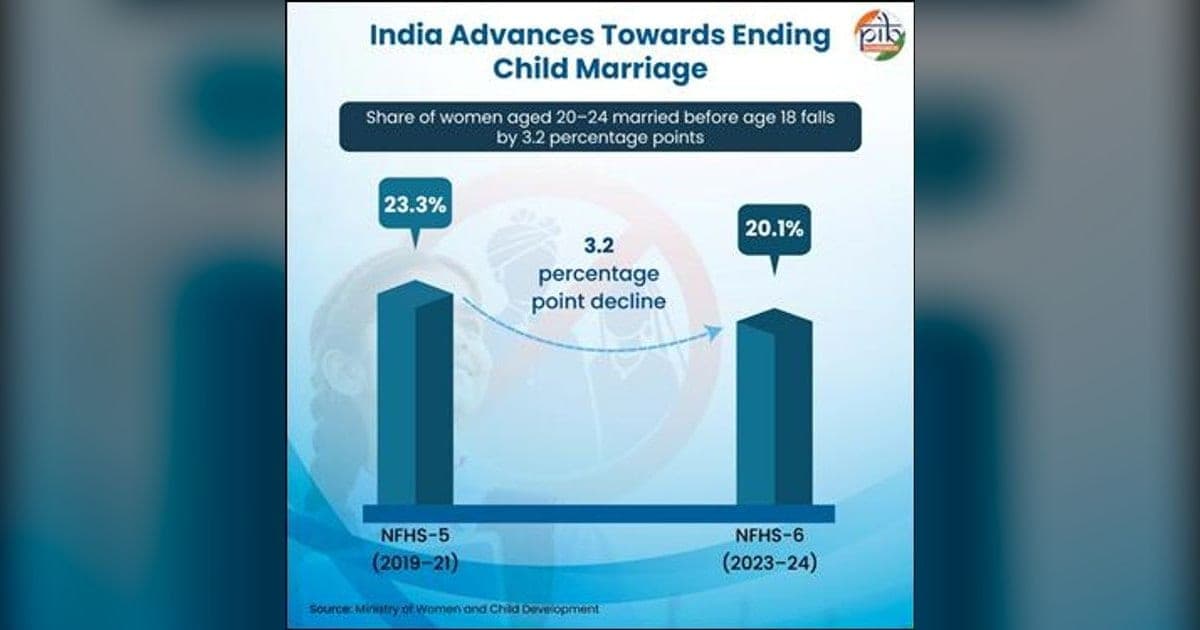
As Bal Vivah Mukt Bharat nears two years, child marriage among women aged 20-24 fell to 20.1% in NFHS-6 from 23.3% in NFHS-5, with a goal of zero by 2030.
Why in News
A PIB backgrounder of 6 November 2026 reviewed two years of the Bal Vivah Mukt Bharat campaign, which marks its National Observance on 27 November 2026, as NFHS-6 showed child marriage prevalence down to 20.1%.
The Bal Vivah Mukt Bharat (BVMB) campaign completes two years on 27 November 2026, the date of its National Observance. A PIB backgrounder released on 6 November 2026 set out what the campaign has done and where child marriage stands. The share of women aged 20–24 who were married before 18 fell from 23.3% in NFHS-5 (2019-21) to 20.1% in NFHS-6 (2023-24), a drop of 3.2 percentage points.
The campaign
The Ministry of Women and Child Development (MWCD) launched BVMB on 27 November 2024. Its goal is a child-marriage-free India by 2030, in line with SDG Target 5.3. The ministry funds it fully and gives priority to 257 high-burden districts, picked from NFHS-5 data as those at or above the national average. The BVMB Portal lists Child Marriage Prohibition Officers (CMPOs), takes reports of child marriages and records pledges.
Two years in numbers
| Measure | Figure |
|---|---|
| Awareness programmes | 6.85 lakh |
| Participants reached | 12.47 crore |
| Pledges | 42.01 lakh (40.96 lakh on portal, 1.05 lakh on MyGov) |
| CMPOs on the portal | 71,882 |
| CMPOs at Gram Panchayat level | 59,686 |
| Incidents recorded | 4,536 |
A 100-Day Intensive Awareness Campaign, launched on 4 December 2025 at Vigyan Bhawan, ran from 27 November 2025 to 8 March 2026 in three spells: schools and colleges first, then faith leaders and marriage service providers, and finally Gram Panchayats and wards.
The legal base
The Prohibition of Child Marriage Act, 2006 replaced the Child Marriage Restraint Act, 1929, known as the Sarda Act. Under it, a child is a male under 21 or a female under 18. Offences are cognizable and non-bailable, with rigorous imprisonment up to two years and/or a fine up to ₹1 lakh; women offenders cannot be jailed. Section 16 lets State Governments appoint CMPOs. In a judgment of 18 October 2024, the Supreme Court laid down a framework that stresses full-time CMPOs and prevention over punishment.
Link with BBBP
Beti Bachao Beti Padhao, launched on 22 January 2015 and now part of Mission Shakti, works on the social attitudes behind early marriage.
State trends
Dadra and Nagar Haveli and Daman and Diu saw the largest fall, of 10.1 percentage points, followed by Andaman and Nicobar Islands (7.4), Assam (6.5), Bihar (6.2) and Tripura (6.1). Twenty-eight States and UTs are better than the national average.
Important Facts
| Campaign | Bal Vivah Mukt Bharat (BVMB) |
|---|---|
| Launched | 27 November 2024 by the Ministry of Women and Child Development |
| Target | Child-marriage-free India by 2030 (SDG Target 5.3) |
| Prevalence (women 20–24 married before 18) | 23.3% in NFHS-5 to 20.1% in NFHS-6 |
| Priority districts | 257 high-burden districts |
| Awareness programmes / reach | 6.85 lakh programmes, 12.47 crore participants |
| Pledges | 42.01 lakh |
| CMPOs on portal | 71,882 (59,686 at Gram Panchayat level) |
| Law | Prohibition of Child Marriage Act, 2006 (replaced Sarda Act, 1929) |
| Legal age | 21 for males, 18 for females |
| Largest fall | Dadra and Nagar Haveli and Daman and Diu, 10.1 percentage points |
| Portal | stopchildmarriage.wcd.gov.in |
Exam Point of View
Remember the launch date (27 November 2024) and ministry (MWCD), the target year (2030) and SDG Target 5.3, NFHS-5 vs NFHS-6 figures (23.3% to 20.1%), 257 high-burden districts, the 2006 Act and the 1929 Sarda Act it replaced, the age limits (21/18), Section 16 on CMPOs, and the top-performing UT.
Practice Questions
The Bal Vivah Mukt Bharat campaign, launched by the Ministry of Women and Child Development, aims to make India child-marriage-free by which year?
- A.2027
- B.2030
- C.2035
- D.2047
Show answer
The Ministry of Women and Child Development launched the Bal Vivah Mukt Bharat campaign on 27 November 2024 with the aim of reducing child marriage and making India child-marriage-free by 2030.
Read the full explanation →According to NFHS-6 (2023-24), what percentage of women aged 20–24 years were married before the age of 18?
- A.26.8 per cent
- B.23.3 per cent
- C.20.1 per cent
- D.17.4 per cent
Show answer
The PIB backgrounder on two years of Bal Vivah Mukt Bharat cites the National Family Health Survey: in NFHS-6, conducted in 2023-24, 20.1 per cent of women aged 20–24 had been married before they turned 18.
Read the full explanation →The Prohibition of Child Marriage Act, 2006 replaced which earlier law?
- A.Child Marriage Restraint Act, 1929
- B.Hindu Marriage Act, 1955
- C.Special Marriage Act, 1954
- D.Dowry Prohibition Act, 1961
Show answer
The Prohibition of Child Marriage Act, 2006 replaced it and changed the legal approach from merely restraining child marriage to prohibiting it, with stronger protection and relief for victims.
Read the full explanation →Which State or Union Territory recorded the largest reduction in child marriage prevalence between NFHS-5 and NFHS-6?
- A.Assam
- B.Bihar
- C.Dadra and Nagar Haveli and Daman and Diu
- D.Andaman and Nicobar Islands
Show answer
The backgrounder on Bal Vivah Mukt Bharat says this Union Territory registered the largest reduction in the prevalence of child marriage between NFHS-5 and NFHS-6, a fall of 10.1 percentage points.
Read the full explanation →Frequently Asked Questions
When was the Bal Vivah Mukt Bharat campaign launched?
On 27 November 2024, by the Ministry of Women and Child Development. It marks two years on 27 November 2026 and aims at a child-marriage-free India by 2030.
What does NFHS-6 show on child marriage?
20.1% of women aged 20–24 were married before 18 in NFHS-6 (2023-24), down from 23.3% in NFHS-5 (2019-21).
Which law governs child marriage in India?
The Prohibition of Child Marriage Act, 2006, which replaced the Child Marriage Restraint Act, 1929 (Sarda Act). Section 16 empowers State Governments to appoint Child Marriage Prohibition Officers.
Sources
- https://www.pib.gov.in/PressReleasePage.aspx?PRID=2333696 (opens in a new tab) — Press Information Bureau
Current Affairs 6 November 2026
- NFDB 13th Governing Body Meet in Hyderabad Chaired by Lalan SinghEconomy
- IAF SDI Signs MoA with IIT Madras for Secure Airborne CommunicationDefence
- GRSE Delivers 'Amini' ASW Shallow Water Craft to Indian NavyDefence
- Tiger Triumph 2026: India-US HADR Exercise Ends at VisakhapatnamDefence
- Rahat Mitra: First India-Myanmar Tri-Services HADR Exercise BeginsDefence
- First BIMSTEC Maritime Security Exercise Ends at Sri Vijaya PuramDefence
- GRAP Stage-III Invoked in Delhi-NCR as AQI Hits 382Environment
- I-STEM and Startup India Portals Linked Through API IntegrationScience & Technology
Related Current Affairs
- Government Schemes
Special Campaign 6: Record ₹970.33 Crore From Scrap Disposal
6 November 2026 · 2 min read
- Government Schemes
DLC Campaign 5: 40 Lakh Life Certificates in 5 Days, Face Auth at 80%
6 November 2026 · 2 min read

Related GK
- Allahabad High Court, UPPSC and UP State Commissions
24 October 2026 · Uttar Pradesh
- Madhya Pradesh High Court, MPPSC and State Commissions
24 October 2026 · Madhya Pradesh
- Article 21: Right to Life, Case Laws and Exam Facts
24 October 2026 · Indian Polity
Take the Quiz
- Current Affairs Quiz
SSC CGL Current Affairs Quiz: 6 November 2026
25 questions25 minutesStart Quiz