
ARIES Study Explains High-Frequency QPOs Near Spinning Black Holes
Scientists at ARIES, an autonomous institute of DST, have shown how a black hole’s spin shapes the frequency of quasi-periodic oscillations in its accretion flow.
Why in News
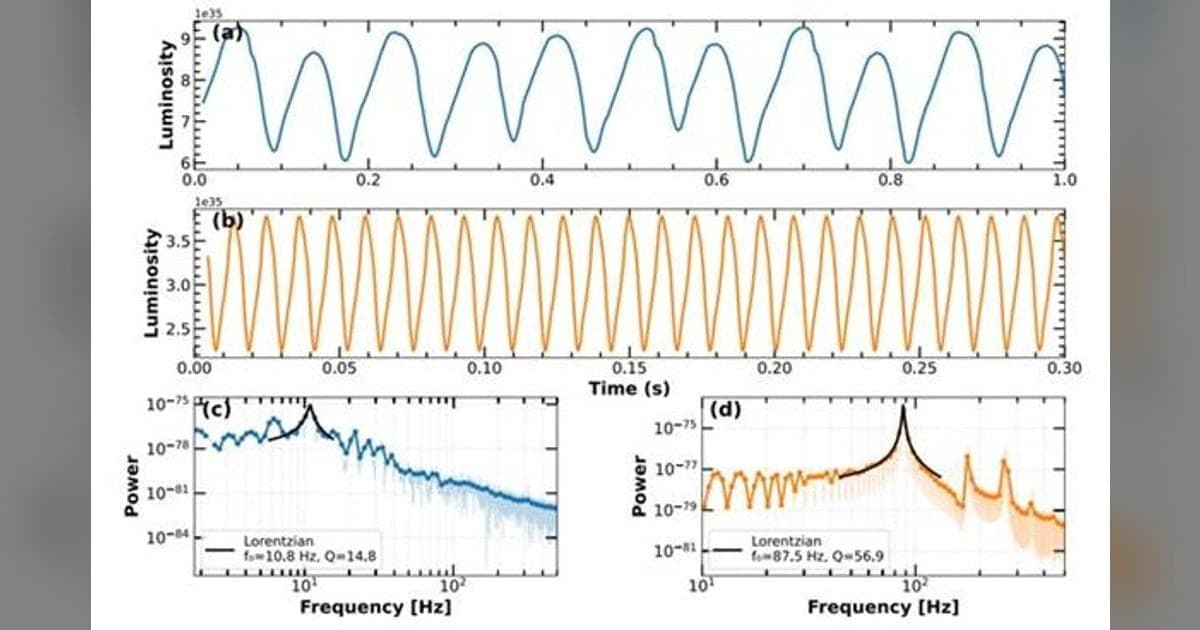
On 23 October 2026 the Ministry of Science and Technology announced that ARIES scientists had uncovered the mechanism by which a black hole’s spin determines the frequency of quasi-periodic oscillations in the X-rays from its accretion disc.
Astronomers at the Aryabhatta Research Institute of Observational Sciences (ARIES), an autonomous institute of the Department of Science and Technology (DST), have identified a single physical mechanism that can explain why matter swirling around a fast-spinning black hole gives off sharply flickering X-rays. The work narrows down the guesswork in theoretical models of these objects.
The science in brief
A black hole is the most compact object known, with gravity so strong that light cannot escape, and it can spin about its axis. Matter dragged towards it forms an accretion flow that falls inward at high speed and gives off non-thermal radiation. The brightness of that radiation varies in an almost regular rhythm, and these variations are called quasi-periodic oscillations (QPOs). In black hole X-ray binaries, QPOs range from less than one cycle a second to several hundred cycles a second. Earlier studies could account for the slow oscillations or had to bring in exotic processes for the fast ones.
How the study was done
The team used a computer simulation built by the Numerical and Theoretical Astrophysics Group at ARIES to model viscous accretion flows, conserving energy, mass and momentum as the matter moves. The work was led by Mr Sanit Debnath and Dr Indranil Chattopadhyay of ARIES, with scientists from the Nicolaus Copernicus Astronomical Center in Poland and MJP Rohilkhand University, Bareilly. The findings appeared in the Journal of High Energy Astrophysics (JHEAP).
What they found
Once the viscosity of the accretion flow rises above a critical value, the normally steady shock in the disc turns unstable and begins to oscillate, and that oscillation shows up as the flickering light observed as QPOs. The spin matters a great deal. Around a slowly spinning black hole, viscosity pushes the average position of the oscillating shock outward, so mostly low-frequency QPOs appear. Around a rapidly spinning one, the shock is pulled closer in and QPOs cover a far wider band; for very high spin the predicted frequencies can exceed 100 Hz for a black hole of about ten solar masses, matching the fast variations seen in X-ray binaries. The study also found a clear link between QPO frequency and the photon index. The researchers call it the first numerical study to simulate an accretion flow with internal friction while using the thermodynamic relations of a relativistic fluid.
Important Facts
| Institute | Aryabhatta Research Institute of Observational Sciences (ARIES) |
|---|---|
| Parent body | Department of Science and Technology (DST), Government of India |
| Subject | Effect of black hole spin on quasi-periodic oscillations (QPOs) |
| Led by | Mr Sanit Debnath and Dr Indranil Chattopadhyay |
| Partners | Nicolaus Copernicus Astronomical Center, Poland, and MJP Rohilkhand University, Bareilly |
| Published in | Journal of High Energy Astrophysics (JHEAP) |
| Key result | QPO frequencies can exceed 100 Hz for a rapidly spinning black hole of about ten solar masses |
Exam Point of View
Remember ARIES (Aryabhatta Research Institute of Observational Sciences) as an autonomous institute of the Department of Science and Technology, the full form of QPO (quasi-periodic oscillation), the journal (Journal of High Energy Astrophysics), the researchers (Sanit Debnath and Indranil Chattopadhyay) and the partner institutions in Poland and at MJP Rohilkhand University, Bareilly.
Practice Questions
The study on the effect of black hole spin on quasi-periodic oscillations was led by scientists of which institute?
- A.Indian Institute of Astrophysics, Bengaluru
- B.Aryabhatta Research Institute of Observational Sciences (ARIES)
- C.Physical Research Laboratory, Ahmedabad
- D.Inter-University Centre for Astronomy and Astrophysics, Pune
Show answer
Its Numerical and Theoretical Astrophysics Group built the computer simulation of viscous accretion flows used in the work, which was led by Mr Sanit Debnath and Dr Indranil Chattopadhyay, with scientists from the Nicolaus Copernicus Astronomical Center in Poland and MJP Rohilkhand University, Bareilly.
Read the full explanation →In the context of black hole research, QPO stands for:
- A.Quantum Photon Oscillation
- B.Quasi-Periodic Oscillation
- C.Quadrupole Phase Orbit
- D.Quasar Polar Outflow
Show answer
Matter pulled towards a black hole forms an accretion flow that falls inward at high speed and emits non-thermal radiation, and the brightness of that radiation shows nearly regular variations known as quasi-periodic oscillations.
Read the full explanation →According to the ARIES study, what happens to the shock in the accretion disc when a black hole spins rapidly?
- A.It is pushed farther from the black hole, giving only low-frequency QPOs
- B.It is pulled closer to the black hole, producing QPOs over a wider range of frequencies
- C.It disappears completely and no QPOs are produced
- D.It becomes permanently stable and stops oscillating
Show answer
The simulations showed that as spin increases, the oscillating shock moves inward and its oscillations grow more pronounced, so the predicted frequencies can exceed 100 Hz for a black hole of about ten solar masses, which matches the fast variations observed in black hole X-ray binary systems.
Read the full explanation →Frequently Asked Questions
What are quasi-periodic oscillations (QPOs)?
They are nearly regular variations in the brightness of radiation emitted by matter falling into a black hole. In black hole X-ray binaries they range from less than one cycle a second to several hundred cycles a second.
Which institute carried out the study on black hole spin and QPOs?
The Aryabhatta Research Institute of Observational Sciences (ARIES), an autonomous institute of the Department of Science and Technology, with partners from Poland and MJP Rohilkhand University, Bareilly.
Why does black hole spin matter for QPOs?
Around a slowly spinning black hole, viscosity pushes the oscillating shock outward and mainly low-frequency QPOs appear. A rapidly spinning black hole pulls the shock inward, producing QPOs over a much wider range of frequencies.
Sources
- https://pib.gov.in/PressReleasePage.aspx?PRID=2327410 (opens in a new tab) — Press Information Bureau
Current Affairs 23 October 2026
- AgriVoltaics World Conference 2026 Meets in New DelhiEnvironment
- Ameena Nazreen Wins Global Youth Institute Award in USAAwards & Honours
- Indo-Pacific Regional Dialogue 2026 to Be Held in New DelhiDefence
- PLFS Sampling Design to Change from January 2027: NSOReports & Indices
- C-DOT Opens Sixth Centre of Excellence at IIT (BHU) VaranasiScience & Technology
- C-DAC and Bank of India Sign Quantum Banking MoUBanking & Finance
- PM Modi Opens Chinmaya Amrit Mahotsav Global SammelanNational
- Special Campaign 6: Textiles, Jal Shakti Report ProgressNational
Related Current Affairs
- Science & Technology
C-DOT Opens Sixth Centre of Excellence at IIT (BHU) Varanasi
23 October 2026 · 2 min read
- Science & Technology
SAEINDIA to Host 23rd APAC Mobility Conference in New Delhi
22 October 2026 · 2 min read
- Science & Technology
RRI Study Finds Accretion Disk Around Pulsar Centaurus X-3
21 October 2026 · 2 min read
- Science & Technology
MoES-AcSIR MoU: 10 Earth Science Institutes to Award PhDs
19 October 2026 · 2 min read
- Science & Technology
Kufri Jamunia: ICAR-CPRI's Biofortified Purple Potato
18 October 2026 · 2 min read


Related GK
- MP Governor, CM and Vidhan Sabha: Articles and Facts
23 October 2026 · Madhya Pradesh
- Haryana Sports and Sportspersons: Medals and Facts
23 October 2026 · Haryana
- Bihar Governor, CM and Legislature: Articles and Facts
23 October 2026 · Bihar
Take the Quiz
- Current Affairs Quiz
Defence Current Affairs Quiz: 23 October 2026
12 questions12 minutesStart Quiz