
Kufri Jamunia: ICAR-CPRI's Biofortified Purple Potato
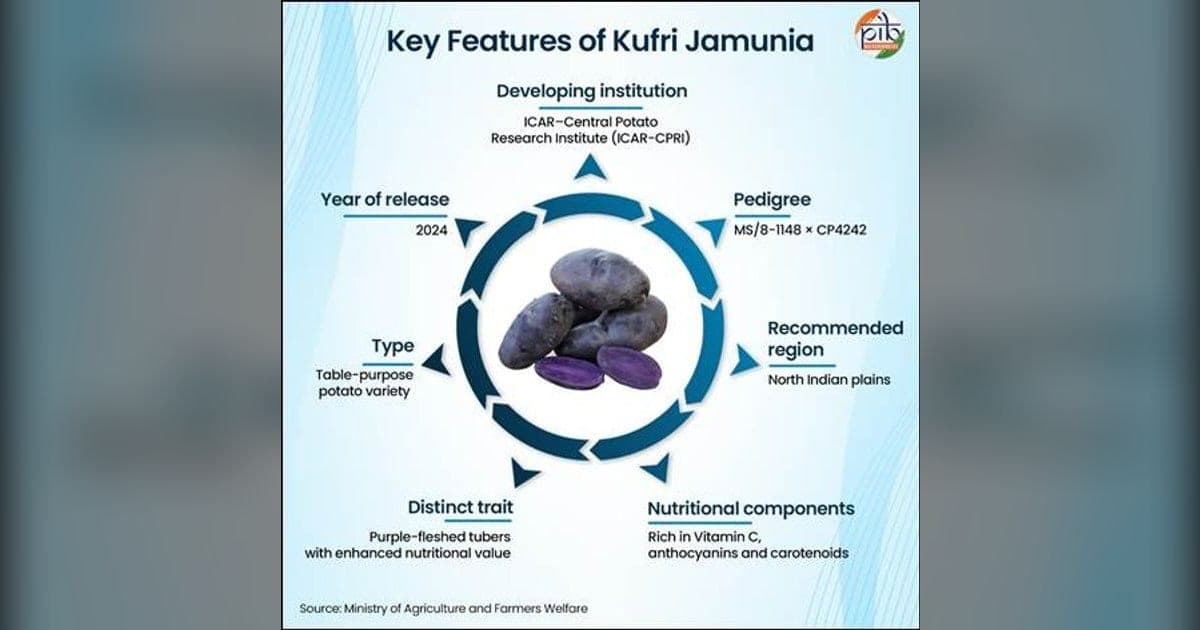
Kufri Jamunia, the purple-fleshed biofortified potato released by ICAR-CPRI in 2024, carries 42.75 mg Vitamin C per 100 g against 23.15 mg in common potato.
Why in News
A PIB backgrounder of 18 October 2026 profiled Kufri Jamunia, the biofortified purple-fleshed potato released by ICAR-CPRI in 2024, as an answer to hidden hunger because of its high Vitamin C, anthocyanin, carotenoid, zinc and iron content.
India's potato basket has a purple entrant worth remembering. Kufri Jamunia, bred by the ICAR-Central Potato Research Institute (ICAR-CPRI), was placed before growers in 2024 and stands at the top of the institute's coloured potatoes on nutrition. A Press Information Bureau backgrounder put out on 18 October 2026 set out what the tuber carries and where it can be grown.
Why a coloured potato at all
The target is hidden hunger: plates that fill the stomach yet leave vitamins and minerals short. One answer is biofortification, which raises a crop's nutrient content through plant breeding rather than adding nutrients during processing, the way ordinary food fortification does. The nutrition therefore travels inside the tuber itself, which keeps the method cheap to sustain once seed reaches a farmer's hands. Natural pigments such as anthocyanins and carotenoids give coloured tubers their red, purple and blue flesh, and those same pigments work as antioxidants, alongside micronutrients like iron and zinc.
Three coloured varieties from ICAR-CPRI
Kufri Neelkanth, cleared in 2018, was the institute's first purple-skinned specialty potato and is grown in Punjab, Haryana, Uttar Pradesh, Uttarakhand, Bihar, Madhya Pradesh and Chhattisgarh. Kufri Manik arrived in 2021, its round deep-red tubers holding yellow flesh rich in anthocyanin, zinc and iron. Kufri Jamunia of 2024 outscores both on ascorbic acid, anthocyanin and carotenoids.
The tuber and the yield
This is a medium-maturing variety with medium-tall plants and a semi-compact canopy. Every plant lifts 10-12 medium to large tubers: oblong, shallow-eyed, dark purple on the skin, purple in the flesh and mealy to the bite. Growers who follow the recommended package can expect 32-35 tonnes a hectare, while station trials of 90 days duration recorded close to 49 tonnes. Nearly 90% of the produce in those trials was marketable, and dormancy of 6-8 weeks keeps the tubers from sprouting early, with little rottage or weight loss in store.
How the nutrition compares
| Nutrient (per 100 g) | Kufri Jamunia | Common potato |
| Vitamin C | 42.75 mg | 23.15 mg |
| Zinc | 2.28 mg | 0.28 mg |
| Iron | 3.22 mg | 0.57 mg |
In the kitchen and in the field
The flesh holds 42.05 mg of anthocyanins per 100 g and the skin 80.66 mg, with carotenoids near 161 micrograms per 100 g of fresh weight, about 22.77 ppm zinc and 32.23 ppm iron. Multi-location trials were steady enough for the variety to be recommended for the North Indian plains. Cooks can use it for curry, paratha, puri and raita, in daliya, halwa, upma, dosa and idli batter, and as potato flour for bakery goods, soups and cookies; the tubers also dehydrate into anthocyanin-rich daliya, suji and flour.
Important Facts
| Variety | Kufri Jamunia, biofortified purple-fleshed potato |
|---|---|
| Developed by | ICAR-Central Potato Research Institute (ICAR-CPRI) |
| Released | 2024 |
| Vitamin C | 42.75 mg per 100 g in flesh, against 23.15 mg in common potato |
| Anthocyanins | 42.05 mg per 100 g in flesh, 80.66 mg per 100 g in skin |
| Zinc and iron | 22.77 ppm zinc and 32.23 ppm iron in the flesh |
| Yield | 32-35 tonnes per hectare; about 49 tonnes in 90-day station trials |
| Dormancy | 6-8 weeks, so tubers do not sprout quickly |
| Recommended for | North Indian plains |
| Earlier coloured varieties | Kufri Neelkanth (2018) and Kufri Manik (2021) |
Exam Point of View
Fix the variety name with its institute and release year (Kufri Jamunia, ICAR-CPRI, 2024), the two earlier coloured potatoes with their years (Kufri Neelkanth 2018, Kufri Manik 2021), the Vitamin C figure of 42.75 mg per 100 g against 23.15 mg in common potato, the 32-35 tonnes per hectare yield, and the difference between biofortification and food fortification.
Practice Questions
In which year was the biofortified purple-fleshed potato variety Kufri Jamunia officially released?
- A.2018
- B.2021
- C.2024
- D.2026
Show answer
Kufri Jamunia, the purple-fleshed biofortified potato developed by the ICAR-Central Potato Research Institute, was officially released in that year, and it carries higher ascorbic acid, anthocyanin and carotenoid levels than the institute's two earlier coloured varieties.
Read the full explanation →How much Vitamin C does the flesh of Kufri Jamunia contain per 100 grams?
- A.23.15 mg
- B.32.23 mg
- C.42.75 mg
- D.80.66 mg
Show answer
The flesh of Kufri Jamunia holds that much Vitamin C, or ascorbic acid, in every 100 grams, which is nearly double what a conventional yellow-skinned potato offers.
Read the full explanation →What yield does Kufri Jamunia give under recommended cultivation practices?
- A.12-15 tonnes per hectare
- B.22-25 tonnes per hectare
- C.32-35 tonnes per hectare
- D.52-55 tonnes per hectare
Show answer
That is the yield the variety returns when the recommended package of practices is followed, and nearly 90% of what is produced in trials proved marketable.
Read the full explanation →Frequently Asked Questions
What is Kufri Jamunia?
It is a biofortified potato variety with dark purple skin and purple flesh, developed by ICAR-CPRI and released in 2024. It carries higher ascorbic acid, anthocyanin and carotenoid levels than Kufri Manik and Kufri Neelkanth, along with extra zinc and iron.
How does biofortification differ from food fortification?
Biofortification raises the nutrient content of a crop through plant breeding, so the nutrition is built into the grain or tuber itself. Food fortification adds nutrients during processing instead, which makes biofortification the more sustainable and cost-effective route.
How much does Kufri Jamunia yield?
It gives 32-35 tonnes per hectare under recommended cultivation practices, and station trials of 90 days duration recorded about 49 tonnes per hectare. Nearly 90% of the produce in trials was marketable.
Which other coloured potato varieties has ICAR-CPRI developed?
Kufri Neelkanth, released in 2018, was its first purple-skinned specialty potato and is grown in states such as Punjab, Haryana, Uttar Pradesh and Bihar. Kufri Manik, released in 2021, has deep red tubers with yellow flesh.
Sources
- भारत का पोषक तत्वों से भरपूर बैंगनी आलू (opens in a new tab) — Press Information Bureau
Current Affairs 18 October 2026
- Rajnath Singh to Lead India at 25th SCO CHG MeetingInternational
- STPI Tech Conclave at IIT BHU Puts AI to Work in Health CareScience & Technology
- DRI Seizes 137 kg Crystal Meth in NagapattinamNational
- Pithoragarh Coldwater Fisheries Cluster Gets PMMSY PushGovernment Schemes
Related Current Affairs
- Science & Technology
STPI Tech Conclave at IIT BHU Puts AI to Work in Health Care
18 October 2026 · 2 min read
- Science & Technology
India Eyes USD 40-45 Billion Space Economy in 7-8 Years
17 October 2026 · 2 min read
- Science & Technology
BSIP Study Reconstructs 4,600 Years of Monsoon History
16 October 2026 · 2 min read
- Science & Technology
Indian Scientists Identify Martian Analogue Sites in Tamil Nadu
16 October 2026 · 2 min read
- Science & Technology
TDB Signs Rs 150 Crore Quantum Security Deal With QNu Labs
16 October 2026 · 2 min read
- Science & Technology
BHASHINI and IISc Build Sourashtra Text-to-Speech Models
16 October 2026 · 2 min read



Related GK
- 1857 and the Freedom Struggle in Madhya Pradesh
18 October 2026 · Madhya Pradesh
- Medieval and Modern History of Haryana for Exams
18 October 2026 · Haryana
- Battles of Panipat and Tarain: Years and Winners
18 October 2026 · Haryana
Take the Quiz
- Current Affairs Quiz
State Exams Current Affairs Quiz: 18 October 2026
15 questions15 minutesStart Quiz