
Aditya-L1 VELC Finds Solar Eruption Expands Asymmetrically
Aditya-L1's VELC payload has shown for the first time that a coronal mass ejection expands unevenly and takes an asymmetric shape, not as a round bubble.
Why in News
On 3 November 2026 the Ministry of Science and Technology announced that the VELC payload on Aditya-L1 has revealed, for the first time, the asymmetric expansion of a coronal mass ejection, a finding with consequences for space-weather forecasting.
Data from the Visible Emission Line Coronagraph (VELC) aboard Aditya-L1, India's first space-based solar observatory, has shown for the first time that a solar eruption does not swell outward from the Sun as a neat symmetric bubble. Instead the eruption expands unevenly and takes on an asymmetric shape. The Ministry of Science and Technology announced the finding on 3 November 2026.
The spacecraft and its payload
Aditya-L1 was launched in September 2023 and now works from the Sun-Earth L1 point, from where it watches the Sun without a break. It carries 7 payloads, and VELC is the primary one. VELC is an internally occulted coronagraph, an instrument that blocks the bright solar disk so that the far fainter corona around it can be studied, and it can observe the corona in several modes at once.
What the study found
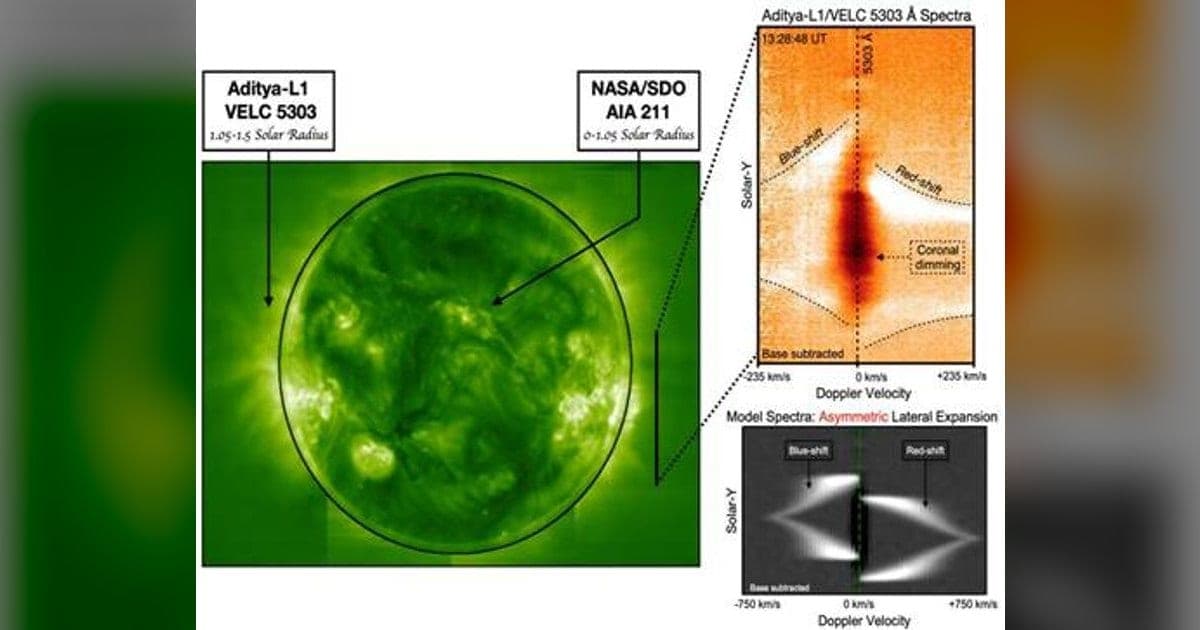
Scientists of the Indian Institute of Astrophysics (IIA), an autonomous institution of the Department of Science and Technology, combined VELC data with observations from the Atmospheric Imaging Assembly on NASA's Solar Dynamics Observatory (SDO) and with three-dimensional modelling to rebuild the full geometry and motion of a coronal mass ejection (CME). The CME studied erupted on 5 August 2024 from an active region near the Sun's western limb. Their results have been published in Astrophysical Journal Letters.
- VELC's spectra showed emission shifted both towards shorter and towards longer wavelengths, the signature of plasma moving towards and away from the observer at the same time.
- The SDO images traced how the CME moved across the sky, while VELC revealed its motion along the line of sight.
- A model assuming symmetric expansion could not reproduce what VELC saw; only a model with an inclined CME axis and uneven sideways expansion matched the data.
Why it matters for space weather
An uneven early shape changes how a CME meets the solar wind and how much drag it feels while crossing the heliosphere, which alters its speed and therefore when it reaches Earth. Better forecasts matter because such disturbances affect satellites and communication networks.
How VELC works
VELC studies young CMEs by spectroscopy in the green emission line at 530.3 nm, produced by highly ionised iron atoms in the corona. That line comes from hot coronal plasma at about 1.8 million Kelvin, and the Doppler shift of the line gives the plasma's velocity along the line of sight, close to the solar disk. The instrument was designed and fabricated by the IIA at its MGK Menon Lab for Space Sciences on the CREST campus at Hosakote, with substantial support from ISRO. The team now plans to apply the technique to other CMEs, which would let them reconstruct a CME's motion without depending wholly on imaging from more than one vantage point in space.
Saurabh Tripathi, a PhD student at IIA, is the lead author; Tanmoy Samanta, a solar astronomer at IIA, is the corresponding author; and Jayant Joshi of IIA is a co-author.
Important Facts
| Spacecraft | Aditya-L1, India's first space-based solar observatory |
|---|---|
| Launched | September 2023 |
| Station | Sun-Earth L1 point |
| Payloads | 7, with VELC as the primary payload |
| Primary payload | Visible Emission Line Coronagraph (VELC), an internally occulted coronagraph |
| Wavelength studied | 530.3 nm green emission line of highly ionised iron |
| Built by | Indian Institute of Astrophysics at MGK Menon Lab, CREST campus, Hosakote, with ISRO support |
| CME observed | The eruption of 5 August 2024, with NASA SDO data |
| Published in | Astrophysical Journal Letters |
| Finding | First evidence that a CME expands non-uniformly and becomes asymmetric |
Exam Point of View
Remember that Aditya-L1 is India's first space-based solar observatory, launched in September 2023 and stationed at the Sun-Earth L1 point with 7 payloads; that VELC is its primary payload and an internally occulted coronagraph working at 530.3 nm; that the Indian Institute of Astrophysics under the DST built it with ISRO support at Hosakote; and that the study used the CME of 5 August 2024 with NASA's SDO and appeared in Astrophysical Journal Letters.
Practice Questions
Which is the primary payload of India's Aditya-L1 solar observatory?
- A.Solar Ultraviolet Imaging Telescope
- B.Visible Emission Line Coronagraph
- C.Atmospheric Imaging Assembly
- D.Plasma Analyser Package
Show answer
Aditya-L1, India's first space-based solar observatory, carries seven payloads, and VELC is described as the primary one.
Read the full explanation →What did the VELC observations reveal about the coronal mass ejection, for the first time?
- A.That it expanded as a perfectly symmetric bubble
- B.That it expanded non-uniformly and became asymmetric
- C.That it did not move towards the Earth at all
- D.That it carried no ionised iron
Show answer
Until this study a coronal mass ejection was thought to swell outward from the Sun like a simple symmetric bubble; the VELC spectra, read together with imaging from NASA's Solar Dynamics Observatory and a three-dimensional model, showed that the expansion was uneven.
Read the full explanation →Which institution designed and fabricated the VELC payload of Aditya-L1?
- A.Physical Research Laboratory, Ahmedabad
- B.Indian Institute of Astrophysics
- C.Tata Institute of Fundamental Research
- D.Inter-University Centre for Astronomy and Astrophysics
Show answer
The coronagraph was designed and fabricated at the institute's MGK Menon Lab for Space Sciences on the CREST campus at Hosakote, with substantial support from ISRO, and the scientists who carried out this study also belong to the IIA: the lead author is Saurabh Tripathi, a research student there, the…
Read the full explanation →In which journal was the study on asymmetric expansion of the solar eruption published?
- A.Nature Astronomy
- B.Astrophysical Journal Letters
- C.Current Science
- D.Monthly Notices of the Royal Astronomical Society
Show answer
The paper reporting that the coronal mass ejection did not expand as a symmetric bubble appeared in that journal, and it was based on the eruption that occurred on 5 August 2024, observed from an active region near the western limb of the Sun.
Read the full explanation →Frequently Asked Questions
What has VELC on Aditya-L1 discovered?
That a coronal mass ejection does not expand outward as a simple symmetric bubble. It expands non-uniformly and develops an asymmetric shape, which can change its speed and its arrival time at Earth.
What is VELC and who built it?
The Visible Emission Line Coronagraph, the primary payload of Aditya-L1 and an internally occulted coronagraph. It was designed and fabricated by the Indian Institute of Astrophysics at its MGK Menon Lab on the CREST campus at Hosakote, with substantial support from ISRO.
Which eruption did the scientists study, and where was the work published?
The coronal mass ejection of 5 August 2024, observed with VELC and with NASA's Solar Dynamics Observatory. The study was published in Astrophysical Journal Letters.
Sources
- https://www.pib.gov.in/PressReleasePage.aspx?PRID=2331935 (opens in a new tab) — Press Information Bureau
Current Affairs 3 November 2026
- Indian Navy Frees Hijacked Fishing Vessel Azini Off SomaliaDefence
- Health Ministry Proposes New Import Gateways for DrugsNational
- PM Modi Opens Pune Metro Hinjawadi-Shivajinagar LineNational
- TRAI Issues Telecom Interconnection Third Amendment Rules 2026National
- Exercise Tiger Triumph 2026 Opens at VisakhapatnamDefence
- Rajnath Singh Chairs Defence Modernisation Meet in JaisalmerDefence
- India Sets USD 1 Trillion Export Target for Current YearEconomy
Related Current Affairs
- Science & Technology
NVS-03 Completes First Orbit Manoeuvre of NavIC Mission
1 November 2026 · 2 min read
- Science & Technology
India's New-Age Space Technologies: NGLV, SpaDeX, NavIC
28 October 2026 · 2 min read


Related GK
- Maps, Map Projections and Remote Sensing for Exams
12 October 2026 · Geography
- Satellite Orbits and Space Debris: LEO, GEO, SSO and Kessler
11 October 2026 · Science & Technology
- Research Institutes of India and Their Locations
11 October 2026 · Static GK
Take the Quiz
- Current Affairs Quiz
Defence Current Affairs Quiz: 3 November 2026
15 questions15 minutesStart Quiz