
NVS-03 Completes First Orbit Manoeuvre of NavIC Mission
ISRO's NVS-03, the third second-generation NavIC satellite, finished its first orbit-raising burn on 31 October 2026 and is headed for 111.75 degrees East.
Why in News
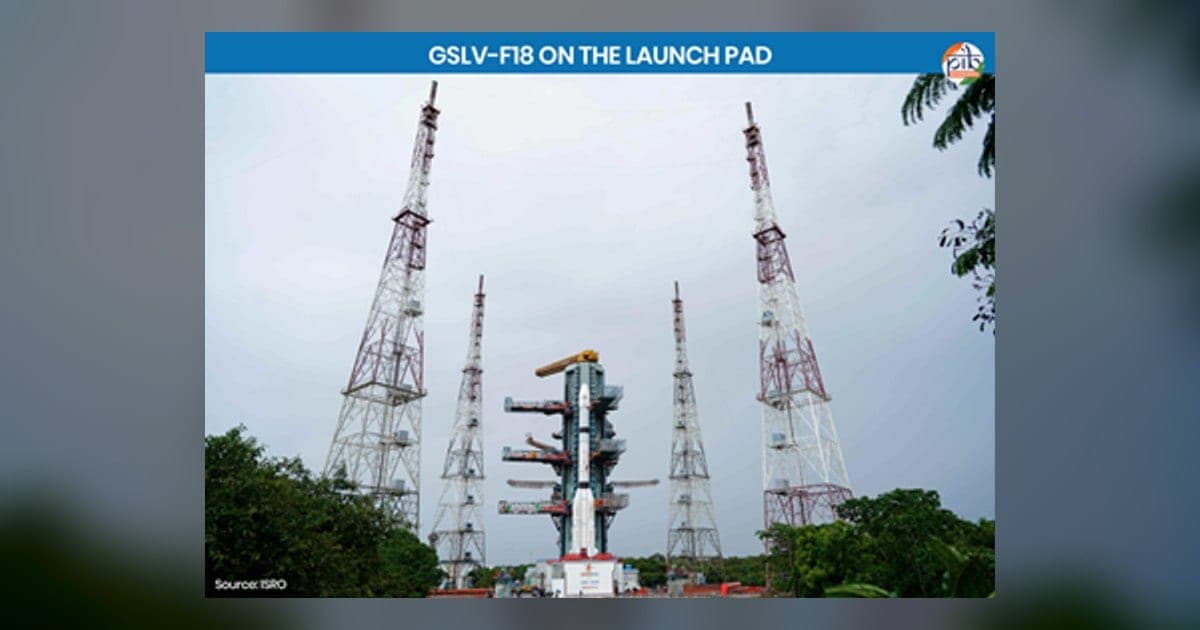
NVS-03, the third second-generation NavIC satellite, completed its first orbit-raising manoeuvre on 31 October 2026 after its launch on GSLV-F18 on 30 October 2026, and is being shifted towards a geosynchronous slot at 111.75 degrees East.
India's own navigation constellation has gained another spacecraft. The Indian Space Research Organisation (ISRO) carried out the GSLV-F18/NVS-03 flight late on 30 October 2026, lifting off at 23:51 hours from the Satish Dhawan Space Centre at Sriharikota. The satellite has since begun climbing towards the orbit it will work from.
From transfer orbit to its slot
The rocket left NVS-03 in a Geosynchronous Transfer Orbit. Such a path is elliptical: its nearest point to Earth is low, while the farthest point of a standard transfer orbit sits roughly 35,786 km above the surface. Lifting a spacecraft out of that ellipse is the work of an apogee motor, and on this satellite the task fell to a Liquid Apogee Motor, a chemical rocket engine. The first of those burns was finished on 31 October 2026 at 16:48 hours. Further manoeuvres are planned before the satellite settles into the slot set aside for it at 111.75 degrees East.
Why this satellite matters
NVS-03 is the third member of a five-satellite second-generation series running from NVS-01 to NVS-05, built to renew and widen NavIC. The flight was also the 20th mission of the Geosynchronous Satellite Launch Vehicle. The spacecraft broadcasts on the L1, L5 and S bands, and putting L1 alongside the older L5 and S pair widens the range of receivers able to use the service. It carries an atomic clock built in India together with bought-in clocks; precise timekeeping is what lets a receiver turn signal travel time into a position on the ground.
NavIC in brief
NavIC, once called the Indian Regional Navigation Satellite System, supplies position, navigation and timing data over the country and about 1,500 km past its boundary. The original design used seven satellites, three of them in geostationary orbit and four in inclined geosynchronous orbit, backed by ground stations working round the clock. Two grades of service are offered. The open Standard Positioning Service serves ordinary users and works alongside GPS, Glonass, Galileo and BeiDou signals; the encrypted Restricted Service is kept for authorised strategic users.
The launch vehicle
GSLV is a three-stage rocket whose distinguishing feature is an Indian-built cryogenic upper stage burning liquid hydrogen with liquid oxygen, which took the place of the Russian-supplied stage flown on earlier missions. Its strap-on boosters, known as the L-40, run on liquid propellant. This vehicle stood roughly 50 metres tall, weighed about 420 tonnes at lift-off, carried a metallic payload fairing 3.4 metres across and a satellite of around 2,250 kg.
Important Facts
| Mission | GSLV-F18 / NVS-03 |
|---|---|
| Launch | 30 October 2026 at 23:51 hours |
| Launch site | Satish Dhawan Space Centre, Sriharikota |
| First orbit manoeuvre | 31 October 2026 at 16:48 hours |
| Target orbital slot | 111.75 degrees East |
| Place in series | Third of five second-generation NavIC satellites |
| GSLV flight number | 20th flight of the GSLV |
| Satellite mass | About 2,250 kg |
| Signal bands | L1, L5 and S |
| Earlier name of NavIC | Indian Regional Navigation Satellite System (IRNSS) |
| Coverage | India and about 1,500 km beyond its boundary |
| Services | Standard Positioning Service (open) and Restricted Service (encrypted) |
Exam Point of View
Fix the mission name (GSLV-F18/NVS-03), the launch date and site, the fact that it was the 20th GSLV flight, the slot at 111.75 degrees East, the L1, L5 and S bands, NavIC’s older name IRNSS, its reach of about 1,500 km beyond India, the original seven-satellite design of three geostationary and four inclined geosynchronous satellites, and the two services, SPS and RS.
Practice Questions
From which launch centre was the GSLV-F18/NVS-03 mission flown?
- A.Vikram Sarabhai Space Centre, Thiruvananthapuram
- B.Satish Dhawan Space Centre, Sriharikota
- C.U R Rao Satellite Centre, Bengaluru
- D.Space Applications Centre, Ahmedabad
Show answer
The navigation satellite NVS-03 rode to orbit on the GSLV-F18 vehicle, which lifted off from Sriharikota on 30 October 2026 at 23:51 hours, and the rocket placed the spacecraft in a Geosynchronous Transfer Orbit as intended.
Read the full explanation →NVS-03 is which satellite of the second-generation NavIC series?
- A.First
- B.Second
- C.Third
- D.Fifth
Show answer
The second-generation series of navigation satellites runs from NVS-01 to NVS-05, and NVS-03 is the third of those five spacecraft to be launched.
Read the full explanation →At which orbital slot is NVS-03 to be stationed?
- A.83 degrees East
- B.93.5 degrees East
- C.111.75 degrees East
- D.55 degrees East
Show answer
After the launch vehicle released NVS-03 into a Geosynchronous Transfer Orbit, the spacecraft began a series of burns meant to lift it into its working geosynchronous position, and the slot assigned to it is 111.75 degrees East.
Read the full explanation →In which frequency bands does NVS-03 carry its navigation payloads?
- A.L1 and L5 only
- B.L5 and S only
- C.L1, L5 and S
- D.L1 and S only
Show answer
The navigation payloads aboard NVS-03 transmit in all three of these bands, and the addition of the L1 signal to the legacy L5 and S signals is one of the gains the second-generation series brings to NavIC.
Read the full explanation →Frequently Asked Questions
Which satellite did GSLV-F18 carry and when was it launched?
GSLV-F18 carried NVS-03, launched on 30 October 2026 at 23:51 hours from the Satish Dhawan Space Centre, Sriharikota. It is the third satellite of the second-generation NavIC series.
What was NavIC called earlier and how far does it reach?
NavIC was earlier known as the Indian Regional Navigation Satellite System (IRNSS). It serves India's landmass and an area reaching about 1,500 km beyond the country's boundary.
Which engine raised NVS-03's orbit and where will the satellite sit?
A Liquid Apogee Motor, a chemical rocket engine, carried out the burn completed on 31 October 2026. Further manoeuvres will place NVS-03 at 111.75 degrees East.
What are the two services NavIC provides?
The Standard Positioning Service is open to civilian users and is interoperable with GPS, Glonass, Galileo and BeiDou. The Restricted Service is encrypted and reserved for authorised strategic users.
Sources
- https://www.pib.gov.in/PressReleasePage.aspx?PRID=2331077 (opens in a new tab) — Press Information Bureau
Current Affairs 1 November 2026
- Coal Imports Decline 5.83% in August 2026 to 104.57 MTEconomy
- INS Trishul Calls at Souda Bay, Greece on Mediterranean TourDefence
- Star Rating Awards for Coal Mines to Be Held at RaipurAwards & Honours
- State Foundation Day Marked by Haryana, Chhattisgarh and MPImportant Days
- PMMSY Projects Worth Rs 375 Lakh for Sikkim FisheriesGovernment Schemes
- National Organ Transplant Games 2026 Opened at Talkatora StadiumNational
Related Current Affairs
- Science & Technology
India's New-Age Space Technologies: NGLV, SpaDeX, NavIC
28 October 2026 · 2 min read
- Science & Technology
India-France Space Ties Widen to Gaganyaan, TRISHNA and Start-ups
28 September 2026 · 2 min read


Related GK
- Maps, Map Projections and Remote Sensing for Exams
12 October 2026 · Geography
- Satellite Orbits and Space Debris: LEO, GEO, SSO and Kessler
11 October 2026 · Science & Technology
- Research Institutes of India and Their Locations
11 October 2026 · Static GK
Take the Quiz
- Current Affairs Quiz
State Exams Current Affairs Quiz: 1 November 2026
24 questions24 minutesStart Quiz