
16th National Meet of Biodiversity Boards Opens in Chandigarh
The National Biodiversity Authority opened the 16th National Meet of State Biodiversity Boards at Chandigarh on 6 September 2026, a two-day meeting on governance.
Why in News
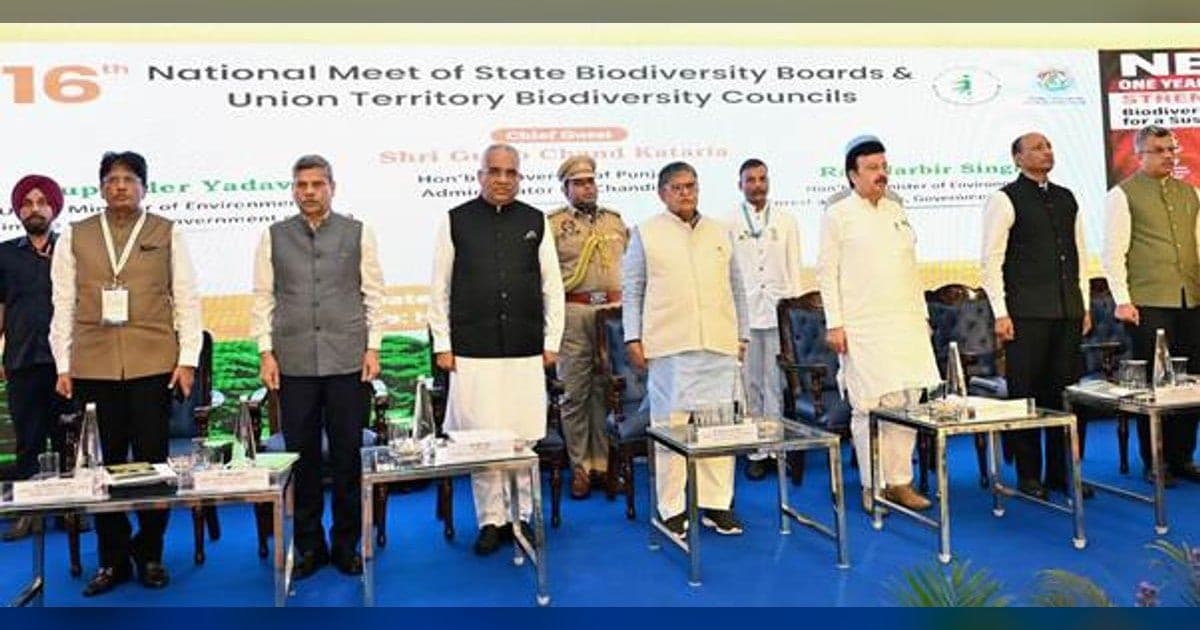
Chandigarh hosted the 16th National Meet of State Biodiversity Boards and Union Territory Biodiversity Councils from 6 September 2026, organised by the National Biodiversity Authority to work on biodiversity governance at State and local levels.
The 16th National Meet of the State Biodiversity Boards and Union Territory Biodiversity Councils opened at Chandigarh on 6 September 2026. The National Biodiversity Authority (NBA) organised it. The meeting runs two days, on 6 and 7 September, and draws chairpersons and member secretaries of the boards and councils from every part of the country.
Who presided
Three leaders presided over the inaugural session. They were Gulab Chand Kataria, Governor of Punjab and Administrator of the Union Territory of Chandigarh; Bhupender Yadav, Union Minister for Environment, Forest and Climate Change; and Rao Narbir Singh, Haryana's Minister for Environment, Forest and Wildlife. Virendra Tiwari is the Chairperson of the National Biodiversity Authority and was present, as were the Ministry's Secretary Tanmay Kumar and Director General of Forests Sushil Kumar Awasthi.
The law behind the meeting
The Governor linked ecological security to food security, water security, livelihoods and sustainable development. He asked for stronger Biodiversity Management Committees and People's Biodiversity Registers. The Union Minister traced the legal frame to the Biological Diversity Act, 2002, and said the Biological Diversity (Amendment) Act, 2023 and the Biological Diversity Rules, 2024 have tightened it further. He urged States and Union Territories to bring their own rules and processes in line with the amended framework.
| Item | Detail |
| Parent law | Biological Diversity Act, 2002 |
| Amendment | Biological Diversity (Amendment) Act, 2023 |
| Rules | Biological Diversity Rules, 2024 |
| Action plan | Updated NBSAP, 2024 to 2030 |
| Global alignment | Kunming-Montreal Global Biodiversity Framework |
| ABS funds shared | Over Rs 200 crore |
Money reaching communities
On Access and Benefit Sharing, the Minister said the National Biodiversity Authority has passed on more than Rs 200 crore of ABS funds. Farmers, local communities, Biodiversity Management Committees, State Biodiversity Boards, Union Territory Biodiversity Councils and research institutions have received the money. He wanted the benefit to be visible to communities and tied to conservation and steady livelihoods. He also asked that the more than 2.76 lakh Biodiversity Management Committees be made to work in practice, and that People's Biodiversity Registers become live planning tools for local bodies.
India's commitments
The Minister noted that India has filed its 7th National Report to the Convention on Biological Diversity and its 1st National Report on the Nagoya Protocol on Access and Benefit Sharing. He spoke of the updated National Biodiversity Strategy and Action Plan for 2024 to 2030, which is aligned with the Kunming-Montreal Global Biodiversity Framework. He asked for measurable results in ecosystem restoration, species and habitat conservation, agro-biodiversity and climate-resilient landscapes, and encouraged States and Union Territories to help meet the global 30-by-30 conservation target. He also recalled Mission LiFE, Ek Ped Maa Ke Naam, Amrit Sarovar and the Green Credit Programme.
Important Facts
| Event | 16th National Meet of State Biodiversity Boards and UT Biodiversity Councils |
|---|---|
| Venue | Chandigarh |
| Dates | 6 and 7 September 2026 |
| Organiser | National Biodiversity Authority (NBA) |
| NBA Chairperson | Virendra Tiwari |
| Presided by | Gulab Chand Kataria, Bhupender Yadav and Rao Narbir Singh |
| Parent law | Biological Diversity Act, 2002 |
| Recent changes | Biological Diversity (Amendment) Act, 2023 and Biological Diversity Rules, 2024 |
| NBSAP period | 2024 to 2030, aligned with the Kunming-Montreal Global Biodiversity Framework |
| ABS funds shared | More than Rs 200 crore |
Exam Point of View
Remember the edition (16th), the host city (Chandigarh), the organiser (National Biodiversity Authority) and its chairperson, the three presiding dignitaries, the parent Act of 2002 with its 2023 amendment and 2024 rules, the NBSAP period of 2024 to 2030, the Kunming-Montreal framework and the Rs 200 crore of ABS funds shared.
Practice Questions
Which city hosted the 16th National Meet of State Biodiversity Boards and Union Territory Biodiversity Councils?
- A.New Delhi
- B.Chandigarh
- C.Panchkula
- D.Jaipur
Show answer
Correct answer: B. Chandigarh
Explanation
The correct answer is Chandigarh. The release states that the 16th National Meet, organised by the National Biodiversity Authority, was inaugurated there and runs for two days, on 6 and 7 September. Option C, Panchkula, is a very strong distractor: the same Union Minister was in Panchkula the same day for International Vulture Awareness Day, and the two towns sit next to each other. Read such releases carefully and tie each event to its own venue. Option A and option D name cities that do not appear in this release at all. It helps to remember who presided over the inaugural session, since that fixes the place in memory: Gulab Chand Kataria, who is Governor of Punjab and Administrator of the Union Territory of Chandigarh, sat alongside Union Environment Minister Bhupender Yadav and Haryana's Environment Minister Rao Narbir Singh.
Which Act is the parent law for biodiversity governance in India?
- A.The Wild Life (Protection) Act, 1972
- B.The Environment (Protection) Act, 1986
- C.The Biological Diversity Act, 2002
- D.The Forest (Conservation) Act, 1980
Show answer
Correct answer: C. The Biological Diversity Act, 2002
Explanation
The correct answer is the Biological Diversity Act, 2002. The Union Minister referred to it as the foundation of the country's biodiversity governance and noted that two later measures have strengthened and streamlined it: the Biological Diversity (Amendment) Act, 2023 and the Biological Diversity Rules, 2024. He asked States and Union Territories to bring their own rules, institutional mechanisms and implementation processes into line with that amended framework, which is the practical purpose of the national meet. Options A, B and D are all genuine environmental statutes, and that is what makes them useful distractors, but none of them creates the structure of the National Biodiversity Authority, the State Biodiversity Boards and the Biodiversity Management Committees. Remember the three dates together as a set: the Act of 2002, the amendment of 2023 and the rules of 2024.
India's updated National Biodiversity Strategy and Action Plan is aligned with which global framework?
- A.The Kunming-Montreal Global Biodiversity Framework
- B.The Aichi Biodiversity Targets
- C.The Sendai Framework
- D.The Ramsar Framework
Show answer
Correct answer: A. The Kunming-Montreal Global Biodiversity Framework
Explanation
The correct answer is the Kunming-Montreal Global Biodiversity Framework. The release says India's updated National Biodiversity Strategy and Action Plan, covering the period from 2024 to 2030, has been aligned with it, and that States and Union Territories were encouraged to become partners in meeting the global 30-by-30 conservation target that flows from it. Option B names the earlier set of global biodiversity targets, which the Kunming-Montreal framework succeeded, so it is the most tempting wrong answer. Option C belongs to disaster risk reduction and option D to the conservation of wetlands, so neither fits. Two related commitments are worth carrying alongside this: India has submitted its 7th National Report to the Convention on Biological Diversity and its 1st National Report on the Nagoya Protocol on Access and Benefit Sharing.
How much in Access and Benefit Sharing funds has the National Biodiversity Authority shared with farmers, communities and institutions?
- A.Over Rs 50 crore
- B.Over Rs 200 crore
- C.Over Rs 500 crore
- D.Over Rs 1,000 crore
Show answer
Correct answer: B. Over Rs 200 crore
Explanation
The correct answer is over Rs 200 crore. Speaking on Access and Benefit Sharing, the Union Minister said the National Biodiversity Authority has shared more than that amount of ABS funds with farmers, local communities, Biodiversity Management Committees, State Biodiversity Boards, Union Territory Biodiversity Councils and research institutions. He added that the benefit should be tangible for communities while also supporting conservation and sustainable livelihoods, and a document on the Authority's work over the past year was released at the event to show how the funds have been distributed. Options A, C and D are round figures that do not appear in the release. Learn this figure together with another number from the same speech: the Minister called for more than 2.76 lakh Biodiversity Management Committees to be made functional and effective, and for People's Biodiversity Registers to turn into working planning tools for local bodies.
Frequently Asked Questions
Who organised the 16th National Meet of State Biodiversity Boards?
The National Biodiversity Authority, whose Chairperson is Virendra Tiwari. The two-day meet opened at Chandigarh on 6 September 2026 and brought together chairpersons and member secretaries of State Biodiversity Boards and Union Territory Biodiversity Councils.
Which law governs biodiversity in India?
The Biological Diversity Act, 2002. It has since been strengthened by the Biological Diversity (Amendment) Act, 2023 and the Biological Diversity Rules, 2024, and States have been asked to align their own rules with the amended framework.
What period does India's updated NBSAP cover?
The updated National Biodiversity Strategy and Action Plan covers 2024 to 2030 and is aligned with the Kunming-Montreal Global Biodiversity Framework. States and Union Territories were encouraged to contribute to the global 30-by-30 conservation target.
Sources
Current Affairs 6 September 2026
- Vibrant Villages Programme: Rs 11,639 Crore for Border VillagesGovernment Schemes
- 6th RISE Conclave 2026 Opens at CSIR-IICB in KolkataScience & Technology
- Vulture Awareness Day 2026 Marked at Panchkula, HaryanaEnvironment
- Vinaya Prakash Singh Re-elected APPU Secretary-GeneralAppointments
- Bhagwat Prasad Makwana Appointed NCSK ChairpersonAppointments
- IAF Sarang Team Reaches Egypt for El Alamein AirshowDefence
- 89th Fit India Sundays on Cycle Held in Surat, GujaratSports
Related Current Affairs
- Summits & Conferences
G20 Innovation Ministerial: Jitin Prasada Leads India at Chapel Hill
24 September 2026 · 2 min read
- Summits & Conferences
World Circular Economy Forum 2026 Ends at Gandhinagar
24 September 2026 · 2 min read
- Summits & Conferences
World Circular Economy Forum 2026 Opens in Gandhinagar
24 September 2026 · 2 min read
- Summits & Conferences
Dryland Congress 2026 Adopts Delhi Declaration on Drylands
23 September 2026 · 2 min read
- Summits & Conferences
18th BRICS IP Offices Heads Meeting Held in New Delhi
23 September 2026 · 2 min read
- Summits & Conferences
BRICS Business Forum 2026 Held in Delhi as Group Turns 20
23 September 2026 · 2 min read




Related GK
- Fundamental Rights (Articles 12–35): Notes, Writs and PYQs
23 September 2026 · Indian Polity
- Preamble of the Indian Constitution: Notes, Keywords and PYQs
22 September 2026 · Indian Polity
- Making of the Indian Constitution: Notes, Key Dates and PYQs
21 September 2026 · Indian Polity
Take the Quiz
- Current Affairs Quiz
State Exams Current Affairs Quiz: 6 September 2026
25 questions25 minutesStart Quiz