
Vibrant Villages Programme: Rs 11,639 Crore for Border Villages
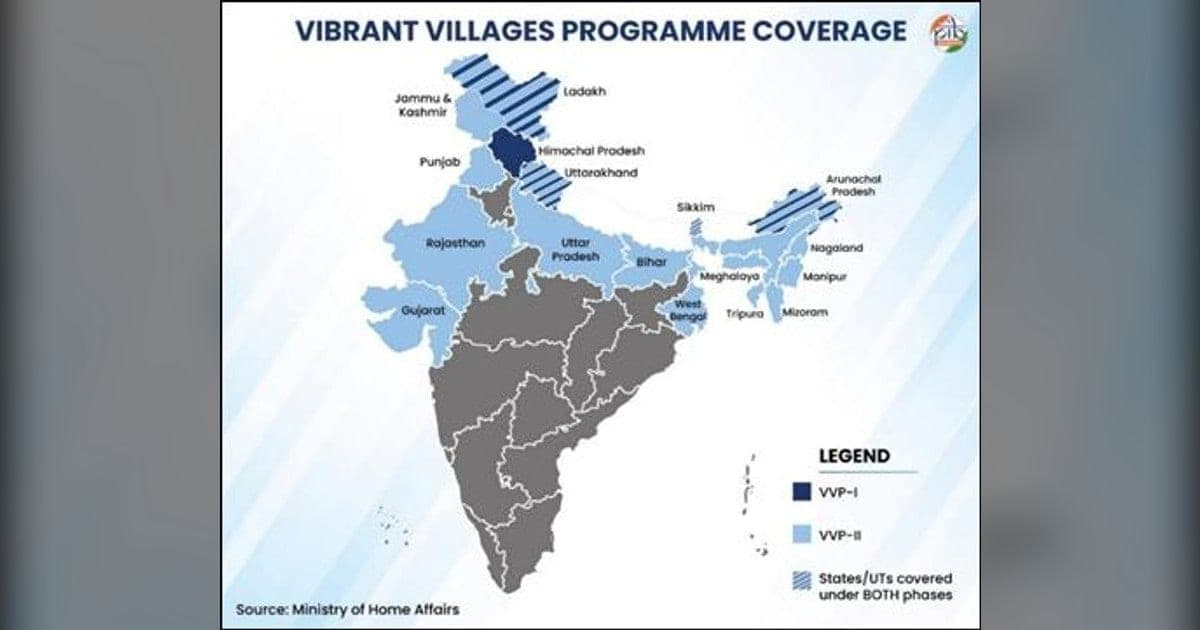
A Home Ministry backgrounder of 6 September 2026 showed the Vibrant Villages Programme covering over 2,616 border villages with an outlay of Rs 11,639 crore.
Why in News
A PIB backgrounder issued on 6 September 2026 gave a full account of the Vibrant Villages Programme, its two phases, its Rs 11,639 crore outlay and the projects sanctioned along India's land borders up to July 2026.
The Vibrant Villages Programme (VVP) treats settlements on India's land frontier as the country's first villages rather than its last. The Ministry of Home Affairs is the nodal ministry for it. A background note put out on 6 September 2026 set down where the scheme has reached.
Two phases, one frontier
The scheme runs in two parts. VVP-I takes in the northern border and is a Centrally Sponsored Scheme run together with the States. VVP-II takes in the remaining land borders and is a Central Sector Scheme paid for wholly by the Centre. Between them the two phases reach more than 2,616 villages, and their outlay adds up to Rs 11,639 crore.
| Phase | Type | Reach |
| VVP-I | Centrally Sponsored Scheme | 662 priority villages in 46 blocks of 19 districts, across 4 States and Ladakh; outlay Rs 4,800 crore |
| VVP-II | Central Sector Scheme | 1,954 villages in 334 blocks, across 15 States and 2 Union Territories |
Why the frontier needed a scheme
India's international land boundary runs beyond 15,000 km and meets seven neighbours. The longest single stretch faces Bangladesh and measures 4,096.7 km. The boundary with China comes next at 3,488 km, and the one with Pakistan at 3,323 km. Hard terrain, thin connectivity and few jobs had pushed families out of many of these villages. The programme was brought in during 2023 to close that gap.
Phase one on the ground
VVP-I was announced in the Union Budget for 2022-23 and launched at Kibithoo in the Anjaw district of Arunachal Pradesh on 10 April 2023. Its outlay of Rs 4,800 crore runs from 2022-23 to 2026-27, and Rs 2,500 crore of that was set aside for roads alone. The 662 villages picked first hold a population of roughly 1.42 lakh. They lie in Arunachal Pradesh, Himachal Pradesh, Sikkim, Uttarakhand and the Union Territory of Ladakh.
What has been sanctioned
By July 2026 the Home Ministry had cleared 1,248 projects carrying an outlay of Rs 3,020.32 crore. Central ministries cleared a further 1,655 projects by pooling their own schemes. Rs 953.47 crore had gone out to the States and Union Territories, and 283 projects stood reported as finished. Roads account for 111 sanctioned projects worth Rs 2,481.93 crore; these will give road access to 134 villages that had none, and include 35 long-span bridges. Tourism accounts for 327 approved projects worth Rs 145 crore.
Reaching people directly
Camps, awareness drives, health and veterinary visits and skill classes crossed 8,800 activities by 31 July 2026. Arunachal Pradesh held 2,990 of them and Ladakh 2,221. Uttarakhand held 2,038, Himachal Pradesh 1,037 and Sikkim 530. Roads come through PMGSY-IV, and a High-Powered Committee under the Cabinet Secretary may relax scheme rules where the frontier demands it. The older Border Area Development Programme, begun in 1986-87, is now winding down after sanctioning over 39,000 works.
Important Facts
| Scheme | Vibrant Villages Programme (VVP-I and VVP-II) |
|---|---|
| Nodal Ministry | Ministry of Home Affairs |
| Combined outlay | Rs 11,639 crore |
| Villages covered | More than 2,616 |
| VVP-I outlay | Rs 4,800 crore, of which Rs 2,500 crore is for roads |
| VVP-I launch | Kibithoo, Anjaw district, Arunachal Pradesh, 10 April 2023 |
| VVP-I priority villages | 662 villages, population about 1.42 lakh |
| VVP-II coverage | 1,954 villages in 334 blocks of 15 States and 2 Union Territories |
| Longest land border | Bangladesh, 4,096.7 km, of a total exceeding 15,000 km |
| Projects sanctioned by MHA | 1,248 worth Rs 3,020.32 crore, up to July 2026 |
| Predecessor scheme | Border Area Development Programme, started in 1986-87 |
Exam Point of View
Remember the two phases and their scheme type, the combined outlay of Rs 11,639 crore, the VVP-I outlay of Rs 4,800 crore, the launch at Kibithoo in Arunachal Pradesh on 10 April 2023, the 662 priority villages of phase one, the 1,954 villages of phase two, the nodal Ministry of Home Affairs and the land border length of over 15,000 km with Bangladesh the longest at 4,096.7 km.
Practice Questions
What is the combined outlay of VVP-I and VVP-II under the Vibrant Villages Programme?
- A.Rs 4,800 crore
- B.Rs 11,639 crore
- C.Rs 15,000 crore
- D.Rs 9,250 crore
Show answer
Correct answer: B. Rs 11,639 crore
Explanation
The correct answer is Rs 11,639 crore. The backgrounder states that the Vibrant Villages Programme is being carried out through two phases whose outlays together come to that figure, and that the two phases between them reach more than 2,616 villages along the international land border. Option A names Rs 4,800 crore, which is the outlay of VVP-I alone: that first phase covers the northern border, was announced in the Union Budget for 2022-23, and runs from 2022-23 to 2026-27, with Rs 2,500 crore of it earmarked for road connectivity. Option A is therefore a part of the answer and not the whole of it, which is exactly the trap a paper setter builds. Option C echoes the length of India's international land border in kilometres, which exceeds 15,000, and not any money figure. Option D does not appear in the release at all. Keep the pair of figures apart in your memory: Rs 4,800 crore for phase one, Rs 11,639 crore for both phases together.
Where was the first phase of the Vibrant Villages Programme launched on 10 April 2023?
- A.Nathanpur, Cachar district, Assam
- B.Kibithoo, Anjaw district, Arunachal Pradesh
- C.Tawang, Arunachal Pradesh
- D.Leh, Ladakh
Show answer
Correct answer: B. Kibithoo, Anjaw district, Arunachal Pradesh
Explanation
The correct answer is Kibithoo, in the Anjaw district of Arunachal Pradesh. The release records that VVP-I was launched there on 10 April 2023. Kibithoo was picked for its location, its history and its development needs: it counts among the easternmost inhabited villages of India, and heavy fighting took place around it during the war with China in 1962. Launching the scheme from such a spot carried the message that development should reach the frontier first. Option A, Nathanpur village in the Cachar district of Assam, is the place where the second phase was formally launched, on 20 February 2026, so it belongs to VVP-II and not to VVP-I. Option C and option D name places that lie within the States and Union Territory the scheme covers, but neither is described in the release as a launch site. Learn the pair together, because questions often swap one launch site for the other.
Which country shares the longest stretch of India's international land border?
- A.China
- B.Pakistan
- C.Bangladesh
- D.Nepal
Show answer
Correct answer: C. Bangladesh
Explanation
The correct answer is Bangladesh. The backgrounder places India's total international land boundary at more than 15,000 km, shared with seven neighbouring countries, and says the longest single stretch runs 4,096.7 km along the boundary with Bangladesh. China comes second at 3,488 km, which rules out option A, and Pakistan third at 3,323 km, which rules out option B. Nepal, Myanmar, Bhutan and Afghanistan make up the balance, so option D is wrong as well. This ordering is asked very often, and the three leading figures are worth committing to memory exactly as the release gives them. Note also why the border length matters to this scheme: the villages along that long frontier had been emptying out through migration, and the Vibrant Villages Programme was framed to keep people there by building roads, power, telecom links, health care, schooling and local livelihoods.
Which ministry is the nodal ministry for the Vibrant Villages Programme?
- A.Ministry of Rural Development
- B.Ministry of Defence
- C.Ministry of Home Affairs
- D.Ministry of Panchayati Raj
Show answer
Correct answer: C. Ministry of Home Affairs
Explanation
The correct answer is the Ministry of Home Affairs. The release names it as the nodal ministry, working with State governments, district administrations and the border guarding forces so that planning and implementation stay coordinated. Option A, the Ministry of Rural Development, does have a role, but a narrower one: the all-weather roads under the programme are built through its Pradhan Mantri Gram Sadak Yojana, in the PMGSY-IV phase. That partial involvement is precisely what makes it a tempting distractor. Option B and option D are not named anywhere in the release as owning the scheme. Two more details are worth carrying with this answer. A High-Powered Committee chaired by the Cabinet Secretary may relax scheme guidelines where border conditions demand it. And the second phase, unlike the first, is implemented directly by the Ministry of Home Affairs as a Central Sector Scheme funded wholly by the Centre.
Frequently Asked Questions
What is the total outlay of the Vibrant Villages Programme?
Rs 11,639 crore for the two phases together. VVP-I carries Rs 4,800 crore for the northern border, and VVP-II, a Central Sector Scheme funded entirely by the Centre, carries the rest for the other land borders.
Where and when was the Vibrant Villages Programme launched?
VVP-I was launched at Kibithoo village in the Anjaw district of Arunachal Pradesh on 10 April 2023, after being announced in the Union Budget for 2022-23. The Ministry of Home Affairs is the nodal ministry.
How many villages does the programme cover?
More than 2,616 villages in all. VVP-I took up 662 priority villages on the northern border with a population of about 1.42 lakh, and VVP-II covers 1,954 villages in 334 blocks across 15 States and 2 Union Territories.
Sources
- Vibrant Villages Programme (opens in a new tab) — Press Information Bureau
Current Affairs 6 September 2026
- 6th RISE Conclave 2026 Opens at CSIR-IICB in KolkataScience & Technology
- Vulture Awareness Day 2026 Marked at Panchkula, HaryanaEnvironment
- 16th National Meet of Biodiversity Boards Opens in ChandigarhSummits & Conferences
- Vinaya Prakash Singh Re-elected APPU Secretary-GeneralAppointments
- Bhagwat Prasad Makwana Appointed NCSK ChairpersonAppointments
- IAF Sarang Team Reaches Egypt for El Alamein AirshowDefence
- 89th Fit India Sundays on Cycle Held in Surat, GujaratSports
Related Current Affairs
- Government Schemes
PM Vishwakarma Turns Three, 30 Lakh Artisans Registered
24 September 2026 · 2 min read
- Government Schemes
Coal Gasification Scheme: ₹37,500 Crore Outlay, NTPC Applies
24 September 2026 · 2 min read
- Government Schemes
Special Campaign 3 Settles 2,306 Long-Pending Pension Grievances
23 September 2026 · 2 min read
- Government Schemes
Grain Storage Plan: Godowns Built in 313 PACS by July 2026
23 September 2026 · 2 min read
- Government Schemes
Nasha Mukt Bharat Abhiyaan Turns Six: National Pledge Planned
23 September 2026 · 2 min read
- Government Schemes
Nadda Opens 10 Critical Care Blocks, 12 Labs in Andhra Pradesh
23 September 2026 · 2 min read
Related GK
- Fundamental Rights (Articles 12–35): Notes, Writs and PYQs
23 September 2026 · Indian Polity
- Preamble of the Indian Constitution: Notes, Keywords and PYQs
22 September 2026 · Indian Polity
- Making of the Indian Constitution: Notes, Key Dates and PYQs
21 September 2026 · Indian Polity
Take the Quiz
- Current Affairs Quiz
CDS Weekly Current Affairs Quiz: 31 August – 6 September 2026
18 questions18 minutesStart Quiz