
Forest Rights Act Review Conference Held in Kolkata for Eight States
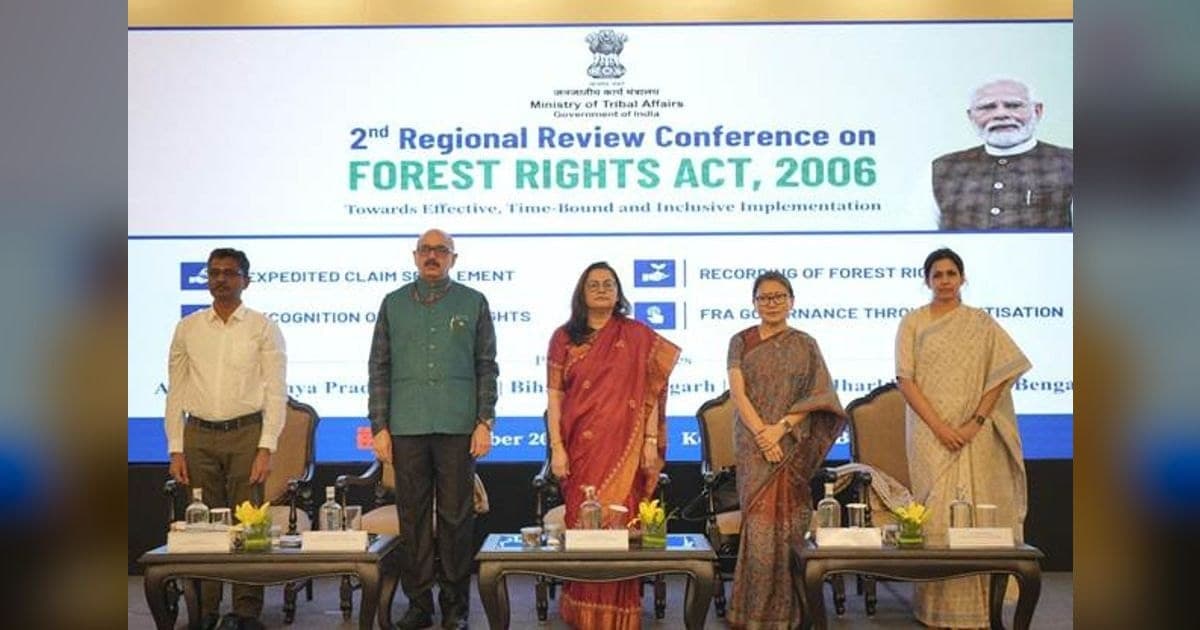
The Ministry of Tribal Affairs held the second regional review conference on the Forest Rights Act at Kolkata on 9 October 2026 with eight States taking part.
Why in News
The Ministry of Tribal Affairs said on 10 October 2026 that the Second Regional Review Conference on the Forest Rights Act had been held at Kolkata on 9 October 2026, where eight States went over pending claims, entry of rights in records, Community Forest Resource Rights and habitat rights of Particularly Vulnerable Tribal Groups.
The Ministry of Tribal Affairs brought officials of eight States to Kolkata, West Bengal, on 9 October 2026 for the Second Regional Review Conference on how forest rights are being recognised on the ground. The law under review is the Scheduled Tribes and Other Traditional Forest Dwellers (Recognition of Forest Rights) Act, 2006, commonly called the FRA.
Who took part
Senior officers of the Tribal Welfare, Revenue and Forest Departments and of the Tribal Research Institutes of eight States attended: West Bengal, Assam, Tripura, Jharkhand, Odisha, Bihar, Madhya Pradesh and Chhattisgarh. Andhra Pradesh was invited as a guest State to explain how it has digitised titles, folded them into government records and tied titleholders to livelihood schemes and bank credit. Collectors, Sub Collectors and Project Officers of the ITDP and ITDA from districts carrying the heaviest load of undecided claims also sat in. The opening meeting of this series was held at Bengaluru on 10 September 2026 for the southern States.
The national figures
The Joint Secretary of the Ministry told the gathering how the Act stands nationally as on 31 August 2026.
| Claims received | More than 54 lakh |
| Titles distributed | About 25 lakh |
| Claims still pending | About 11 lakh |
| Claims rejected | Over 18 lakh |
Madhya Pradesh, Odisha and Assam hold much of the backlog, and inside those States it sits in a handful of districts. The priorities set out for the region were quick disposal of pending claims, a fresh look at rejected ones under the Act and its Rules, reconciliation of data, digitisation of case papers, entry of recognised rights in revenue and forest records, and faster recognition of community and habitat rights.
What the States were asked to do
The Secretary of the Ministry said the Act places the rights, dignity and hopes of forest-dwelling communities at the heart of development. She praised Andhra Pradesh for its record keeping, and Odisha and Chhattisgarh for leading on habitat rights of Particularly Vulnerable Tribal Groups and on the largest count of individual forest rights recognised. Recognition of Community Forest Resource Rights, she said, counts only if a Gram Sabha can use it: villages need help to draw up and run Community Forest Resource Management Plans, and money for that is available under DA-JGUA. States were asked to put to work the joint advisory of the Ministry and the Ministry of Environment, Forest and Climate Change, which lets such plans sit beside the working plans of Forest Departments while the Gram Sabha keeps the last word. Roadmaps for habitat rights are to be drawn up group by group with traditional institutions taking part.
Records, portal and action plans
The Director of the FRA division set out pendency State by State and district by district, and pointed to the Ministry advisory of 24 June 2026 on writing recognised rights into revenue and forest records and to the habitat rights guidelines of 5 January 2026. States were told to clear data mismatches and delays in their Monthly Progress Reports. The Deputy Secretary for Tribal Research Institutes and Information Technology showed the national FRA Portal and the FRA mobile app and asked States to link their own records through an API. Each of the eight States then placed its own time-bound action plan before the house.
Important Facts
| Event | Second Regional Review Conference on implementation of the Forest Rights Act |
|---|---|
| Organiser | Ministry of Tribal Affairs, Government of India |
| Venue | Kolkata, West Bengal |
| Date of the conference | 9 October 2026 |
| The law | Scheduled Tribes and Other Traditional Forest Dwellers (Recognition of Forest Rights) Act, 2006 |
| States reviewed | West Bengal, Assam, Tripura, Jharkhand, Odisha, Bihar, Madhya Pradesh, Chhattisgarh (eight) |
| Guest State | Andhra Pradesh, for digitisation and integration of titles into records |
| First conference of the series | Bengaluru, 10 September 2026, for the southern States |
| Claims received (as on 31 August 2026) | More than 54 lakh |
| Titles distributed | About 25 lakh |
| Pending and rejected claims | About 11 lakh pending; over 18 lakh rejected |
| Digital tools shown | National FRA Portal and the FRA mobile app |
Exam Point of View
Remember the full name of the Act and its year (2006), the edition (second) and venue (Kolkata, West Bengal) of the regional review conference, its date (9 October 2026), the eight States that took part, the first conference of the series (Bengaluru, 10 September 2026, southern States), the figures as on 31 August 2026 — over 54 lakh claims, about 25 lakh titles, about 11 lakh pending, over 18 lakh rejected — and the terms CFRR, PVTG habitat rights, DA-JGUA and the FRA Portal.
Practice Questions
In which city was the Second Regional Review Conference on implementation of the Forest Rights Act held?
- A.Bengaluru
- B.Bhubaneswar
- C.Kolkata
- D.Ranchi
Show answer
Explanation
The correct answer is Kolkata. The Ministry of Tribal Affairs convened the second of its regional review conferences on the Forest Rights Act in the West Bengal capital, and officers of the Tribal Welfare, Revenue and Forest Departments of eight States took part, along with district Collectors from places where claims have piled up. Option A, Bengaluru, is the trap here, because the first conference of the same series was indeed held in that city for the southern States a month earlier; the second one moved east. Option B, Bhubaneswar, is wrong even though Odisha was one of the eight States under review and was praised for its work on habitat rights, since the State was a participant and not the host. Option D, Ranchi, is wrong in the same way: Jharkhand attended but did not host. For the examination, tie the pair together, Kolkata for the eastern and central States and Bengaluru for the southern ones.
The Forest Rights Act, whose implementation was reviewed at the conference, was enacted in which year?
- A.2005
- B.2006
- C.2008
- D.2013
Show answer
Explanation
The correct answer is 2006. The full name of the law is the Scheduled Tribes and Other Traditional Forest Dwellers (Recognition of Forest Rights) Act, and the year that goes with it is 2006. It is the statute under which individual forest rights, Community Forest Resource Rights and habitat rights of Particularly Vulnerable Tribal Groups are recognised, and it is the law the Kolkata conference examined State by State. Options A, C and D are years attached to other laws that aspirants often mix up with this one, and none of them belongs to the forest rights statute. A useful memory aid is that the recognition of these rights is always paired with the figure in option B, while the Ministry advisories discussed at the conference, on writing rights into revenue and forest records and on habitat rights, are much more recent. Keep the full title of the Act and its year together, because papers set the question both ways.
How many titles had been distributed under the Forest Rights Act nationally, as reported at the conference?
- A.About 11 lakh
- B.About 18 lakh
- C.About 25 lakh
- D.About 54 lakh
Show answer
Explanation
The correct answer is about 25 lakh. The Joint Secretary of the Ministry of Tribal Affairs gave the national position as on 31 August 2026, and that is the number of titles handed over to forest dwellers so far. Option D, about 54 lakh, is the number of claims received in all, which is the figure candidates most often swap with the titles figure. Option A, about 11 lakh, is the number of claims still waiting for a decision at one stage or another, concentrated in a few districts of Madhya Pradesh, Odisha and Assam. Option B, about 18 lakh, is the number of claims that have been rejected, and the conference asked States to look at those rejections again under the Act and its Rules. Learn the four numbers as one set, claims received, titles given, claims pending and claims rejected, because a question can be set on any one of them.
Where was the first Regional Review Conference on the Forest Rights Act held in September 2026?
- A.Hyderabad
- B.Bengaluru
- C.Chennai
- D.Guwahati
Show answer
Explanation
The correct answer is Bengaluru. The Ministry of Tribal Affairs began this round of regional reviews there, taking up the southern States, and the Kolkata meeting a month later was the second in the series and covered eight eastern and central States. Option A, Hyderabad, is a plausible distractor because Andhra Pradesh figured prominently at the Kolkata conference as a guest State sharing its practices on digitisation of titles, but the State was not the host of either meeting. Option C, Chennai, is wrong: no conference of this series was held there, although Tamil Nadu falls in the southern group that the first meeting covered. Option D, Guwahati, is wrong too, and the clue is that Assam was named at Kolkata as one of the States holding a large share of pending claims, which makes it a participant rather than a host. Remember the order of the two venues.
Frequently Asked Questions
Where was the Second Regional Review Conference on the Forest Rights Act held?
At Kolkata, West Bengal, on 9 October 2026. It was convened by the Ministry of Tribal Affairs for eight States, and followed the first such conference held at Bengaluru on 10 September 2026 for the southern States.
Which States were covered by the Kolkata conference?
West Bengal, Assam, Tripura, Jharkhand, Odisha, Bihar, Madhya Pradesh and Chhattisgarh. Andhra Pradesh was invited separately to share its practices on digitisation, integration of titles into government records and credit for titleholders.
How many forest rights claims and titles were reported nationally?
As on 31 August 2026 more than 54 lakh claims had been received and about 25 lakh titles distributed. About 11 lakh claims were still pending at various stages and over 18 lakh had been rejected, with Madhya Pradesh, Odisha and Assam holding much of the pendency.
What is the Forest Rights Act being reviewed?
The Scheduled Tribes and Other Traditional Forest Dwellers (Recognition of Forest Rights) Act, 2006. The conference looked at individual claims, Community Forest Resource Rights and habitat rights of Particularly Vulnerable Tribal Groups, with support for Gram Sabha plans available under DA-JGUA.
Sources
- https://www.pib.gov.in/PressReleasePage.aspx?PRID=2321667 (opens in a new tab) — Press Information Bureau
Current Affairs 10 October 2026
- Exercise Tarang Shakti 2026 Second Edition Held at JodhpurDefence
- Milton Dick of Australia Elected President of the IPU at ArushaInternational
- BRICS Traditional Sports Demonstration Games to Open in AhmedabadSports
- Vice-President Addresses Second Convocation of AIIMS DeogharNational
- 94th Fit India Sundays on Cycle to Be Held in VaranasiGovernment Schemes
Related Current Affairs

Related GK
- State-wise Dances, Festivals and Symbols for Exams
10 October 2026 · Indian States & UTs
- Lead Bank Scheme and Service Area Approach: SLBC and DCC
10 October 2026 · Banking & Financial Awareness
- Bronze Sculpture in India: Chola Bronzes to Dhokra
10 October 2026 · Art & Culture
Take the Quiz
- Current Affairs Quiz
State Exams Current Affairs Quiz: 10 October 2026
22 questions22 minutesStart Quiz