
Swachhata Hi Seva 2026: Theme, Dates and ODF Plus Progress
Swachhata Hi Seva 2026 began on 17 September with the theme 'Swachhata Mein Sahbhag'. India now has 5.69 lakh ODF Plus villages, 5.25 lakh of them Model.
Why in News
PIB released a backgrounder on rural sanitation as the Swachhata Hi Seva 2026 campaign got under way, with updated ODF Plus figures as of 17 September 2026.
Swachhata Hi Seva 2026
This year's Swachhata Hi Seva (SHS) campaign began on 17 September 2026 under the theme 'Swachhata Mein Sahbhag; Swachh Bharat, Viksit Bharat'. A PIB backgrounder published on 20 September sets out the campaign calendar and takes stock of rural sanitation under the Swachh Bharat Mission-Gramin (SBM-G).
- 1 October: citizens join a collective shramdaan under the banner 'Ek Din, Ek Ghanta, Ek Saath'.
- 2 October: special Gram Sabhas and cleanliness awareness programmes are held in villages.
SHS was launched in 2017 as an annual campaign to draw citizens into cleanliness work, and more than 18.06 crore citizens took part in the 2025 edition. The 2026 campaign puts students and young people at its centre, with Swachhata Gyan Yatras, school Samvads, demonstrations of segregating waste at source, Swachhata Evam Jal Samvads and sessions on the Solid Waste Management (SWM) Rules, 2026.
From ODF to ODF Plus
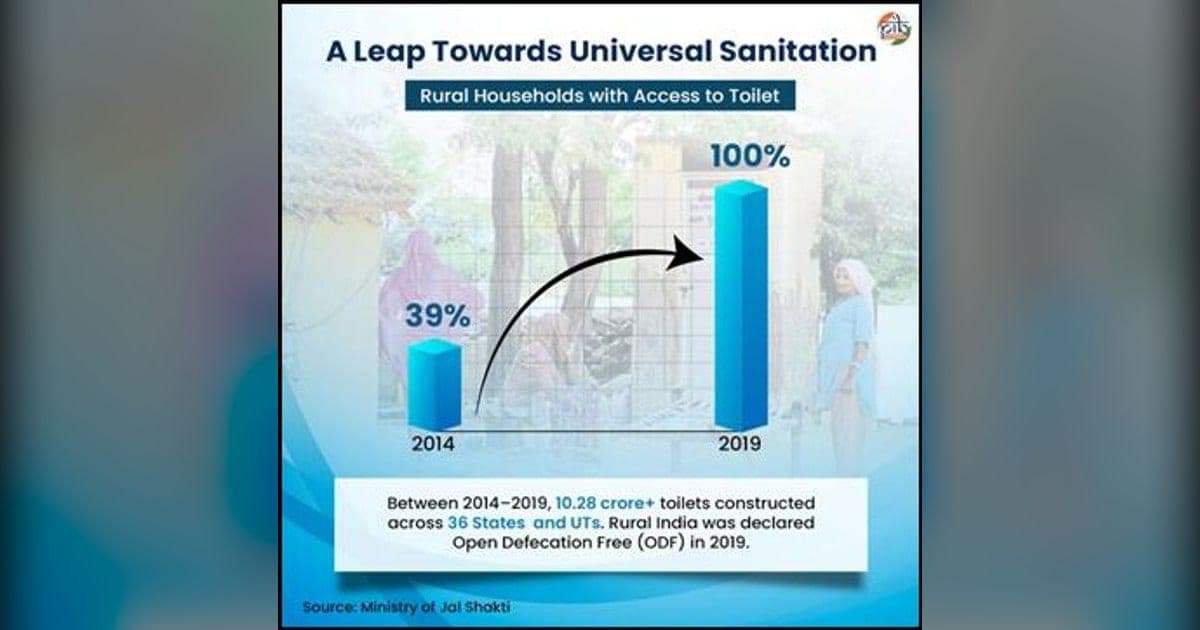
When the Swachh Bharat Mission started in 2014, rural sanitation coverage stood at 39 percent. Between 2014 and 2019 more than 10.28 crore toilets were built across 36 States and Union Territories; rural India reached 100 percent coverage and was declared Open Defecation Free (ODF) in 2019. Phase II of SBM-G then moved the focus to keeping villages ODF and managing their solid and liquid waste.
An ODF Plus village keeps its ODF status, manages solid and liquid waste and stays visibly clean. Such villages move through three stages:
- Aspiring: manages either solid or liquid waste
- Rising: manages both solid and liquid waste
- Model: manages both, is visibly clean and displays ODF Plus messages
Where things stand
| Indicator (as of 17 September 2026) | Figure |
|---|---|
| ODF Plus villages | 5.69 lakh |
| ODF Plus Model villages | 5.25 lakh |
| Villages with solid waste management | 5.38 lakh |
| Villages with liquid waste management | 5.65 lakh |
| GOBARdhan biogas plants operational | 1,314 in 582 districts |
| Individual household toilets built | 12.22 crore |
| Household biogas plants built | 98,273 |
GOBARdhan, short for Galvanizing Organic Bio-Agro Resources Dhan, is the flagship umbrella initiative of SBM-G Phase II. It turns cattle dung, crop residue and organic waste into biogas, compressed biogas (CBG) and organic manure.
People behind the numbers
The backgrounder puts as much weight on behaviour as on infrastructure. SBM-G guidelines give women preference as Swachhagrahis and treat DAY-NRLM self-help groups as key platforms for behaviour change communication. Among the examples it gives:
- In Howrah, West Bengal, SHGs gathered 9.32 tonnes of plastic waste in 18 days across 18 gram panchayats along the Ganga.
- Gadli Gram Panchayat in Haryana reached ODF Plus Model status, treating greywater through five ponds under Sarpanch Kanta Kanwar.
- Karnataka's Swachh Sanivara brings communities out to clean public places on the first Saturday of every month.
- In Betul, Madhya Pradesh, Babita Dhurve became the district's first woman e-rickshaw waste collector.
- Vedancha in Gujarat treats 200 kilolitres of greywater a day and earns about ₹2.5 lakh a year from compost and reused water.
Exam focus
The facts most likely to be asked: the SHS 2026 theme and start date, the year SHS began (2017), the three ODF Plus stages, the figure of 5.69 lakh ODF Plus villages, the full form of GOBARdhan, and the SBM starting point of 39 percent rural sanitation coverage in 2014.
Important Facts
| SHS 2026 theme | Swachhata Mein Sahbhag; Swachh Bharat, Viksit Bharat |
|---|---|
| SHS 2026 start | 17 September 2026 |
| 1 October | Collective shramdaan: Ek Din, Ek Ghanta, Ek Saath |
| 2 October | Special Gram Sabhas in villages |
| SHS launched | 2017 |
| SHS 2025 participation | More than 18.06 crore citizens |
| ODF Plus villages | 5.69 lakh (5.25 lakh Model), as of 17 September 2026 |
| ODF Plus stages | Aspiring, Rising, Model |
| GOBARdhan | Galvanizing Organic Bio-Agro Resources Dhan; 1,314 plants in 582 districts |
| Rural sanitation coverage in 2014 | 39 percent |
| Rural India declared ODF | 2019 |
Exam Point of View
Remember the SHS 2026 theme and dates (17 September start, 1 October shramdaan, 2 October Gram Sabhas), that SHS began in 2017, the three ODF Plus stages, the 5.69 lakh ODF Plus villages and the full form of GOBARdhan.
Practice Questions
What is the theme of Swachhata Hi Seva 2026, which began on 17 September 2026?
- A.Swachhata Mein Sahbhag; Swachh Bharat, Viksit Bharat
- B.Swabhav Swachhata, Sanskaar Swachhata
- C.Garbage Free India
- D.Ek Din, Ek Ghanta, Ek Saath
Show answer
Correct answer: A. Swachhata Mein Sahbhag; Swachh Bharat, Viksit Bharat
Explanation
The correct answer is Swachhata Mein Sahbhag; Swachh Bharat, Viksit Bharat. The PIB backgrounder of 20 September 2026 gives this as the theme of Swachhata Hi Seva 2026, which began on 17 September. The campaign places students and young people at the centre of lasting behaviour change.
Option D is the trap. 'Ek Din, Ek Ghanta, Ek Saath' is part of the same campaign, but it is the banner for the collective shramdaan that citizens will carry out on 1 October, not the campaign's theme. Options B and C are not given in the release as the 2026 theme, so they are wrong as well. Keep the campaign calendar straight: it began on 17 September, the shramdaan is on 1 October, and special Gram Sabhas are held in villages on 2 October.
Under the Swachh Bharat Mission-Gramin, an ODF Plus village that manages both solid and liquid waste but has not yet reached the top stage is classified as:
- A.Aspiring
- B.Rising
- C.Model
- D.Emerging
Show answer
Correct answer: B. Rising
Explanation
The correct answer is Rising. The backgrounder explains that ODF Plus villages are classified into three progressive stages. Aspiring villages manage either solid or liquid waste. Rising villages manage both solid and liquid waste. Model villages manage both waste streams and, in addition, are visibly clean and display ODF Plus messaging.
Option A is wrong because an Aspiring village manages only one of the two kinds of waste. Option C is wrong because the question describes a village that has not reached the top stage, and Model is that top stage. Option D, Emerging, is not one of the three stages at all. The order to remember is Aspiring, then Rising, then Model. As of 17 September 2026, 5.25 lakh of India's 5.69 lakh ODF Plus villages had reached the Model stage.
As of 17 September 2026, how many villages in India had attained ODF Plus status?
- A.5.25 lakh
- B.5.38 lakh
- C.5.69 lakh
- D.6.10 lakh
Show answer
Correct answer: C. 5.69 lakh
Explanation
The correct answer is 5.69 lakh. According to the PIB backgrounder, India had attained 5.69 lakh ODF Plus villages as of 17 September 2026. An ODF Plus village sustains its Open Defecation Free status, manages solid and liquid waste and maintains visual cleanliness.
The other figures are close enough to confuse, and two of them come from the same release. Option A, 5.25 lakh, is the number of villages that have reached ODF Plus Model status, a subset of the total. Option B, 5.38 lakh, is the number of villages with solid waste management arrangements. Option D, 6.10 lakh, does not appear in the release. The release also gives 5.65 lakh villages with liquid waste management systems, so read such questions carefully and match each figure to what it measures.
In which year was the Swachhata Hi Seva campaign, an annual drive for citizen participation in cleanliness, launched?
- A.2014
- B.2017
- C.2019
- D.2021
Show answer
Correct answer: B. 2017
Explanation
The correct answer is 2017. The PIB backgrounder says Swachhata Hi Seva was launched in 2017 as an annual campaign that brings government institutions, local bodies, organisations and citizens together around a shared responsibility for cleanliness. More than 18.06 crore citizens took part in its 2025 edition.
Option A, 2014, is the year the Swachh Bharat Mission itself began, when rural sanitation coverage stood at 39 percent; SHS came later. Option C, 2019, is the year rural India was declared Open Defecation Free. Option D, 2021, is not linked to the launch of the campaign in the release. Questions on sanitation often line up these years as options, so keep the sequence clear: SBM in 2014, SHS in 2017, rural India ODF in 2019. The 2026 edition of the campaign began on 17 September.
Frequently Asked Questions
What is the theme of Swachhata Hi Seva 2026?
The theme is 'Swachhata Mein Sahbhag; Swachh Bharat, Viksit Bharat'. The campaign began on 17 September 2026.
What is an ODF Plus Model village?
It is a village that sustains its Open Defecation Free status, manages both solid and liquid waste, is visibly clean and displays ODF Plus messaging. Aspiring and Rising are the two stages below it.
What is the full form of GOBARdhan?
Galvanizing Organic Bio-Agro Resources Dhan. It is the flagship umbrella initiative under SBM-G Phase II that turns cattle dung, crop residue and organic waste into biogas, compressed biogas and organic manure.
When was Swachhata Hi Seva launched?
Swachhata Hi Seva was launched in 2017 as an annual campaign for citizen participation in cleanliness. More than 18.06 crore citizens took part in its 2025 edition.
Sources
- When Swachhata Became a People’s Movement (opens in a new tab) — Press Information Bureau
Current Affairs 20 September 2026
- SLINEX-26: 13th India–Sri Lanka Naval Exercise at VisakhapatnamDefence
- 72nd National Film Awards: Winners, Venue and Key FactsAwards & Honours
- Asian Games 2026: Elavenil Valarivan Wins Two Silvers in ShootingSports
- Suryakiran Aerobatic Team Performs Over Meerut for the First TimeDefence
- India Aims to Be World's No. 1 Silk Producer by 2028-29Economy
- NGT Conference on Future of Environment and Climate ConcludesEnvironment
- Asia's First Telecom Manufacturing Zone to Come Up in GwaliorEconomy
Related Current Affairs
- Government Schemes
Jal Jeevan Mission 2.0: Nal Jal Mitra and Sujalam Shakti Push
22 September 2026 · 2 min read
- Government Schemes
DDU-GKY 2.0 Training to Begin in 14 States from October
19 September 2026 · 2 min read
Related GK
- Preamble of the Indian Constitution: Notes, Keywords and PYQs
22 September 2026 · Indian Polity
- Making of the Indian Constitution: Notes, Key Dates and PYQs
21 September 2026 · Indian Polity