
PM GatiShakti at Five: 58 Ministries, 23,493 Data Layers
PM GatiShakti, the GIS-based infrastructure planning platform launched on 13 October 2021, completes five years covering 58 ministries and all 36 states and UTs.
Why in News
A PIB backgrounder on 12 October 2026 marked five years of the PM GatiShakti National Master Plan, setting out how the GIS-based platform launched on 13 October 2021 now spans 58 ministries and all 36 states and union territories.
The PM GatiShakti National Master Plan (PMGS-NMP) completes five years this month, and a PIB backgrounder issued on 12 October 2026 traced how it grew from a mapping tool into a planning framework for the whole of government. Launched on 13 October 2021, it placed data from ministries, states and union territories on one Geographic Information System platform so that roads, railways, ports, airports, waterways and utilities could be planned together rather than separately. It now covers 58 Central Ministries and Departments and all 36 States and Union Territories.
How it is built
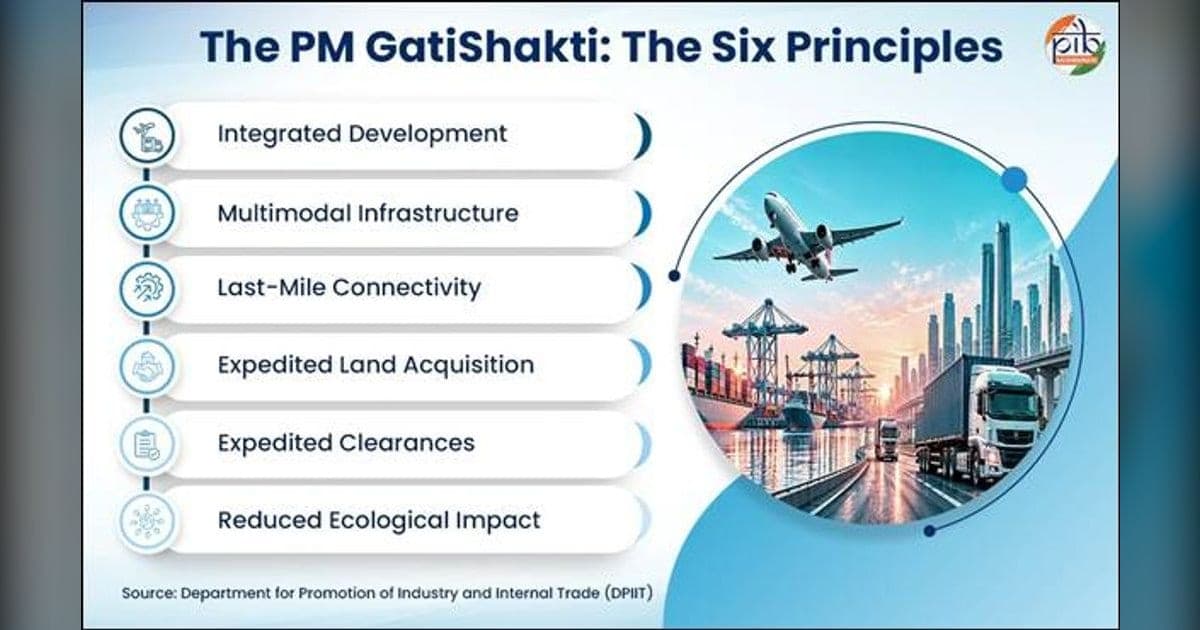
Seven infrastructure engines sit at the core: roads, railways, ports, waterways, airports, mass transport and logistics infrastructure. Six guiding principles shape the approach, namely integrated development, multimodal infrastructure, last mile connectivity, faster land acquisition, fewer clearances and lower ecological impact. Schemes such as Bharatmala, Sagarmala, inland waterways, dry and land ports and UDAN are folded into the plan. The platform carried 23,493 data layers as of 12 October 2026, and the public version opens 230 approved datasets for site suitability analysis, connectivity mapping, alignment planning and compliance checks. That public window was opened to private users in October 2025 through a query-based mechanism built by BISAG-N.
Who decides
A three-tier structure runs the plan. The Empowered Group of Secretaries, chaired by the Cabinet Secretary, oversees implementation and clears changes to the master plan. The Network Planning Group examines proposals for integration and optimisation. A Technical Support Unit of domain experts assists evaluation. As of 11 August 2026 the Network Planning Group had assessed 396 projects worth about 18.66 lakh crore rupees, of which 256 were sanctioned and 198 were under implementation. The Union Cabinet has also approved an Integrated Transport and Logistics Authority (ITLA), which will draw up a National Transport Master Plan with a horizon of ten years or more, appraise projects costing 500 crore rupees or more, and build a National Transport Data Repository using FASTag, Vahan and GSTN e-way bill data.
On the ground
The Pune-Bengaluru Expressway, 699 km long and due in 2027-28, links 15 national highways, 25 state highways and 6 railway stations; planning on the platform cut forest land overlap by 19 per cent, and the road should save 7 to 8 hours of travel, about 16 crore litres of fuel a year and some 39 crore kg of carbon emissions. In Assam, a four-lane Brahmaputra bridge between Dhubri and Phulbari near the Jogighopa Multimodal Logistics Park will shorten a 205 km journey to 20 km. A green energy corridor from Pang in Ladakh to Kaithal in Haryana, a 480 km HVDC line, will evacuate 13 GW of renewable power through a 5 GW system by 2029-30. Gati Shakti Vishwavidyalaya, set up in 2022 for transport and logistics, had trained more than 2.4 lakh officers by July 2026.
Important Facts
| Launched on | 13 October 2021 |
|---|---|
| Coverage | 58 Central Ministries and Departments, all 36 States and UTs |
| Infrastructure engines | Seven: roads, railways, ports, waterways, airports, mass transport, logistics |
| Data layers | 23,493 as of 12 October 2026 |
| Public datasets | 230 approved datasets, opened to private users in October 2025 |
| Projects appraised | 396 worth about 18.66 lakh crore rupees as of 11 August 2026 |
| Top tier | Empowered Group of Secretaries, chaired by the Cabinet Secretary |
| New authority | Integrated Transport and Logistics Authority (ITLA) |
| ITLA appraisal threshold | Projects costing 500 crore rupees or more |
| University | Gati Shakti Vishwavidyalaya, established 2022, over 2.4 lakh officers trained |
Exam Point of View
Remember the launch date (13 October 2021), the coverage (58 ministries and departments, 36 states and UTs), the seven engines and six principles, the data numbers (23,493 layers, 230 public datasets), the Network Planning Group's record (396 projects worth about 18.66 lakh crore rupees, 256 sanctioned, 198 under implementation), the three-tier structure under the Cabinet Secretary, ITLA's 500 crore rupee appraisal threshold, and Gati Shakti Vishwavidyalaya (2022).
Practice Questions
On which date was the PM GatiShakti National Master Plan launched?
- A.13 October 2021
- B.15 August 2021
- C.13 October 2022
- D.1 April 2020
Show answer
Explanation
The correct answer is 13 October 2021, which is why the plan completes five years in October 2026. The idea was to put data held by different ministries, states and union territories onto one Geographic Information System platform so that road, rail, port, airport, waterway and utility networks could be planned together instead of in isolation. Option B is wrong because no launch on that date is recorded for this plan. Option C, 13 October 2022, names the right day of the year but the wrong year, and 2022 is instead the year Gati Shakti Vishwavidyalaya was established, so candidates often mix the two. Option D falls before the plan existed. Five years on, the platform covers 58 Central Ministries and Departments and all 36 States and Union Territories.
How many Central Ministries and Departments does the PM GatiShakti National Master Plan cover?
- A.36
- B.46
- C.58
- D.230
Show answer
Explanation
The correct answer is 58. The master plan brings 58 Central Ministries and Departments into a single planning framework, so that infrastructure proposals can be assessed across sectors rather than ministry by ministry. Option A, 36, is the number of States and Union Territories covered by the plan, and the pair of figures is easy to swap in an exam. Option B belongs to the Unified Logistics Interface Platform, which had connected 46 government systems as of July 2026 through its application programming interfaces. Option D, 230, is the count of approved datasets made available on the public PM GatiShakti platform for site suitability analysis, connectivity mapping, alignment planning and compliance checks. Only option C answers the question asked, which is about ministries and departments.
The Integrated Transport and Logistics Authority will undertake technical appraisal of projects costing at least how much?
- A.100 crore rupees
- B.250 crore rupees
- C.500 crore rupees
- D.1000 crore rupees
Show answer
Explanation
The correct answer is 500 crore rupees. The Union Cabinet has approved setting up the Integrated Transport and Logistics Authority, which will take a long-term view of transport planning. It will prepare a National Transport Master Plan with a horizon of ten years or more, assess sectoral and annual transport plans, appraise projects costing 500 crore rupees or more, and monitor their implementation. The other three thresholds are plausible figures for project appraisal but none of them is the limit set for this authority. The authority will also build a National Transport Data Repository by pulling together information from sources such as FASTag, Vahan and GSTN e-way bills, which gives planners a single view of how goods and people actually move across the country.
How many data layers did the PM GatiShakti National Master Plan carry as of 12 October 2026?
- A.3,964
- B.12,560
- C.23,493
- D.58,000
Show answer
Explanation
The correct answer is 23,493. That is the number of data layers on the common Geographic Information System platform as of 12 October 2026, covering infrastructure assets and other information that planners need when they fix an alignment or test a site. Option A is close to the count of projects the Network Planning Group has appraised, which is 396, and is offered here as a trap built from that figure. Option B is simply a plausible intermediate number with no basis in the plan. Option D is built out of the 58 ministries and departments the plan covers and is far above the actual layer count. Separately, the public platform carries 230 approved datasets, and private users have had access through a query-based mechanism since October 2025.
Frequently Asked Questions
When was the PM GatiShakti National Master Plan launched?
On 13 October 2021, as a GIS-based platform bringing ministries, states and union territories onto a common planning system. It now covers 58 ministries and departments and all 36 states and UTs.
What are the seven engines of PM GatiShakti?
Roads, railways, ports, waterways, airports, mass transport and logistics infrastructure. Six principles guide it, including multimodal infrastructure, last mile connectivity and fewer clearances.
What will the Integrated Transport and Logistics Authority do?
It will prepare a National Transport Master Plan for ten years or more, appraise projects of 500 crore rupees or more, monitor them, and build a National Transport Data Repository from sources such as FASTag, Vahan and GSTN e-way bills.
How many projects has the Network Planning Group appraised?
As of 11 August 2026 it had evaluated 396 projects worth about 18.66 lakh crore rupees, of which 256 were sanctioned and 198 were under implementation.
Sources
- https://www.pib.gov.in/PressReleasePage.aspx?PRID=2322164 (opens in a new tab) — Press Information Bureau
Current Affairs 12 October 2026
- Coal Stocks at Power Plants Stay Above 18 MT in October 2026Economy
- TDB Backs Peptris VIGOR Programme With Rs 86 Crore RDI SupportScience & Technology
- MY Bharat Holds Youth Parliaments at 1,469 Locations in 34 StatesGovernment Schemes
- IGNFA Begins IFS Mid-Career Training for 68 OfficersEnvironment
- Asian Games 2026: Services Athletes Win Record 27 MedalsSports
- Indian Army Launches Bharat Rice for Troops, Signs FCI MoUDefence
- PM-SETU: Rs 440 Crore Cleared for Nine Government ITIsGovernment Schemes
- Exercise Tarang Shakti 2026: CAPSS-IAF Seminar on Air PowerDefence
Related Current Affairs
- Government Schemes
PM-SETU: Rs 440 Crore Cleared for Nine Government ITIs
12 October 2026 · 2 min read
- Government Schemes
MY Bharat Holds Youth Parliaments at 1,469 Locations in 34 States
12 October 2026 · 2 min read
- Government Schemes
Yuva Sangam Phase VII Takes Uttarakhand Youth to West Bengal
11 October 2026 · 2 min read
- Government Schemes
Mission for Aatmanirbharta in Pulses Completes One Year
11 October 2026 · 2 min read
- Government Schemes
Telangana Delegation Visits Assam Under Yuva Sangam Phase VII
10 October 2026 · 2 min read
- Government Schemes
Nasha Mukt Yuva Abhiyan Reaches 1.06 Lakh in First Month
10 October 2026 · 2 min read



Related GK
- Uttar Pradesh Location and Physical Divisions for Exams
12 October 2026 · Uttar Pradesh
- Rajasthan Location and Physical Divisions: Extent, Aravalli, Thar
12 October 2026 · Rajasthan
- Madhya Pradesh Location and Physical Divisions for Exams
12 October 2026 · Madhya Pradesh
Take the Quiz
- Current Affairs Quiz
SSC CHSL Current Affairs Quiz: 12 October 2026
13 questions13 minutesStart Quiz