
Mission for Aatmanirbharta in Pulses Completes One Year
The Mission for Aatmanirbharta in Pulses, begun on 11 October 2025 with an outlay of Rs 11,440 crore, completed one year, targeting 350 lakh tonnes by 2030-31.
Why in News
On 11 October 2026 the Mission for Aatmanirbharta in Pulses completed one year since its launch on 11 October 2025, and a PIB backgrounder set out its targets, outlay of Rs 11,440 crore and first-year progress.
India observed the first anniversary of the Mission for Aatmanirbharta in Pulses on 11 October 2026. The six-year programme, which the government began on 11 October 2025, carries a financial allocation of Rs 11,440 crore and runs from 2025-26 to 2030-31. Its purpose is to end the country’s dependence on imported pulses, lift farm incomes and treat the crop as a whole value chain rather than a single sowing season. India is already the largest producer of pulses in the world, and the crop carries 20-25 per cent protein, far ahead of wheat and rice.
What the Mission targets
- Output of nearly 350 lakh tonnes by 2030-31, with average yield climbing to 1,130 kg per hectare.
- An extra 35 lakh hectares under pulses, taking the sown area to a targeted 310 lakh hectares by 2030-31.
- Tur, Urad and Masoor singled out for a push, with climate-resilient and better quality seed.
- Free seed kits numbering 87.5 lakh and 126 lakh quintals of certified seed over the six years.
- A cluster plan spread over 489 districts and 1,000 new dal mills, of which 528 units went to States and Union Territories in the opening phase.
Where the numbers stand
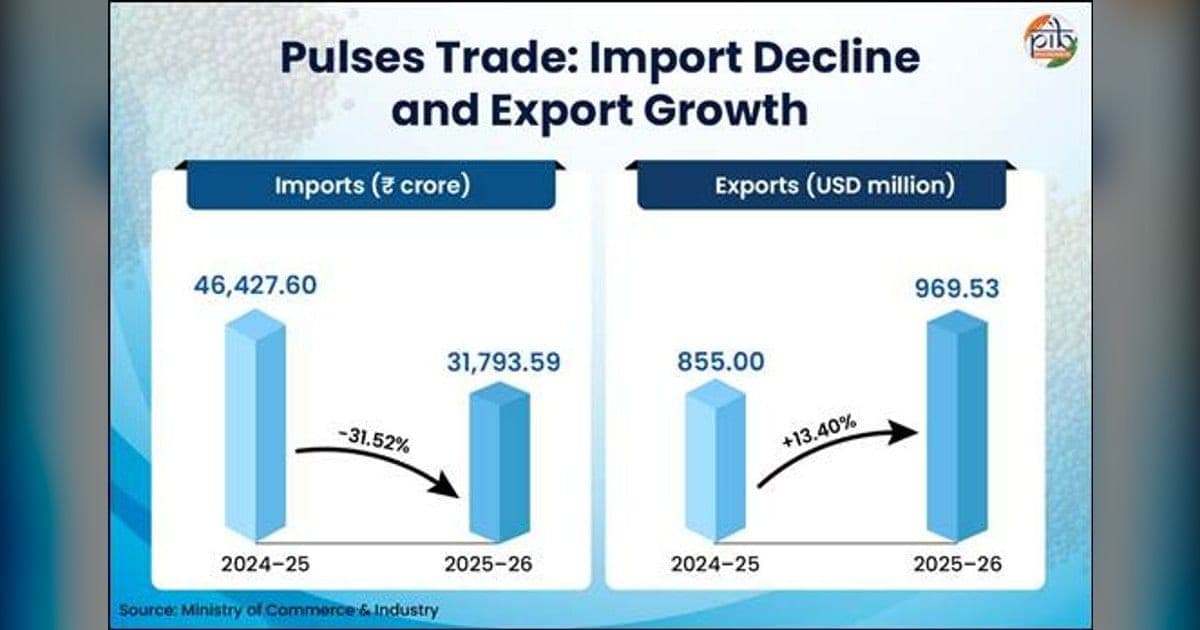
Pulses output rose to 274.09 lakh tonnes in 2025-26 on the third advance estimates, against 256.83 lakh tonnes a year earlier. The area sown widened from 277.20 lakh hectares to 286.46 lakh hectares, and productivity moved up from 926 kg to 957 kg per hectare. Imports fell 31.52 per cent, from Rs 46,427.60 crore in 2024-25 to Rs 31,793.59 crore in 2025-26, while exports gained 13.40 per cent, from USD 855 million to USD 969.53 million on a volume of 10.01 lakh tonnes. China, the UAE, Bangladesh, the United States and Sri Lanka were the leading buyers. Madhya Pradesh, Maharashtra, Rajasthan and Uttar Pradesh remain the main growing States.
Price support and purchase
NCCF and NAFED may buy the entire marketed quantity of Tur, Masur and Urad for four years, from 2025-26 to 2028-29. Minimum Support Price for Urad has gone from Rs 7,400 a quintal in 2024-25 to Rs 8,200 for 2026-27, Tur from Rs 7,550 to Rs 8,450 and Masur from Rs 6,700 to Rs 7,000. Digital tools carry the load of monitoring: the Krishi Mapper application for geo-tagging, the SATHI portal for seed traceability, AgriStack with the Digital Crop Survey, and e-Samriddhi and Vistaar for payments and market prices. A three-tier steering committee watches progress at national, State and district levels.
Important Facts
| Mission | Mission for Aatmanirbharta in Pulses |
|---|---|
| Launched on | 11 October 2025 |
| Outlay | Rs 11,440 crore (2025-26 to 2030-31) |
| Production target | About 350 lakh tonnes by 2030-31 |
| Yield target | 1,130 kg per hectare |
| Area target | 310 lakh hectares by 2030-31 |
| Focus crops | Tur, Urad and Masoor |
| Districts covered | 489 districts in cluster mode |
| Processing units | 1,000 dal mills planned; 528 allotted in the first phase |
| Procurement agencies | NCCF and NAFED |
| Output in 2025-26 | 274.09 lakh tonnes (third advance estimates) |
| Ministry | Ministry of Agriculture and Farmers Welfare |
Exam Point of View
Remember the launch date (11 October 2025), the outlay (Rs 11,440 crore), the period (2025-26 to 2030-31), the 2030-31 targets of 350 lakh tonnes and 1,130 kg per hectare, the 489 districts, 1,000 dal mills, the three focus crops Tur, Urad and Masoor, the procuring agencies NCCF and NAFED, and the portals SATHI, Krishi Mapper and e-Samriddhi.
Practice Questions
What is the financial outlay of the Mission for Aatmanirbharta in Pulses?
- A.Rs 7,047 crore
- B.Rs 11,440 crore
- C.Rs 14,217 crore
- D.Rs 6,431 crore
Show answer
Explanation
The correct answer is Rs 11,440 crore. The Mission for Aatmanirbharta in Pulses was sanctioned with this allocation for the six years from 2025-26 to 2030-31, and the money pays for seed kits, certified seed, cluster-based cultivation in 489 districts and a thousand dal mills. Option A, Rs 7,047 crore, is wrong because that figure is the Minimum Support Price amount released directly to farmers by NCCF, not the Mission outlay. Option C, Rs 14,217 crore, is wrong because that is the MSP value paid out in Rabi 2026-27 procurement, again a purchase figure rather than the scheme allocation. Option D, Rs 6,431 crore, is wrong for the same reason: it is the worth of pulses bought in Kharif 2025-26. Only option B names the sanctioned outlay of the Mission itself, which is the figure asked for in the question.
What pulses production does India target by 2030-31 under the Mission for Aatmanirbharta in Pulses?
- A.274.09 lakh tonnes
- B.286.46 lakh tonnes
- C.350 lakh tonnes
- D.310 lakh tonnes
Show answer
Explanation
The correct answer is 350 lakh tonnes. The Mission sets this as the production goal for 2030-31, to be reached with yield of 1,130 kg per hectare and a sown area taken up to 310 lakh hectares. Option A is wrong because 274.09 lakh tonnes is the output already achieved in 2025-26 on the third advance estimates, a starting point and not the target. Option B is wrong because 286.46 lakh hectares is the area under pulses in 2025-26, a measure of land and not of tonnage. Option D confuses the two measures as well: 310 lakh hectares is the area targeted for 2030-31, not the quantity of pulses to be harvested. Candidates should keep the three numbers separate, since paper setters often swap the area target and the production target.
Which two agencies are authorised to procure Tur, Masur and Urad under the Mission for Aatmanirbharta in Pulses?
- A.FCI and CWC
- B.NCCF and NAFED
- C.NABARD and SFAC
- D.APEDA and NCDC
Show answer
Explanation
The correct answer is NCCF and NAFED, that is the National Cooperative Consumers’ Federation of India Limited and the National Agricultural Cooperative Marketing Federation of India Limited. Under the Mission they may buy the whole quantity of Tur, Masur and Urad offered by willing and registered farmers for four years, from 2025-26 to 2028-29, which gives growers an assured market at the Minimum Support Price. Option A is wrong because the Food Corporation of India and the Central Warehousing Corporation are not named as the procuring agencies for this Mission. Option C is wrong because NABARD is a development bank for agriculture and rural credit rather than a buyer of pulses. Option D is wrong because APEDA deals with export promotion of farm produce. Only option B names the two cooperative federations placed in charge of assured purchase.
Which portal set up for seed authentication and traceability is used under the Mission for Aatmanirbharta in Pulses?
- A.SATHI portal
- B.Krishi Mapper
- C.Vistaar
- D.e-Samriddhi
Show answer
Explanation
The correct answer is the SATHI portal, which stands for Seed Authentication, Traceability and Holistic Inventory. It follows the seed through its life cycle across generations by automating the supply chain from seed production to certification and sale, so that farmers receive seed of verified quality. Option B is wrong because Krishi Mapper is a mobile application used for geo-fencing, land geo-tagging and real-time tracking of seed variety demonstrations and yields, not for seed certification records. Option C is wrong because Vistaar, like e-Samriddhi, is a verification platform meant for direct payments, live market data and price stability rather than seed traceability. Option D is wrong for the same reason. Remember SATHI with seed, Krishi Mapper with geo-tagging, and e-Samriddhi and Vistaar with payments and market information.
Frequently Asked Questions
When was the Mission for Aatmanirbharta in Pulses launched and what is its outlay?
It was launched on 11 October 2025 with an allocation of Rs 11,440 crore covering 2025-26 to 2030-31, and it seeks self-sufficiency in pulses by 2030-31.
What production and yield does the Mission target by 2030-31?
Nearly 350 lakh tonnes of pulses with yield of 1,130 kg per hectare, on a sown area taken up to 310 lakh hectares by adding 35 lakh hectares.
Which agencies procure pulses under the Mission?
NCCF and NAFED are authorised to procure the entire quantity of Tur, Masur and Urad offered by registered farmers for four years, from 2025-26 to 2028-29.
How much did pulses imports fall in 2025-26?
Imports declined 31.52 per cent, from Rs 46,427.60 crore in 2024-25 to Rs 31,793.59 crore in 2025-26, while exports rose 13.40 per cent to USD 969.53 million.
Sources
- https://www.pib.gov.in/PressReleasePage.aspx?PRID=2321892 (opens in a new tab) — Press Information Bureau
Current Affairs 11 October 2026
- DRI Seizes 7.8 kg Smuggled Gold in Eastern Region, Six HeldNational
- DRI Seizes 5.753 kg Crystal Meth from Train PassengerNational
- Railways Notifies 3,548 Graduate NTPC Posts Under CEN 06/2026National
Related Current Affairs
- Government Schemes
PM Dhan-Dhaanya Krishi Yojana Completes One Year in 100 Districts
10 October 2026 · 3 min read
- National
Special Campaign 6.0 to Run in Government Offices From 2 October
28 September 2026 · 3 min read




Related GK
- Sustainable Development and the SDGs: All 17 Goals
9 October 2026 · Environment & Ecology
- Planning in India and NITI Aayog: Plans, Models and Bodies
25 September 2026 · Indian Economy
Take the Quiz
- Current Affairs Quiz
State Exams Current Affairs Quiz: 11 October 2026
16 questions16 minutesStart Quiz