
National Supercomputing Mission Reaches 40 Systems, 68 PF
India had 40 locally built supercomputers with a combined 68 PF capacity by September 2026 under the National Supercomputing Mission, a PIB backgrounder said.
Why in News
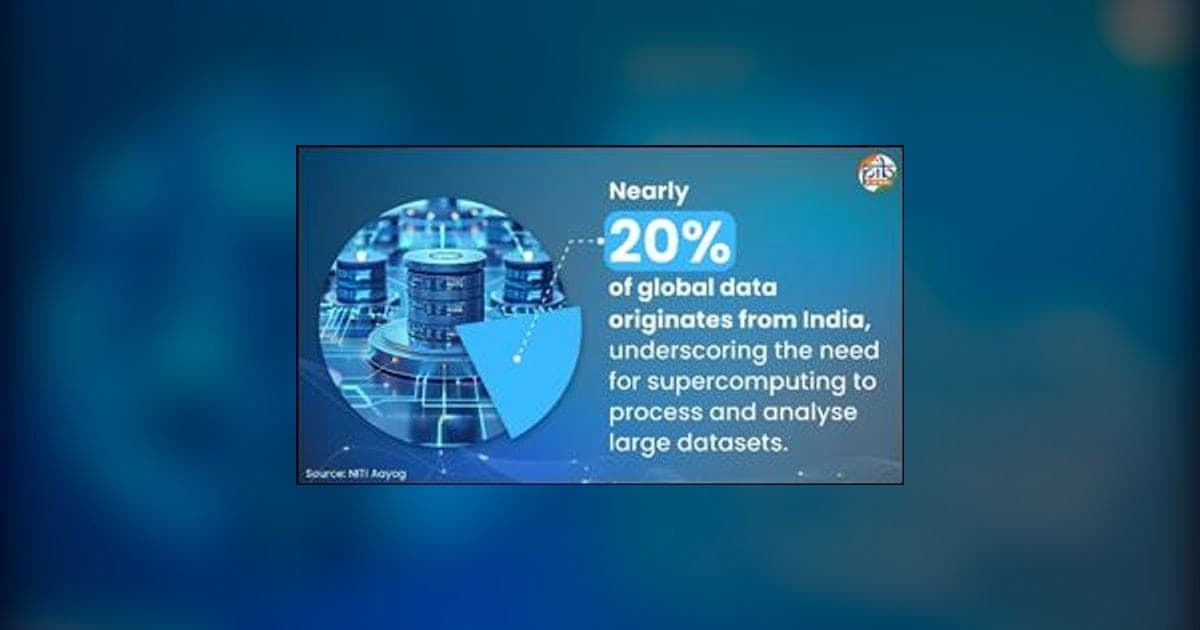
On 4 October 2026 PIB released a backgrounder on India's supercomputing ecosystem, giving the National Supercomputing Mission's status as of September 2026: 40 supercomputers, 68 PF of capacity and a target of 50 systems above 123 PF.
A Press Information Bureau backgrounder issued on 4 October 2026 set out how far India's supercomputing ecosystem has come under the National Supercomputing Mission (NSM). The Mission began in April 2015 with an outlay of roughly Rs 4,500 crore and is steered together by the Department of Science and Technology (DST) and the Ministry of Electronics and Information Technology (MeitY).
Capacity in place
By September 2026 the country had 40 supercomputers running, built in India, with a combined 68 PF of computing power. The tally breaks up as 13 high-end machines faster than 1 PF, 12 mid-range systems between 500 TF and 1 PF, and 15 systems below 500 TF. The Mission's target is 50 supercomputers adding up to more than 123 PF, spread across academic and research institutions.
Who builds and runs it
The Centre for Development of Advanced Computing (C-DAC), Pune, and the Indian Institute of Science (IISc), Bengaluru, carry out the Mission. NSM works through a 'Build approach' of three concurrent phases, namely assembly, manufacturing, and design and manufacturing support, so that fresh capacity and home-grown skill grow side by side. Power is counted in FLOPS: one teraFLOPS is a trillion calculations a second and one petaFLOPS a quadrillion.
From PARAM 8000 to PARAM Rudra
India entered indigenous supercomputing with PARAM 8000, built by C-DAC and unveiled in 1991 at a speed of 1 gigaflop. The PARAM family grew through systems such as PARAM Yuva at 54 teraflops. The current flagship line, PARAM Rudra, runs on Rudra servers designed in India, whose technology has gone to domestic electronics manufacturing partners. Of these, 6,000 Rudra servers were already in service by September 2026 and another 1,500 were on the production line.
Home-grown parts, users and uses
Besides the servers, NSM has produced an HPC system software stack, an indigenous cooling technology and a node-to-node interconnect proven at 100 Gbps and 200 Gbps. PARAM Shavak is a made-in-India supercomputing-in-a-box for engineering colleges. The Mission's machines have served over 16,000 researchers, among them more than 2,900 PhD scholars, at over 400 institutions, finishing more than 1.5 crore compute jobs and feeding over 1,990 research papers. The National Knowledge Network (NKN) ties the facilities together. Applications include a flood early-warning system that gives the Mahanadi basin up to 2 days of notice, a forest-fire spread model tried out in the Sikkim Himalayas, a genomics and drug discovery platform used during COVID-19, an urban environment decision support system and a seismic imaging suite; the Mission is counted as contributing to 11 UN Sustainable Development Goals.
ESTIC-2026 ahead
The backgrounder also flagged ESTIC-2026, the second edition of India's Emerging Science, Technology and Innovation Conclave, to be held from 27 to 29 October 2026 at Bharat Mandapam, New Delhi. Organised by the Council of Scientific and Industrial Research (CSIR) on the theme 'Creative Minds, Catalyzing Science, Empowering Technologies', it covers 12 thematic areas and backs the Viksit Bharat 2047 goal.
Important Facts
| Mission | National Supercomputing Mission (NSM) |
|---|---|
| Launched | April 2015, outlay about Rs 4,500 crore |
| Steered by | Department of Science and Technology and Ministry of Electronics and Information Technology |
| Implementing agencies | C-DAC, Pune and IISc, Bengaluru |
| Status (September 2026) | 40 supercomputers, combined capacity 68 PF |
| Target | 50 supercomputers, cumulative capacity above 123 PF |
| First indigenous system | PARAM 8000, unveiled 1991, speed 1 gigaflop |
| Rudra servers deployed | 6,000, with 1,500 more under manufacturing |
| Researchers served | Over 16,000, including more than 2,900 PhD scholars |
| Upcoming event | ESTIC-2026, 27 to 29 October 2026, Bharat Mandapam, New Delhi |
Exam Point of View
Fix the Mission's basics: launched April 2015, outlay about Rs 4,500 crore, steered by DST and MeitY, implemented by C-DAC Pune and IISc Bengaluru. Remember 40 supercomputers at 68 PF as of September 2026 against a target of 50 systems above 123 PF, PARAM 8000 in 1991 at 1 gigaflop, PARAM Yuva at 54 teraflops, PARAM Rudra on Rudra servers, PARAM Shavak for colleges, and ESTIC-2026 at Bharat Mandapam from 27 to 29 October 2026.
Practice Questions
In which year was the National Supercomputing Mission (NSM) launched?
- A.2010
- B.2015
- C.2018
- D.2022
Show answer
Correct answer: B. 2015
Explanation
The correct answer is 2015. India started the National Supercomputing Mission in April 2015 to build up the country's computing strength, and it was given an outlay of roughly Rs 4,500 crore. The Mission is steered jointly by the Department of Science and Technology and the Ministry of Electronics and Information Technology, while the Centre for Development of Advanced Computing, Pune and the Indian Institute of Science, Bengaluru put it into practice. Option A, 2010, is wrong because nothing of this Mission existed then; India's indigenous supercomputing story had begun much earlier with PARAM 8000 in 1991, but that was a single machine and not a national mission. Option C, 2018, is wrong: by that time the Mission was already working towards its goal of self-reliance in supercomputing. Option D, 2022, is wrong as well, since the figures reported for the Mission, such as 40 supercomputers delivering 68 PF as of September 2026, describe several years of work that followed the 2015 launch.
As of September 2026, what was the combined capacity of the supercomputers deployed in India under NSM?
- A.32 PF
- B.45 PF
- C.68 PF
- D.123 PF
Show answer
Correct answer: C. 68 PF
Explanation
The correct answer is 68 PF. By September 2026 India had 40 supercomputers in service, all built within the country, and their capacity added up to 68 PF. That total is made up of 13 high-end machines faster than 1 PF, 12 mid-range systems placed between 500 TF and 1 PF, and 15 systems below 500 TF. Options A and B are simply lower than the reported total and match no stated figure for the Mission. Option D is the trap, because 123 PF is a real number in this story but it belongs to the future, not the present: the Mission plans a total of 50 supercomputers with a cumulative capacity exceeding 123 PF across academic and research institutions, so 123 PF is the target rather than the capacity already deployed. Remember the pair together: 40 systems at 68 PF achieved, 50 systems above 123 PF planned.
Which two institutions implement the National Supercomputing Mission?
- A.ISRO, Bengaluru and DRDO, Hyderabad
- B.C-DAC, Pune and IISc, Bengaluru
- C.IIT Bombay and BARC, Mumbai
- D.CSIR, New Delhi and NIC, New Delhi
Show answer
Correct answer: B. C-DAC, Pune and IISc, Bengaluru
Explanation
The correct answer is C-DAC, Pune and IISc, Bengaluru. The Centre for Development of Advanced Computing at Pune and the Indian Institute of Science at Bengaluru are the two bodies that implement the Mission, while the Department of Science and Technology and the Ministry of Electronics and Information Technology steer it. C-DAC is also the house that built PARAM 8000 in 1991 and has designed the Rudra series of servers on which the PARAM Rudra supercomputers run. Option A is wrong: neither space nor defence research laboratories are named as implementing agencies for this Mission. Option C is wrong because no individual IIT or atomic research centre has that role, even though research institutions across the country use the Mission's machines. Option D mixes in a genuine name from the story in a wrong place, as the Council of Scientific and Industrial Research organises the ESTIC-2026 conclave but does not implement the supercomputing Mission.
PARAM 8000, India's first indigenous supercomputer, was unveiled in which year?
- A.1985
- B.1991
- C.1998
- D.2005
Show answer
Correct answer: B. 1991
Explanation
The correct answer is 1991. PARAM 8000 was developed by the Centre for Development of Advanced Computing and unveiled in 1991 with a speed of 1 gigaflop, and it marked India's entry into indigenous supercomputing. It laid the base for the PARAM series, which moved on to far more powerful machines such as PARAM Yuva at 54 teraflops, supporting work like weather forecasting and computational fluid dynamics, and later to the PARAM Rudra systems built on Rudra servers designed in India. Option A, 1985, comes before the machine existed. Option C, 1998, and option D, 2005, fall after the unveiling; by then the PARAM line was already growing through newer and faster systems. A useful way to hold the timeline is PARAM 8000 in the early 1990s, the national mission from 2015, and 40 machines at 68 PF by September 2026.
Frequently Asked Questions
When was the National Supercomputing Mission launched and by whom is it run?
It was launched in April 2015 with an outlay of about Rs 4,500 crore. The Department of Science and Technology and the Ministry of Electronics and Information Technology steer it jointly, while C-DAC, Pune and IISc, Bengaluru implement it.
How many supercomputers does India have under NSM?
As of September 2026 India had 40 supercomputers with a combined capacity of 68 PF, including 13 systems above 1 PF. The Mission plans 50 systems with a cumulative capacity of more than 123 PF.
Which was India's first indigenous supercomputer?
PARAM 8000, developed by C-DAC and unveiled in 1991 with a speed of 1 gigaflop. The PARAM series later included PARAM Yuva at 54 teraflops and the present PARAM Rudra systems built on indigenous Rudra servers.
What is ESTIC-2026?
It is the second edition of India's Emerging Science, Technology and Innovation Conclave, to be held from 27 to 29 October 2026 at Bharat Mandapam, New Delhi, by CSIR on the theme 'Creative Minds, Catalyzing Science, Empowering Technologies', spanning 12 thematic areas.
Sources
- भारत का उभरता सुपरकंप्यूटिंग परितंत्र (opens in a new tab) — Press Information Bureau
Current Affairs 4 October 2026
- Asian Games 2026: India Wins Silver in Women's Team GolfSports
- Asian Games: Antim Panghal Wins Silver in 53 kg WrestlingSports
- Swachhata Hi Seva 2026 Ends at AIIA, Campaign 6.0 Till 31 OctGovernment Schemes
- Great Indian Bustards Released in Desert National ParkEnvironment
- MoRTH to Hold Chintan Shivir 2026 at Ekta Nagar, GujaratSummits & Conferences
- 17th Pension Adalat to Take Up 897 Pending GrievancesGovernment Schemes
- Andhra Pradesh Gets 3 Lakh PMAY-G Houses Worth Rs 3,600 CroreGovernment Schemes
- ICSI 58th Foundation Day Marked at Bharat Mandapam, DelhiNational
Related Current Affairs
- Science & Technology
India Demonstrates First 5.56 km Free-Space Quantum Key Link
3 October 2026 · 2 min read
- Science & Technology
BharatNet Deal Brings Rs 10,520 Crore to Rural Maharashtra
1 October 2026 · 2 min read
- Science & Technology
ICAR and FCI Sign MoU on Safer Foodgrain Fumigation Methods
1 October 2026 · 2 min read
- Science & Technology
Nalanda University and CSIR-TKDL Sign Traditional Knowledge Pact
1 October 2026 · 2 min read
- Science & Technology
CHIME Telescope Makes First Solo Detection of Hydrogen Glow
30 September 2026 · 2 min read
- Science & Technology
CAG and BHASHINI Launch AI Translation Tool for Audit Papers
30 September 2026 · 2 min read

Related GK
- Supercomputers of India: PARAM Series, NSM and PYQs
4 October 2026 · Science & Technology
- Telangana GK: Formation, Rivers, Culture and Exam Facts
4 October 2026 · Indian States & UTs
- Abbreviations and Full Forms: Exam List for GK Papers
4 October 2026 · Static GK
Take the Quiz
- Current Affairs Quiz
RRB NTPC Current Affairs Quiz: 4 October 2026
25 questions25 minutesStart Quiz