
Great Indian Bustards Released in Desert National Park
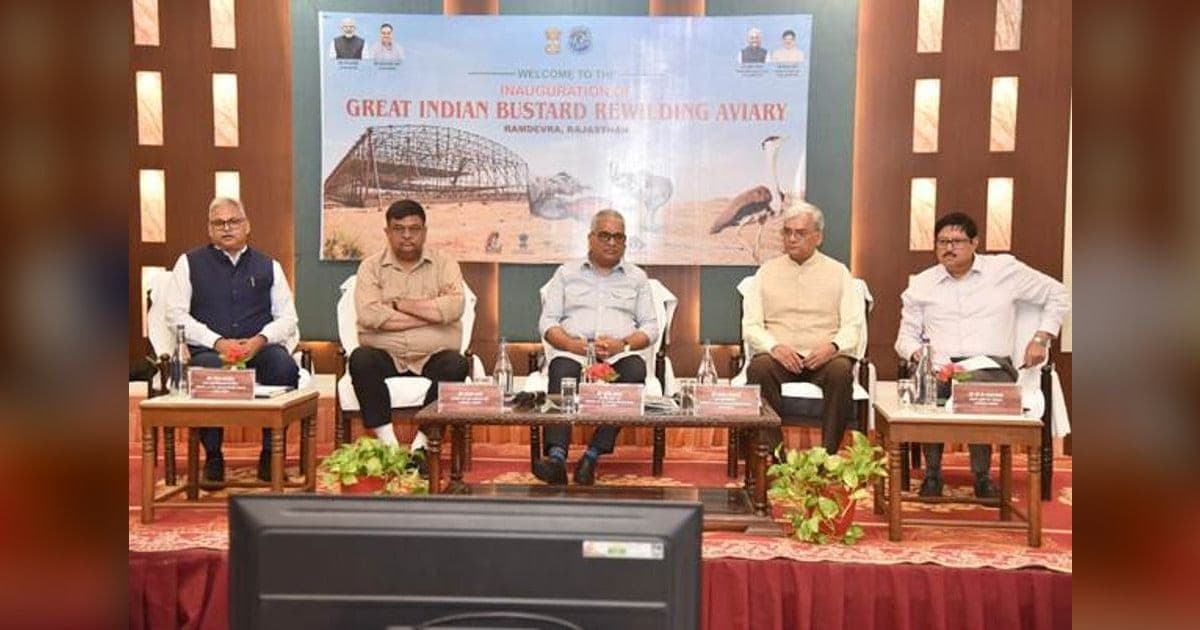
Union Environment Minister Bhupender Yadav freed two male Great Indian Bustards into the wild at Sam in Desert National Park, Jaisalmer, Rajasthan.
Why in News
Union Minister for Environment, Forest and Climate Change Bhupender Yadav released two male Great Indian Bustards into the wild at Sam in the Desert National Park, Jaisalmer, marking the shift of India’s Bustard Recovery Programme from conservation breeding to rewilding.
India’s long effort to save the Great Indian Bustard reached a turning point when Union Minister for Environment, Forest and Climate Change Bhupender Yadav set two male birds free at Sam, inside the Desert National Park of Jaisalmer in Rajasthan. Rajasthan’s Minister for Forest and Environment, Sanjay Sharma, and senior officers of the Union and State governments were present when the birds went out.
Why this release matters
The bird is listed as critically endangered, and for years the work around it was about keeping a safe breeding stock alive in enclosures. Letting captive-raised males loose in the desert moves the programme to its next stage, from building that stock to putting birds back into the wild population. The ministry said the behaviour of these two birds will be watched closely, and what is learnt will be used to improve the method before the next group is freed.
Where the breeding programme stands
The centres at Sam and Ramdevra together hold 97 bustards. Of these, 40 hatched from eggs picked up in the wild and 57 were bred inside the facilities. 86 of the birds are kept back for breeding, and 11 have been marked for release in the wild — the two freed on this occasion came out of that group. Breeding in captivity yielded 24 live chicks in 2025 and 29 in 2026.
The jumpstart method
Researchers also tried an unusual step they call jumpstart: eggs laid in captivity were slipped into nests in the wild, and the females sitting on those nests accepted them. Six chicks hatched this way in Rajasthan and two in Gujarat.
Who runs the Bustard Recovery Programme
The programme is a joint effort of the Ministry of Environment, Forest and Climate Change, the Rajasthan Forest Department and the Wildlife Institute of India (WII). Technical support comes from the International Fund for Houbara Conservation, and the money from National CAMPA. Its five strands are conservation breeding, habitat management, cutting down threats, restoring habitat and bringing local communities in.
Habitat work in the desert
The Rajasthan Forest Department has fenced roughly 200 sq km of grassland inside the Desert National Park. Telemetry fitted on birds by WII, followed over a long period, shows that these enclosures are the best breeding ground the species has. The steps taken for the bird follow a judgement of the Supreme Court of India, which drew on the advice of an expert committee set up for the purpose.
Important Facts
| Species | Great Indian Bustard (critically endangered) |
|---|---|
| Released by | Bhupender Yadav, Union Minister for Environment, Forest and Climate Change |
| Site | Sam, Desert National Park, Jaisalmer, Rajasthan |
| Birds released | Two males |
| Birds in captivity | 97 at Sam and Ramdevra (40 from wild-laid eggs, 57 captive-bred) |
| Earmarked for release | 11 birds, of which 86 are kept for captive reproduction |
| Chicks bred | 24 in 2025 and 29 in 2026 |
| Programme partners | MoEFCC, Rajasthan Forest Department and Wildlife Institute of India |
| Technical and financial support | International Fund for Houbara Conservation; funding from National CAMPA |
| Fenced grassland enclosures | About 200 sq km inside the Desert National Park |
Exam Point of View
Remember the species (Great Indian Bustard, critically endangered), the site (Sam, Desert National Park, Jaisalmer, Rajasthan), the minister (Bhupender Yadav), the partners (MoEFCC, Rajasthan Forest Department, Wildlife Institute of India, International Fund for Houbara Conservation, National CAMPA) and the figures: 97 birds at Sam and Ramdevra, 40 from wild eggs, 57 captive-bred, 86 for breeding, 11 for release, 24 chicks in 2025 and 29 in 2026, and 200 sq km of fenced enclosures.
Practice Questions
At which site were two male Great Indian Bustards released into the wild in October 2026?
- A.Sam, Desert National Park, Jaisalmer
- B.Tal Chhapar Sanctuary, Churu
- C.Ramdevra conservation-breeding centre, Pokhran
- D.Kachchh Bustard Sanctuary, Gujarat
Show answer
Correct answer: A. Sam, Desert National Park, Jaisalmer
Explanation
The correct answer is Sam, in the Desert National Park of Jaisalmer, Rajasthan. The Union Minister for Environment, Forest and Climate Change, Bhupender Yadav, freed two male Great Indian Bustards at that spot, with the Rajasthan Minister for Forest and Environment, Sanjay Sharma, and senior officers of the Union and State governments present. Tal Chhapar Sanctuary in Churu is wrong, because the release took place inside the Desert National Park and the announcement names no other protected area in Rajasthan for it. Ramdevra is wrong as a release site: along with Sam it houses the conservation-breeding facilities that between them hold the captive birds, and the two males were let out into open desert rather than kept at a centre. The Kachchh Bustard Sanctuary in Gujarat is wrong as well; Gujarat enters this story only through the jumpstart trial, in which two chicks hatched from captive-laid eggs placed in wild nests.
How many Great Indian Bustards are presently housed at the Sam and Ramdevra facilities?
- A.40
- B.57
- C.86
- D.97
Show answer
Correct answer: D. 97
Explanation
The correct answer is 97. The two conservation-breeding facilities at Sam and Ramdevra together hold 97 Great Indian Bustards, and that total is made up of two streams of birds. 40 is wrong on its own because that is only the count of birds that began as eggs collected from the wild, not the whole population at the centres. 57 is wrong for the mirror reason: it counts the birds hatched and raised in captivity, the second stream that makes up the same total. 86 is wrong because it is the number of birds held back for captive reproduction, which leaves 11 birds earmarked for release into the wild; the two males freed in the Desert National Park were drawn from those 11. Captive reproduction at these centres gave 24 live chicks in 2025 and 29 in 2026.
Which organisation works with the Environment Ministry and the Rajasthan Forest Department on the Bustard Recovery Programme?
- A.Botanical Survey of India
- B.Wildlife Institute of India
- C.Indian Council of Forestry Research and Education
- D.National Biodiversity Authority
Show answer
Correct answer: B. Wildlife Institute of India
Explanation
The correct answer is the Wildlife Institute of India. The Bustard Recovery Programme is a joint effort of the Ministry of Environment, Forest and Climate Change, the Rajasthan Forest Department and the Wildlife Institute of India, with technical collaboration from the International Fund for Houbara Conservation and funding from National CAMPA. The Wildlife Institute of India also carries out the long-running telemetry work that identified the fenced grassland enclosures, covering roughly 200 sq km inside the Desert National Park, as the finest breeding habitat available to the species. The Botanical Survey of India is wrong because its work lies with plants, not with a bird recovery effort. The Indian Council of Forestry Research and Education is wrong as it is not named among the partners of this programme. The National Biodiversity Authority is wrong for the same reason, and it has no role in the breeding and rewilding steps described here.
Frequently Asked Questions
Where were the two Great Indian Bustards released into the wild?
At Sam in the Desert National Park, Jaisalmer, Rajasthan. Union Environment Minister Bhupender Yadav freed the two males, with Rajasthan Forest and Environment Minister Sanjay Sharma present.
How many Great Indian Bustards are held in the conservation-breeding facilities?
The facilities at Sam and Ramdevra hold 97 birds. 40 of them came from eggs laid in the wild and 57 were bred in captivity; 86 are retained for breeding and 11 have been earmarked for release.
Who runs the Bustard Recovery Programme?
The Ministry of Environment, Forest and Climate Change, the Rajasthan Forest Department and the Wildlife Institute of India, with technical collaboration from the International Fund for Houbara Conservation and funding from National CAMPA.
What is the jumpstart approach?
Eggs laid in captivity are placed in nests in the wild, where incubating females accept them. The method produced six chicks in Rajasthan and two in Gujarat.
Sources
- https://www.pib.gov.in/PressReleasePage.aspx?PRID=2318842 (opens in a new tab) — Press Information Bureau
Current Affairs 4 October 2026
- Asian Games 2026: India Wins Silver in Women's Team GolfSports
- Asian Games: Antim Panghal Wins Silver in 53 kg WrestlingSports
- Swachhata Hi Seva 2026 Ends at AIIA, Campaign 6.0 Till 31 OctGovernment Schemes
- MoRTH to Hold Chintan Shivir 2026 at Ekta Nagar, GujaratSummits & Conferences
Related Current Affairs
- Environment
Delhi Logs Best September Air Quality in Five Years at AQI 102
30 September 2026 · 2 min read
- Environment
National Coastal Mission 2.0 Guidelines Out, Rs 767 Crore Outlay
30 September 2026 · 2 min read

Related GK
- Supercomputers of India: PARAM Series, NSM and PYQs
4 October 2026 · Science & Technology
- Telangana GK: Formation, Rivers, Culture and Exam Facts
4 October 2026 · Indian States & UTs
- Abbreviations and Full Forms: Exam List for GK Papers
4 October 2026 · Static GK
Take the Quiz
- Current Affairs Quiz
RRB NTPC Current Affairs Quiz: 4 October 2026
13 questions13 minutesStart Quiz