
GOBARdhan Scheme Launched for Compressed Biogas Sector
Petroleum Minister Hardeep Singh Puri launched the GOBARdhan Central Sector Scheme for compressed biogas, carrying an outlay of Rs 23,731 crore over ten years.
Why in News
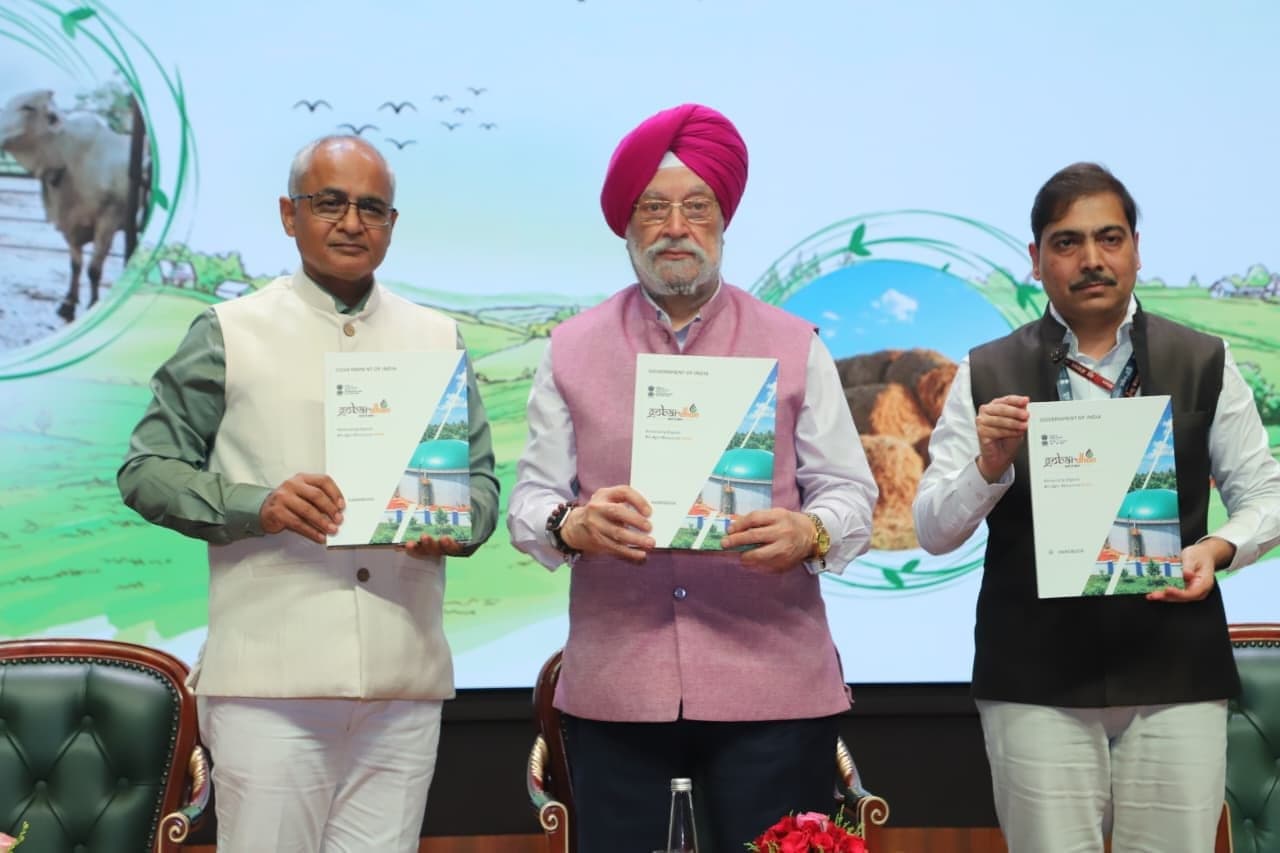
On 1 October 2026 Union Petroleum and Natural Gas Minister Hardeep Singh Puri launched the GOBARdhan Central Sector Scheme for compressed biogas, along with the GOBARdhan Handbook and the Unified GOBARdhan Portal.
Union Minister of Petroleum and Natural Gas Hardeep Singh Puri formally rolled out GOBARdhan, the Central Sector Scheme built to grow India’s Compressed Biogas (CBG) industry. The Union Cabinet had cleared the scheme on 6 August 2026.
Size and span of the scheme
The scheme carries an outlay of ₹23,731 crore and runs for ten years, from FY 2026-27 to FY 2035-36. Its stated aim is to lift domestic CBG output nearly ten times, to about 5 MMSCMD, so that investors and lenders get a long horizon to plan against. The Ministry of Petroleum and Natural Gas is the single nodal ministry, replacing the scattered support schemes the sector had earlier.
Six interventions
- CBG Offtake Assurance, under which plants are mapped to City Gas Distribution areas or CBG clusters
- A CBG Pricing Framework with an administered price of ₹2,110 per MMBtu
- Capital Assistance of up to ₹2 crore for every TPD of installed capacity in greenfield projects
- Pipeline infrastructure support, covering up to 80 per cent of eligible capital cost for cluster pipelines and up to 50 per cent for standalone plants joining CGD networks
- Credit Guarantee Support for MSME projects, covering up to 85 per cent of the amount outstanding at default
- The CBG Ecosystem Challenge Fund for technology, feedstock assessment and manure value addition
The purchase obligation
City Gas Distribution entities carry the CBG Obligation. For the CNG (transport) and PNG (domestic) segments they must buy 3 per cent of their requirement as CBG in FY 2026-27, 4 per cent the next year and 5 per cent from FY 2028-29 onward. The guarantee cap under the credit mechanism is ₹20 crore for a general MSME project and ₹25 crore where the enterprise is led by women.
What was also released
Two supports went live with the scheme: the GOBARdhan Handbook, a reference guide for developers, states and lenders, and the Unified GOBARdhan Portal, a single digital window for applications.
Where the sector stands
| Measure | Figure |
|---|---|
| Plants commissioned by August 2026 | More than 217 |
| Installed capacity | Over 1,700 TPD |
| Expected forex savings | More than ₹40,000 crore |
| Expected addition to GDP | Over ₹75,000 crore |
Secretary Neeraj Mittal said India imports nearly half the natural gas it uses, so turning organic waste into gas at home matters. The scheme is expected to create more than 1.5 lakh jobs, displace 10 million tonnes of fossil fuel, cut over 40 million tonnes of carbon dioxide and yield 250 million tonnes of organic manure. Puri tied it to the ideas of Waste to Wealth and Annadata to Urjadata.
Important Facts
| Scheme | GOBARdhan, a Central Sector Scheme for Compressed Biogas (CBG) |
|---|---|
| Launched by | Union Petroleum and Natural Gas Minister Hardeep Singh Puri |
| Outlay | Rs 23,731 crore |
| Period | FY 2026-27 to FY 2035-36 (ten years) |
| Cabinet approval | 6 August 2026 |
| Production target | Nearly ten-fold rise, to about 5 MMSCMD |
| Administered CBG price | Rs 2,110 per MMBtu |
| Nodal ministry | Ministry of Petroleum and Natural Gas |
| Also launched | GOBARdhan Handbook and Unified GOBARdhan Portal |
Exam Point of View
Hold on to the outlay (Rs 23,731 crore), the Cabinet approval date (6 August 2026), the span (FY 2026-27 to FY 2035-36), the administered price (Rs 2,110 per MMBtu), the CBG obligation ladder of 3, 4 and 5 per cent, and the nodal ministry. The six interventions and the two launches, Handbook and Unified Portal, are the other likely questions.
Practice Questions
What is the outlay of the GOBARdhan Scheme launched for the compressed biogas sector?
- A.Rs 10,900 crore
- B.Rs 23,731 crore
- C.Rs 31,500 crore
- D.Rs 45,000 crore
Show answer
Correct answer: B. Rs 23,731 crore
Explanation
The correct answer is Rs 23,731 crore. The Union Cabinet cleared GOBARdhan on 6 August 2026 with this outlay, and the scheme gives the compressed biogas sector a ten-year framework running from FY 2026-27 to FY 2035-36. Option A is wrong because no figure of that size appears anywhere in the scheme architecture; the smaller amounts named in the scheme are per-project limits, such as capital assistance of up to Rs 2 crore for each TPD of installed capacity. Option C is wrong for the same reason, and candidates often confuse an outlay with the expected gain to the economy, which the government puts at over Rs 75,000 crore added to GDP. Option D is wrong as well, and it is close to the expected foreign-exchange saving of more than Rs 40,000 crore rather than to the money the scheme spends. Only Rs 23,731 crore is the sanctioned outlay, so B is the answer a paper setter wants here.
Which ministry is the single nodal ministry for the GOBARdhan Scheme?
- A.Ministry of New and Renewable Energy
- B.Ministry of Agriculture and Farmers Welfare
- C.Ministry of Petroleum and Natural Gas
- D.Ministry of Jal Shakti
Show answer
Correct answer: C. Ministry of Petroleum and Natural Gas
Explanation
The correct answer is the Ministry of Petroleum and Natural Gas. One of the main changes GOBARdhan brings is that a single ministry now anchors compressed biogas instead of the fragmented support the sector had before, and that ministry is Petroleum and Natural Gas. Union Minister Hardeep Singh Puri launched the scheme and Secretary Neeraj Mittal addressed the gathering, which further fixes the ministry in place. Option A is a tempting distractor because biogas is a clean fuel, but renewable energy is not the nodal ministry here. Option B is wrong even though farmers, cooperatives and gaushalas supply feedstock such as crop residue and cattle dung; supplying feedstock does not make agriculture the nodal ministry. Option D is wrong because Jal Shakti deals with water resources and sanitation, not gas offtake or pricing. So C is correct.
Under GOBARdhan, what administered price has been fixed for compressed biogas?
- A.Rs 1,500 per MMBtu
- B.Rs 2,110 per MMBtu
- C.Rs 2,500 per MMBtu
- D.Rs 3,200 per MMBtu
Show answer
Correct answer: B. Rs 2,110 per MMBtu
Explanation
The correct answer is Rs 2,110 per MMBtu. The scheme sets this administered price so that producers can see their revenue in advance, which was one of the sector’s long-standing complaints along with fragmented support and poor access to finance. Options A, C and D are invented figures and none of them belongs to the pricing framework; mixing them up usually happens because the scheme carries several other numbers close in form, such as the guarantee cap of Rs 20 crore for a general MSME project and Rs 25 crore for a project led by women. Remember that the pricing framework is only one of the six interventions, the others being offtake assurance, capital assistance, pipeline infrastructure development, credit guarantee support and the CBG Ecosystem Challenge Fund. Keeping the price separate from the guarantee caps and the capital assistance of up to Rs 2 crore per TPD is what makes B the right choice.
Frequently Asked Questions
What is the outlay of the GOBARdhan Scheme?
Rs 23,731 crore. The Union Cabinet approved the scheme on 6 August 2026 and it provides a ten-year framework from FY 2026-27 to FY 2035-36 for the compressed biogas sector.
Which ministry is the nodal ministry for GOBARdhan?
The Ministry of Petroleum and Natural Gas is the single nodal ministry. Union Minister Hardeep Singh Puri launched the scheme, and Secretary Neeraj Mittal spoke at the event.
What CBG price has been fixed under the scheme?
An administered price of Rs 2,110 per MMBtu, meant to give producers revenue visibility. Greenfield projects can also get capital assistance of up to Rs 2 crore per TPD of installed capacity.
What is the CBG Obligation on gas distributors?
City Gas Distribution entities must buy CBG for 3 per cent of their CNG transport and domestic PNG segments in FY 2026-27, 4 per cent in FY 2027-28 and 5 per cent from FY 2028-29 onward.
Sources
- https://www.pib.gov.in/PressReleasePage.aspx?PRID=2317937 (opens in a new tab) — Press Information Bureau
Current Affairs 1 October 2026
- Swachhata Hi Seva 2026: Health Ministry Holds ShramdaanGovernment Schemes
- Narendra Bhooshan Assumes Charge as MoEFCC SecretaryAppointments
- Jal Jeevan Mission 2.0 Sets Aside Rs 5,000 Crore for Tribal VillagesGovernment Schemes
- Special Campaign 6.0 Begins 2 October With E-Waste FocusNational
- Surya Kiran Air Show Sought at Lonar, Ajanta and ElloraNational
- PM Modi Joins UPSC Centenary Celebrations at Bharat MandapamNational
- INS Trishul Joins 24th India-France Exercise Varuna at ToulonDefence
- 5th Kautilya Economic Conclave: Resilience in an Age of FluxSummits & Conferences
Related Current Affairs
- Government Schemes
SETU NSP App Brings Scholarship Services to One Platform
1 October 2026 · 2 min read
- Government Schemes
Jal Jeevan Mission 2.0 Sets Aside Rs 5,000 Crore for Tribal Villages
1 October 2026 · 2 min read
- Government Schemes
Swachhata Hi Seva 2026: Health Ministry Holds Shramdaan
1 October 2026 · 2 min read
- Government Schemes
PRIP First Round Clears 41 Projects With Rs 1,600 Crore Aid
30 September 2026 · 2 min read
Related GK
- Himachal Pradesh GK: Formation, Rivers and Exam Facts
1 October 2026 · Indian States & UTs
- Uttarakhand GK: Formation, Rivers, Parks and Exam Facts
1 October 2026 · Indian States & UTs
- Indian Railways Zones and Facts: Complete Exam Notes
1 October 2026 · Static GK
Take the Quiz
- Current Affairs Quiz
State Exams Current Affairs Quiz: 1 October 2026
25 questions25 minutesStart Quiz