
National FRA Digital Platform Launched for Forest Rights Claims
The Ministry of Tribal Affairs launched the National FRA Digital Platform during Janjatiya Gaurav Pakhwada, with 25.42 lakh forest rights titles given.
Why in News
On 16 November 2026 the Ministry of Tribal Affairs announced the launch of the National FRA Digital Platform during Janjatiya Gaurav Pakhwada, taking the entire forest rights claim process from Gram Sabha filing to digitally signed titles onto one system.
The Ministry of Tribal Affairs has launched the National FRA Digital Platform, a single online system for forest rights claims, during Janjatiya Gaurav Pakhwada, the fortnight of tribal pride programmes held across the country from 1 to 15 November 2026. The platform is built to carry a claim through every stage of its journey, from the moment a villager files it before the Gram Sabha to the day a digitally signed title reaches the claimant.
The law the platform serves
The Scheduled Tribes and Other Traditional Forest Dwellers (Recognition of Forest Rights) Act, known simply as the Forest Rights Act, won the assent of the President on 29 December 2006 and was brought into force on 31 December 2007. Its rules followed on 1 January 2008. Generations of forest dwellers had no paper to show for land they had always used, because their rights went unrecorded when State forests were consolidated. The Act repairs that gap by recognising both family and community rights over forest land. The Ministry of Tribal Affairs is the nodal ministry; States and Union Territories do the work on the ground. It runs in 20 States and in the Union Territory of Jammu and Kashmir.
Who may file a claim
- Members of Scheduled Tribes who live mainly in forests and draw their livelihood from them.
- Other traditional forest dwellers whose families have depended on the forest for three generations, counted in the law as 75 years, before 13 December 2005.
- A claim for a house or a field covers only the land actually in use, with a ceiling of four hectares, and a married couple is named jointly on the title.
- Three kinds of title exist: individual, community forest rights and community forest resource.
How a claim is decided
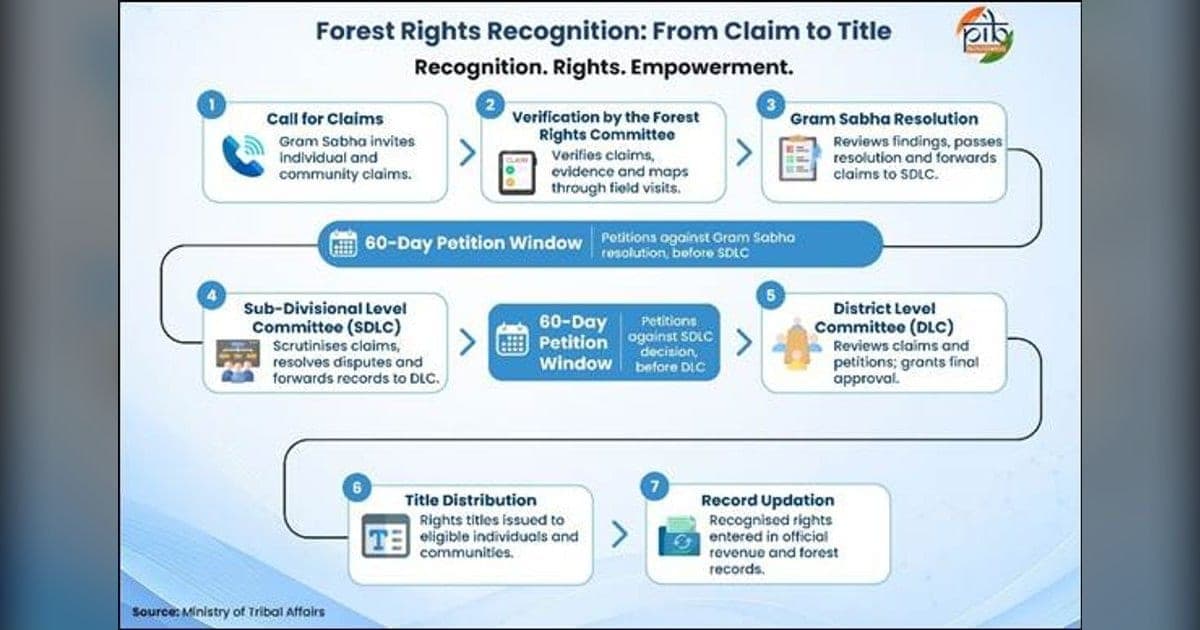
The Gram Sabha elects a Forest Rights Committee of ten to fifteen villagers; two-thirds of its members must come from Scheduled Tribes and a third must be women. The Gram Sabha verifies claims, maps the land and passes a resolution, which travels to the Sub-Divisional Level Committee and then to the District Level Committee, whose ruling is final and binding. A claimant who disagrees may petition the next committee within 60 days, with up to 30 days more allowed. Every rejection must carry a written order with reasons. A State Level Monitoring Committee under the Chief Secretary reviews progress once in three months.
Where the numbers stand
As on 31 August 2026 roughly 54 lakh claims had been filed. Of these, 43.56 lakh, or 80.64 per cent, had been disposed of, and 25.42 lakh titles had been handed over, covering close to 238 lakh acres of forest land. The tally splits into 24.18 lakh individual titles and 1.24 lakh community titles.
| Stage | As on 31 August 2026 |
| Claims received | About 54 lakh |
| Claims disposed of | 43.56 lakh, or 80.64 per cent |
| Titles distributed | 25.42 lakh |
| Individual titles | 24.18 lakh |
| Community titles | 1.24 lakh |
| Area covered | Nearly 238 lakh acres |
Chhattisgarh has given out more titles than any other State, and Odisha, Madhya Pradesh, Telangana and Andhra Pradesh follow in that order. Chhattisgarh also stands first on community titles, which belong to a village as a whole rather than to one family.
What the Centre gives the States
Under the Dharti Aaba Janjatiya Gram Utkarsh Abhiyan the ministry pays for dedicated FRA cells in States and districts for two years, and funds State portals, digital mapping, servers and security audits. Each Community Forest Resource Management Plan drawn up by a Gram Sabha draws Rs 15 lakh, with another Rs 1 lakh for technical help, while the Support to Tribal Research Institutes scheme gives Rs 25 lakh to a State for mapping potential forest area. Habitat rights have so far gone to 11 Particularly Vulnerable Tribal Groups in Odisha, Chhattisgarh and Madhya Pradesh. Three regional review conferences were held in Bengaluru, Kolkata and Srinagar in September and October 2026 with 19 States and Jammu and Kashmir.
Important Facts
| Launched | National FRA Digital Platform, during Janjatiya Gaurav Pakhwada (1 to 15 November 2026) |
|---|---|
| Nodal ministry | Ministry of Tribal Affairs |
| Act | Forest Rights Act, 2006; assent 29 December 2006; in force 31 December 2007; rules 1 January 2008 |
| Coverage | 20 States and the Union Territory of Jammu and Kashmir |
| Eligibility cut-off | Forest land occupied before 13 December 2005; three generations means 75 years |
| Land ceiling | Up to four hectares for a home or cultivation claim |
| Deciding body | District Level Committee; its decision is final and binding |
| Titles distributed | 25.42 lakh over nearly 238 lakh acres, as on 31 August 2026 |
| State order | Chhattisgarh first, then Odisha, Madhya Pradesh, Telangana and Andhra Pradesh |
| Habitat rights | 11 Particularly Vulnerable Tribal Groups in Odisha, Chhattisgarh and Madhya Pradesh |
Exam Point of View
Remember the Act dates (assent 29 December 2006, in force 31 December 2007, rules 1 January 2008), the nodal ministry, the cut-off of 13 December 2005, the four-hectare ceiling, the Gram Sabha to SDLC to DLC route with the DLC decision final, the 60-day appeal window, and the figures as on 31 August 2026: 25.42 lakh titles over 238 lakh acres and Chhattisgarh on top.
Practice Questions
On which date did the Forest Rights Act, 2006 come into force?
- A.29 December 2006
- B.31 December 2007
- C.1 January 2008
- D.13 December 2005
Show answer
The Scheduled Tribes and Other Traditional Forest Dwellers (Recognition of Forest Rights) Act was passed in 2006, but a law takes effect only from the day it is notified to commence, and for this Act that day was 31 December 2007.
Read the full explanation →How many forest rights titles had been distributed in India as on 31 August 2026?
- A.43.56 lakh
- B.24.18 lakh
- C.25.42 lakh
- D.54 lakh
Show answer
That is the number of forest rights titles actually handed over to claimants as on 31 August 2026, and they cover nearly 238 lakh acres of forest land.
Read the full explanation →Which State has distributed the largest number of forest rights titles?
- A.Odisha
- B.Madhya Pradesh
- C.Chhattisgarh
- D.Telangana
Show answer
In the State-wise position as on 31 August 2026 it stands first in forest rights titles distributed, and it leads on community titles as well, the kind of title that belongs to a village as a whole rather than to one family.
Read the full explanation →Under which programme does the Ministry of Tribal Affairs fund dedicated FRA cells in States and districts?
- A.Dharti Aaba Janjatiya Gram Utkarsh Abhiyan
- B.Support to Tribal Research Institutes
- C.Pradhan Mantri Kisan Samman Nidhi
- D.Mission Karmayogi
Show answer
This programme, launched to close infrastructure gaps in tribal villages, carries support for dedicated FRA cells at the State and district level for two years, so that pending claims are settled and the sub-divisional and district committees meet on time.
Read the full explanation →Frequently Asked Questions
What is the National FRA Digital Platform?
It is a single online system launched by the Ministry of Tribal Affairs during Janjatiya Gaurav Pakhwada, the fortnight observed from 1 to 15 November 2026. It carries a forest rights claim through every stage, from submission before the Gram Sabha to the issue of a digitally signed title, and the ministry has urged States to link their own records with it.
How many forest rights titles have been distributed so far?
As on 31 August 2026, 25.42 lakh titles had been distributed over nearly 238 lakh acres. These include 24.18 lakh individual and 1.24 lakh community titles. About 54 lakh claims had been received and 43.56 lakh of them, or 80.64 per cent, had been disposed of.
Which committee takes the final decision on a forest rights claim?
The District Level Committee. A claim begins with the Gram Sabha, which verifies it and passes a resolution; the Sub-Divisional Level Committee prepares the record of forest rights and sends it to the District Level Committee, whose decision is final and binding. An appeal may be filed with the next committee within 60 days.
Sources
- https://www.pib.gov.in/PressReleasePage.aspx?PRID=2336824 (opens in a new tab) — Press Information Bureau
Current Affairs 16 November 2026
- India-Egypt 7th Joint Trade Committee Meets at Ministerial LevelInternational
- Modi Departs for 23rd ASEAN-India Summit in ManilaSummits & Conferences
- WPI Inflation Climbs to 12.29 Per Cent in October 2026Economy
- 31st CII Partnership Summit 2026 Held in VisakhapatnamSummits & Conferences
- Vice-President Opens 17th Odisha Assembly Orientation ProgrammeState News
- Kutch Earthquake 2001: Rebuilding, GSDMA and Key FiguresNational
- COVID-19 Response: 22.89 Crore Precaution Doses AdministeredNational
- TDB Backs NeoSeeker Metals Critical Minerals Recycling ProjectScience & Technology
Related Current Affairs
- Government Schemes
EPFO Lounge and ESIC Pavilion Open at IITF 2026 in Delhi
15 November 2026 · 2 min read
- Government Schemes
Agriculture Pavilion at IITF 2026 Runs on Seed to Market
15 November 2026 · 2 min read
- Government Schemes
Lakhpati Didi Count Reaches 3.76 Crore Against 6 Crore Target
15 November 2026 · 2 min read
- Government Schemes
TULIP Brand Pushed as 130 Artisans Join 45th IITF 2026
14 November 2026 · 2 min read
- Government Schemes
AVYAY Elderly Care to Reach Cantonment Boards Under New MoU
14 November 2026 · 2 min read
- Government Schemes
NSS Block-Level Sports Meets Draw 87,481 in Anti-Drug Drive
14 November 2026 · 2 min read


Related GK
- Famous Personalities of Rajasthan: Exam Notes
28 October 2026 · Rajasthan
- Districts and Divisions of Rajasthan: Exam Notes
28 October 2026 · Rajasthan
- Tourism and World Heritage Sites of Rajasthan Notes
27 October 2026 · Rajasthan
Take the Quiz
- Current Affairs Quiz
State Exams Current Affairs Quiz: 16 November 2026
25 questions25 minutesStart Quiz