
Delhi Gets 150 Electric Buses and 13 New CAAQMS Stations
Bhupender Yadav and Delhi CM Rekha Gupta flagged off 150 electric buses and opened 13 new air quality monitoring stations, taking Delhi's network to 60.

Why in News
On 13 October 2026 Union Environment Minister Bhupender Yadav and Delhi Chief Minister Rekha Gupta reviewed the Anand Vihar pollution hotspot, flagged off 150 electric buses and inaugurated 13 new air quality monitoring stations in Delhi.
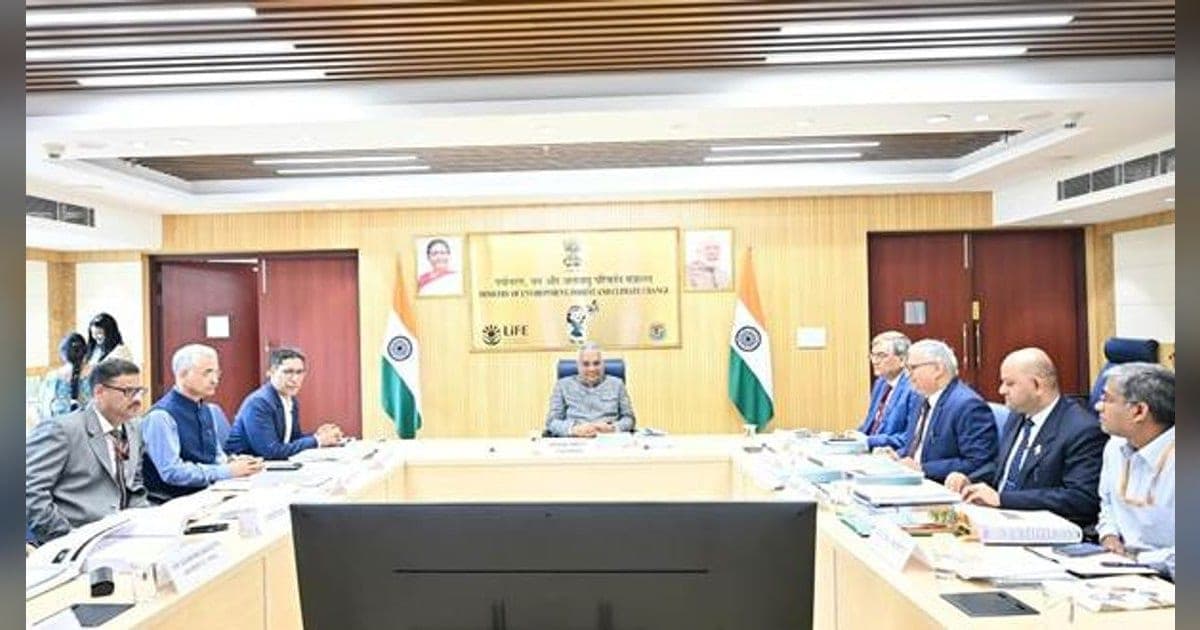
Union Minister for Environment, Forest and Climate Change Bhupender Yadav and Delhi Chief Minister Rekha Gupta reviewed air pollution control work at the Anand Vihar hotspot on 13 October 2026 and visited the Delhi Pollution Control Committee's Integrated Command and Control Centre at Shastri Park.
What was launched
The two leaders flagged off 150 new electric buses at Swami Vivekanand ISBT, Anand Vihar, under the Sewa Sankalp Abhiyaan. They also opened public electric vehicle charging stations at five places, namely ISBT Anand Vihar and the bus depots at Nand Nagri, Rohini Sector-37, Nangloi and Keshopur. Thirteen new Continuous Ambient Air Quality Monitoring Stations, or CAAQMS, set up by the pollution control committee across the capital were inaugurated on the same occasion.
A denser monitoring grid
Delhi already had 47 such stations run by several agencies, among them the pollution control committee, the Central Pollution Control Board, the India Meteorological Department, the Indian Institute of Tropical Meteorology and the housing ministry. With the new additions the network rises to 60 stations. Besides the older norms based on population, monitoring now works to a grid of one station for every 25 square kilometres, that is a five kilometre by five kilometre square, and the minister said the grid would be widened to other cities in the National Capital Region. Readings reach the public through the board's server and the SAMEER mobile application.
The Anand Vihar hotspot
Anand Vihar had turned into a pollution hotspot because of traffic at the bus terminal, dust from unpaved roads and roadsides, potholes, construction and demolition waste, garbage dumping and open burning. Short term and long term tasks were handed to eleven agencies. Internal roads were paved, encroachment removed, green netting and dust control enforced at construction sites, illegal waste dumping cleared and congestion eased, while greening work continues.
The command centre
The AI-enabled centre at Shastri Park pulls together data on air quality, dust control sites, noise levels, industrial emissions, stubble burning, citizen complaints and enforcement vehicles on one platform, using cameras and location tracking for round-the-clock watch. It is designed to link fifteen external data systems, of which nine are connected and the rest are being added in phases.
Important Facts
| Event date | 13 October 2026 |
|---|---|
| Union Environment Minister | Bhupender Yadav |
| Delhi Chief Minister | Rekha Gupta |
| Hotspot reviewed | Anand Vihar, Delhi |
| Electric buses flagged off | 150, under Sewa Sankalp Abhiyaan |
| New monitoring stations | 13 CAAQMS, taking the network to 60 |
| Monitoring grid | One station per 25 square kilometres |
| Command centre | AI-enabled ICCC of DPCC at Shastri Park |
| Public access to data | CPCB server and SAMEER mobile app |
Exam Point of View
Remember the two leaders involved, the hotspot reviewed (Anand Vihar), the scheme named for the bus flag-off (Sewa Sankalp Abhiyaan), the count of 150 electric buses and 13 new CAAQMS, the network size rising from 47 to 60 stations, the one station per 25 square kilometre grid, the SAMEER app and the ICCC at Shastri Park run by DPCC.
Practice Questions
How many electric buses were flagged off at Anand Vihar in Delhi on 13 October 2026?
- A.100
- B.150
- C.250
- D.500
Show answer
The Union Minister for Environment, Forest and Climate Change, Bhupender Yadav, along with Delhi Chief Minister Rekha Gupta, flagged off 150 new electric buses at Swami Vivekanand ISBT in Anand Vihar under the Sewa Sankalp Abhiyaan, as part of the capital's push towards cleaner public transport.
Read the full explanation →After the stations inaugurated on 13 October 2026, how many Continuous Ambient Air Quality Monitoring Stations does Delhi have?
- A.47
- B.53
- C.60
- D.75
Show answer
Delhi had forty-seven monitoring stations run by various agencies, among them the Delhi Pollution Control Committee, the Central Pollution Control Board, the India Meteorological Department, the Indian Institute of Tropical Meteorology and the ministry dealing with housing and urban affairs.
Read the full explanation →Where is the AI-enabled Integrated Command and Control Centre of the Delhi Pollution Control Committee located?
- A.Anand Vihar
- B.Shastri Park
- C.Keshopur
- D.Nand Nagri
Show answer
The centre acts as a single digital platform bringing together data on air quality, dust control sites, ambient noise, industrial emissions, stubble burning incidents, citizen grievances and enforcement vehicles, and uses cameras and location tracking for round-the-clock watch.
Read the full explanation →Frequently Asked Questions
How many electric buses were flagged off in Delhi on 13 October 2026?
150 electric buses were flagged off at Swami Vivekanand ISBT, Anand Vihar, under the Sewa Sankalp Abhiyaan by Union Environment Minister Bhupender Yadav and Delhi Chief Minister Rekha Gupta.
How large is Delhi's air quality monitoring network now?
Sixty stations. Delhi had 47 CAAQMS run by agencies such as DPCC, CPCB, IMD and IITM, and 13 new stations set up by DPCC were inaugurated on 13 October 2026.
What is the ICCC at Shastri Park?
It is the AI-enabled Integrated Command and Control Centre of the Delhi Pollution Control Committee. It brings air quality, dust, noise, industrial emission, stubble burning and complaint data onto one platform for round-the-clock monitoring.
Sources
- https://www.pib.gov.in/PressReleasePage.aspx?PRID=2322719 (opens in a new tab) — Press Information Bureau
Current Affairs 13 October 2026
- Ashtalakshmi Darshan Programme Takes 590 Students to NortheastGovernment Schemes
- Khadi Sales Touch Record Rs 1.87 Lakh Crore in 2025-26Government Schemes
- Bloomberg New Economy Forum Held in India for the First TimeSummits & Conferences
- BHASHINI Runs Live Translation at NCGG Mussoorie ProgrammeScience & Technology
- DARPG Releases 53rd CPGRAMS Monthly Report for September 2026Reports & Indices
- Indian Railways Freight Loading Rises 6.14% in September 2026Economy
- NLMC's First End-to-End E-Auction Sells 150 RINL Land PlotsEconomy
- Rajnath Singh Holds Defence Talks With Czech Deputy PMDefence
Related Current Affairs
- Environment
NBA Releases Rs 13.76 Crore in ABS Funds to 28 States, 4 UTs
27 November 2026 · 2 min read
- Environment
Coal Ministry Issues Mining and Mine Closure Plan Guidelines 2026
23 November 2026 · 2 min read


Related GK
- Famous Personalities of Rajasthan: Exam Notes
28 October 2026 · Rajasthan
- Districts and Divisions of Rajasthan: Exam Notes
28 October 2026 · Rajasthan
- Tourism and World Heritage Sites of Rajasthan Notes
27 October 2026 · Rajasthan
Take the Quiz
- Current Affairs Quiz
Delhi Current Affairs Quiz: October 2026
50 questions50 minutesStart Quiz