
Nine Cheetah Cubs Born at Kuno, India's Tally Reaches 62
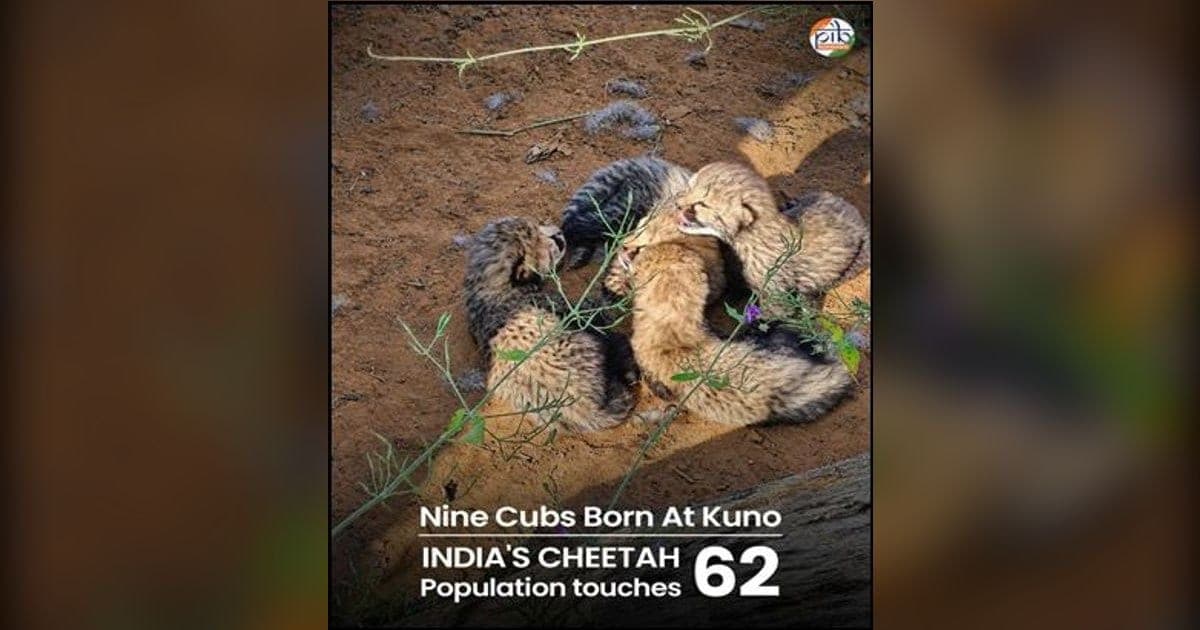
Two litters at Kuno National Park added nine cubs, taking India’s cheetah population to 62, of which 43 were born in the country under Project Cheetah.
Why in News
A PIB backgrounder of 26 November 2026 reported two fresh litters at Kuno National Park, nine new cubs in all, lifting India’s cheetah population to 62 under Project Cheetah.
Two successive litters at Kuno National Park in Madhya Pradesh have added nine cubs to India's cheetah population, which has now climbed to 62 animals. Of these, 43 were born on Indian soil, so India-born cheetahs make up close to 70 per cent of the total. The park lies in Sheopur district, in the northern stretch of the Vindhyachal range, and remains the main site of the reintroduction programme.
The two litters
- On 5 October 2026 a 32-month-old India-born female, KJP21, delivered five healthy cubs. She is the third India-born female to breed, after Mukhi and KGP12. Because the father is a male brought from Botswana, the litter carries the Botswana lineage into the India-born stock.
- On 20 November 2026 KOMG 3, a 30-month-old female brought from Botswana, delivered four cubs. She is the first Botswana-origin female to give birth in India, and she did so in free-ranging conditions after more than four months outside the fenced enclosures.
The second birth is only the second recorded case of a cheetah littering in the open wild, outside the Closed Natural Areas, since the programme began in 2022. The National Action Plan treats breeding by the first India-born generation and breeding in the wild as two of the markers of a successfully settled population.
How the programme began
The cheetah was declared extinct in India in 1952, after the last three wild Asiatic cheetahs were shot in the Sal forests of what is now Koriya district of Chhattisgarh in December 1947. The species had once ranged from Punjab to Tirunelveli. Project Cheetah restarted the story on 17 September 2022, when eight cheetahs flown in from Namibia were released into quarantine enclosures at Kuno by the Prime Minister. Twelve more arrived from South Africa in February 2023, and nine from Botswana on 28 February 2026, six of them females. The Ministry of Environment, Forest and Climate Change runs the project through the National Tiger Conservation Authority.
Habitat, people and the road ahead
Kuno was freed of human pressure by shifting 24 villages and 1,545 families, releasing about 6,258 hectares for wildlife. More than 450 Cheetah Mitras work across 80 villages, roughly 380 direct jobs have been created, and nearby villages get a five per cent share of eco-tourism earnings. The target is a self-sustaining metapopulation of 60 to 70 cheetahs by 2032 across about 17,000 square kilometres of the Kuno and Gandhi Sagar landscape. Gandhi Sagar Wildlife Sanctuary is the second site, where Prabash and Paavak were shifted in April 2025, and Veerangana Durgavati Tiger Reserve in Sagar district became the State's third cheetah home in October 2026.
Important Facts
| Site of the births | Kuno National Park, Sheopur district, Madhya Pradesh |
|---|---|
| First litter | Five cubs to KJP21, an India-born female, on 5 October 2026 |
| Second litter | Four cubs to KOMG 3, a Botswana-brought female, on 20 November 2026 |
| Cheetahs in India now | 62, of which 43 were born in India |
| Project launched | 17 September 2022, with eight cheetahs from Namibia |
| Implementing body | National Tiger Conservation Authority, under the Ministry of Environment, Forest and Climate Change |
| Second and third sites | Gandhi Sagar Wildlife Sanctuary and Veerangana Durgavati Tiger Reserve, Sagar district |
| Target | 60 to 70 cheetahs by 2032 over about 17,000 square kilometres |
Exam Point of View
Fix the numbers: 62 cheetahs in India, 43 born here, nine new cubs, five from KJP21 on 5 October 2026 and four from KOMG 3 on 20 November 2026. Also remember Kuno in Sheopur district, the 1952 extinction, the 17 September 2022 release of eight Namibian cheetahs, NTCA as the implementing body and the 2032 target.
Practice Questions
Nine cheetah cubs were born in two litters during October and November 2026 at which protected area?
- A.Gandhi Sagar Wildlife Sanctuary
- B.Kuno National Park
- C.Veerangana Durgavati Tiger Reserve
- D.Nauradehi Wildlife Sanctuary
Show answer
Both litters were born at Kuno, which lies in Sheopur district of Madhya Pradesh in the northern part of the Vindhyachal range and is the principal site of the cheetah reintroduction programme.
Read the full explanation →Which cheetah became the first female brought from Botswana to give birth in India?
- A.Mukhi
- B.KGP12
- C.KOMG 3
- D.KJP21
Show answer
She is a 30-month-old female brought from Botswana and she delivered four healthy cubs on 20 November 2026, making her the first Botswana-origin female to litter in India.
Read the full explanation →Project Cheetah is implemented by the Ministry of Environment, Forest and Climate Change through which body?
- A.Wildlife Institute of India
- B.National Tiger Conservation Authority
- C.Central Zoo Authority
- D.National Biodiversity Authority
Show answer
Project Cheetah is run by the Ministry of Environment, Forest and Climate Change through the NTCA, and its stated aim is to restore the cheetah as a flagship species of open forests and grasslands.
Read the full explanation →How many cheetahs does India now have, and how many of them were born in the country?
- A.52 in all, 33 born in India
- B.62 in all, 43 born in India
- C.70 in all, 50 born in India
- D.60 in all, 40 born in India
Show answer
With the November litter the population reached 62 animals, of which 43 were born on Indian soil, so cheetahs born here account for close to 70 per cent of the total.
Read the full explanation →Frequently Asked Questions
How many cheetahs are there in India after the November 2026 litter?
India now has 62 cheetahs, of which 43 were born in the country. The two recent litters at Kuno National Park added nine cubs in all, five on 5 October 2026 and four on 20 November 2026.
Which cheetah became the first Botswana-brought female to give birth in India?
KOMG 3, a 30-month-old female brought from Botswana, delivered four cubs on 20 November 2026 at Kuno National Park. She littered in free-ranging conditions, the second such wild birth since the programme began in 2022.
When did Project Cheetah begin and who runs it?
It began on 17 September 2022, when eight cheetahs from Namibia were released at Kuno National Park. The Ministry of Environment, Forest and Climate Change runs it through the National Tiger Conservation Authority.
Which are the cheetah sites in Madhya Pradesh?
Kuno National Park is the principal site. Gandhi Sagar Wildlife Sanctuary is the second site, receiving Prabash and Paavak in April 2025, and Veerangana Durgavati Tiger Reserve in Sagar district became the third in October 2026.
Sources
- चीतों की वापसी और बढ़ती रफ्तार (opens in a new tab) — Press Information Bureau
Current Affairs 26 November 2026
- Chariot-1 Foundation Models Launched Under IndiaAI MissionScience & Technology
- MoSPI Launches State Dashboard on eSankhyiki PortalReports & Indices
- NLMC Board Takes Up ₹1,300 Crore Monetisation ProposalsEconomy
- Constitution Day Observed on 26 November With Preamble ReadingImportant Days
- 57th IFFI Campus at Panaji Showcases Creative InstitutionsNational
Related Current Affairs
- Environment
Coal Ministry Issues Mining and Mine Closure Plan Guidelines 2026
23 November 2026 · 2 min read
- Environment
CSIR-NEERI Holds Clean Air Workshop for Indo-Gangetic Plains
21 November 2026 · 2 min read
Related GK
- Famous Personalities of Rajasthan: Exam Notes
28 October 2026 · Rajasthan
- Districts and Divisions of Rajasthan: Exam Notes
28 October 2026 · Rajasthan
- Tourism and World Heritage Sites of Rajasthan Notes
27 October 2026 · Rajasthan
Take the Quiz
- Current Affairs Quiz
State Exams Current Affairs Quiz: 26 November 2026
19 questions19 minutesStart Quiz