
DFS Orders Scheme-Wise Reporting of SC Beneficiaries by Banks
After NCSC intervention, the Department of Financial Services directed SLBCs and UTLBCs to report scheme-wise and bank-wise Scheduled Caste beneficiary data.
Why in News
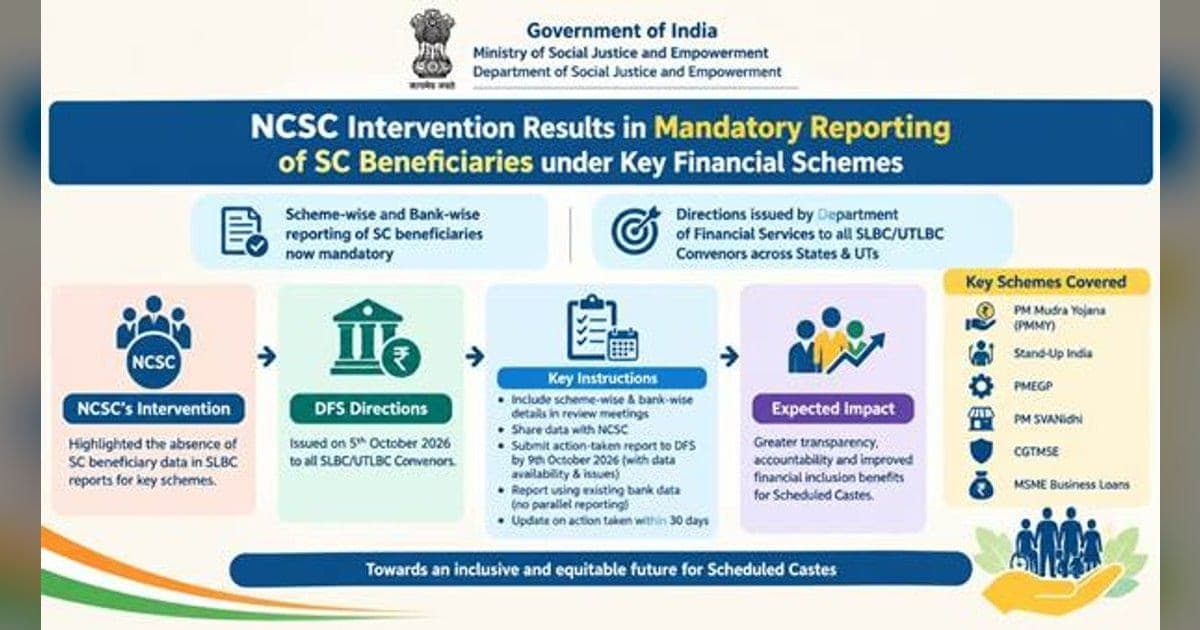
On 7 October 2026 the Social Justice Ministry said that, after the National Commission for Scheduled Castes intervened, the Department of Financial Services has ordered mandatory scheme-wise and bank-wise reporting of Scheduled Caste beneficiaries by SLBC and UTLBC convenors.
The Department of Financial Services (DFS) in the Finance Ministry has told bankers' committees in every State and Union Territory to count, scheme by scheme and bank by bank, the Scheduled Caste borrowers helped under the government's main financial schemes. The order follows an intervention by the National Commission for Scheduled Castes (NCSC).
How the matter began
On 24 September 2026 the Commission's Secretary, Shri Vivek Kumar Dewangan, wrote to the Secretary, DFS, pointing out that reports of the State Level Bankers' Committee carried no figure for the share of Scheduled Caste families and beneficiaries assisted under major schemes. The schemes he named were Pradhan Mantri Mudra Yojana, Stand-Up India, the Prime Minister's Employment Generation Programme, PM SVANidhi, CGTMSE and MSME business loans.
Without that data, the Commission argued, it could not discharge the duty Article 338(5)(c) of the Constitution places on it, which is to evaluate the progress of socio-economic development of the Scheduled Castes.
What the directions say
- Convenors of State Level Bankers' Committees and their Union Territory counterparts must place, at their periodic review meetings, the number and the percentage of Scheduled Caste beneficiaries assisted, split by scheme and by bank.
- The same information has to be shared with the Commission regularly.
- An action-taken report, covering how far the data exists and what makes compilation difficult, is due to DFS by 9 October 2026.
- An update on the action taken must follow within 30 days.
- The exercise has to draw on data that banks and implementing agencies already hold, so that definitions and method stay uniform and no parallel reporting system grows up alongside.
DFS issued the directions on 5 October 2026 to convenors across all States and Union Territories. The Commission has said it will keep watching how they are carried out and stay in touch with the agencies concerned. Read scheme-wise and bank-wise, the figures should show whether financial inclusion is in fact reaching Scheduled Caste households, and give the Commission firmer ground for the constitutional assessment it owes Parliament.
Important Facts
| Commission | National Commission for Scheduled Castes (NCSC) |
|---|---|
| Directions issued by | Department of Financial Services, Ministry of Finance |
| Date of directions | 5 October 2026 |
| Who must report | SLBC and UTLBC convenors in all States and Union Territories |
| What must be reported | Number and percentage of SC beneficiaries, scheme-wise and bank-wise |
| Schemes named | PMMY, Stand-Up India, PMEGP, PM SVANidhi, CGTMSE and MSME business loans |
| Action-taken report due | 9 October 2026 |
| Update on action taken | Within 30 days |
| Constitutional provision | Article 338(5)(c) |
| NCSC Secretary | Shri Vivek Kumar Dewangan |
Exam Point of View
Remember the two bodies involved (NCSC and the Department of Financial Services), the constitutional hook (Article 338(5)(c)), the committees that must report (SLBC and UTLBC), the six schemes listed, the letter of 24 September 2026, the directions of 5 October 2026, the 9 October 2026 deadline for the action-taken report and the 30-day window for an update.
Practice Questions
Which department has directed bankers committees to report Scheduled Caste beneficiary data scheme-wise and bank-wise?
- A.Department of Financial Services
- B.Department of Expenditure
- C.Department of Revenue
- D.Department of Economic Affairs
Show answer
Correct answer: A. Department of Financial Services
Explanation
The correct answer is the Department of Financial Services. It is the department of the Finance Ministry that deals with banks, insurance and the financial inclusion schemes, and it is the body that issued the directions to convenors of State Level Bankers Committees and their Union Territory counterparts after the National Commission for Scheduled Castes raised the gap. Option B, the Department of Expenditure, handles public expenditure management, financial rules and pay matters, and has no role in directing bankers committees. Option C, the Department of Revenue, looks after direct and indirect taxes through the two Boards under it, again unrelated to this instruction. Option D, the Department of Economic Affairs, deals with macroeconomic policy, the Budget and external assistance. Only the Department of Financial Services has administrative charge of banks and the lending schemes named in the Commission letter.
Under which constitutional provision is the National Commission for Scheduled Castes required to evaluate the socio-economic development of Scheduled Castes?
- A.Article 338(5)(c)
- B.Article 330
- C.Article 341
- D.Article 342
Show answer
Correct answer: A. Article 338(5)(c)
Explanation
The correct answer is Article 338(5)(c). The Commission told the Department of Financial Services that the absence of Scheduled Caste beneficiary figures in bankers committee reports was hindering the constitutional mandate this clause gives it, namely to evaluate the progress of socio-economic development of the Scheduled Castes. That is precisely why it asked for scheme-wise and bank-wise data. Option B deals with the reservation of seats for Scheduled Castes and Scheduled Tribes in the House of the People, a matter of political representation rather than evaluation. Option C empowers the President to specify the castes that shall be deemed Scheduled Castes in relation to a State or Union Territory. Option D does the same for Scheduled Tribes. None of these three concerns the evaluative duty the Commission invoked here, so only the first option fits.
By when must the bankers committees submit their action-taken report to the Department of Financial Services?
- A.5 October 2026
- B.9 October 2026
- C.24 September 2026
- D.30 October 2026
Show answer
Correct answer: B. 9 October 2026
Explanation
The correct answer is 9 October 2026. The directions ask convenors of State Level Bankers Committees and Union Territory Level Bankers Committees to share the Scheduled Caste beneficiary information with the Commission regularly and to send an action-taken report to the Department of Financial Services by that date, setting out how far the data is available and what difficulties arise in compiling it. An update on the action taken is separately due within thirty days. Option A is the date on which the Department of Financial Services itself issued the directions to the convenors, not the deadline for their reply. Option C is the date on which the Commission Secretary wrote to the Department of Financial Services, which is where the matter started. Option D does not figure in the directions at all.
Frequently Asked Questions
Which constitutional provision does the NCSC rely on in this case?
Article 338(5)(c), which asks the Commission to evaluate the progress of socio-economic development of the Scheduled Castes. The absence of SC beneficiary figures in bankers committee reports was hindering that duty.
Which schemes must now carry Scheduled Caste beneficiary data?
Pradhan Mantri Mudra Yojana, Stand-Up India, the Prime Minister Employment Generation Programme, PM SVANidhi, CGTMSE and MSME business loans, as listed in the Commission letter to the Department of Financial Services.
By when must the bankers committees report back?
An action-taken report must reach the Department of Financial Services by 9 October 2026, and an update on the action taken is due within 30 days. Reporting must use data banks already hold.
Sources
Current Affairs 7 October 2026
- Pre-COP31 in Fiji: Bhupender Yadav Leads Indian DelegationEnvironment
- Additive Manufacturing: MeitY's NSAM Moves to NSAM 2.0 PhaseScience & Technology
- TRAI Drive Test Grades Mobile Networks in Balasore CityReports & Indices
- Fleet Support Ship FSS-1 Launched at Hindustan ShipyardDefence
- 153rd IPU Assembly: Harivansh Leads India in ArushaInternational
- Piyush Goyal Meets Top US Firms in New York on InvestmentEconomy
- MoSPI Releases Environmental Accounts Strategy for 2026-2030Reports & Indices
- Textiles Ministry Wraps Up Swachhata Hi Seva 2026 DriveGovernment Schemes
Related Current Affairs
- Banking & Finance
DFS Reviews Financial Inclusion Schemes, Plans FI Saturation Drive
6 October 2026 · 2 min read
- Banking & Finance
NABKISAN Raises ₹180 Crore Through India's First WASH Bond
3 October 2026 · 2 min read
- Banking & Finance
Bankers' Books Evidence Act 2026 Replaces 1891 Law from 1 October
30 September 2026 · 2 min read
- Banking & Finance
Government Urges PSB and RRB Staff to Call Off Bank Strikes
21 September 2026 · 2 min read
- Banking & Finance
Bankers' Books Evidence Act 2026 in Force from 1 October
11 September 2026 · 2 min read
Related GK
- Arunachal Pradesh GK: Tawang, Tribes, Rivers and Exam Facts
7 October 2026 · Indian States & UTs
- Geographical Epithets of the World: Nicknames of Places
7 October 2026 · Static GK
- Cyber Security and Digital Public Infrastructure: Notes
7 October 2026 · Science & Technology
Take the Quiz
- Current Affairs Quiz
SBI Current Affairs Quiz: 7 October 2026
16 questions16 minutesStart Quiz