
Bankers' Books Evidence Act 2026 Replaces 1891 Law from 1 October
The Bankers' Books Evidence Act, 2026 comes into force on 1 October 2026, replacing the 1891 law and making digital bank records admissible as evidence.
Why in News
PIB issued a backgrounder on the Bankers' Books Evidence Act, 2026, which comes into force on 1 October 2026 and replaces the Bankers' Books Evidence Act, 1891 with a technology-neutral framework for admitting banking records as evidence.
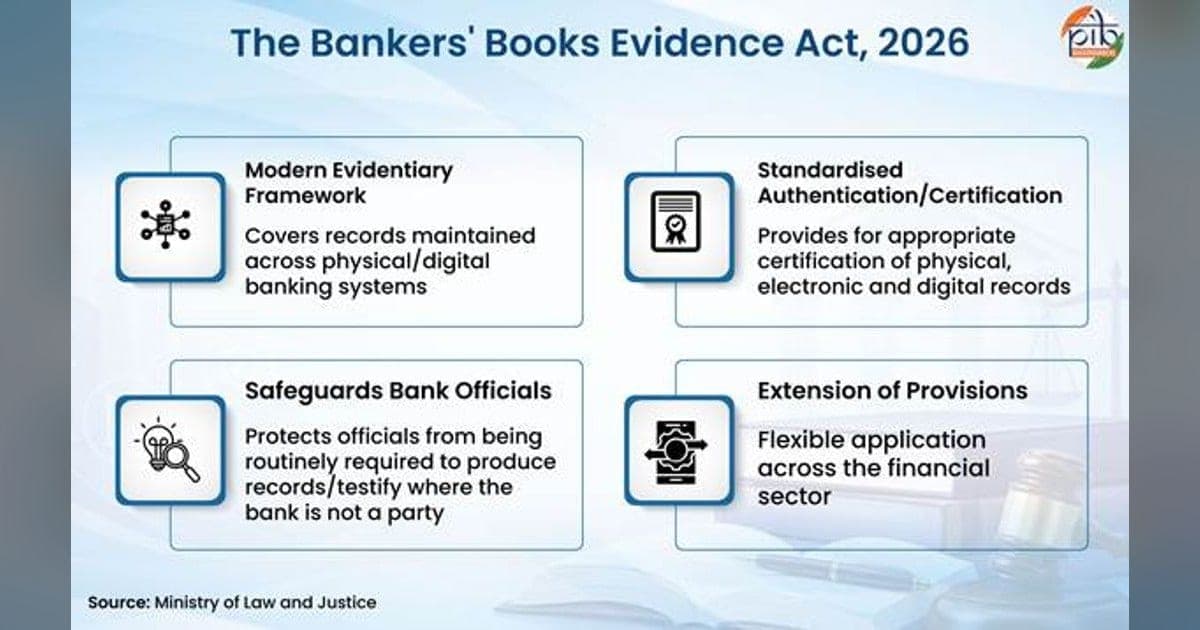
The Bankers' Books Evidence Act, 2026 comes into force on 1 October 2026 and replaces the Bankers' Books Evidence Act, 1891, a colonial-era law written when banking was entirely paper-based. The new Act sets out how bank records are to be admitted as evidence, and it does so in a technology-neutral way that covers physical, electronic and digital records alike.
Where the Act applies
The law will be used in any legal proceeding, in arbitration, and in any investigation or inquiry under the Bharatiya Nagarik Suraksha Sanhita, 2023 or under any other law in force, wherever evidence is or may be taken. Bankers' books are defined to include ledgers, day-books, cash-books, account books and every other record kept in the ordinary course of a bank's business, whether written on paper or held in any form of data storage.
What changes
The 2026 Act keeps the core idea of the old law, which is that banking records are proved through certified copies, and then modernises it. An electronic or digital record of a banker's book is now admissible, valid and legally enforceable as evidence, provided three conditions are met: the copy is a true copy of the entry and correctly represents or is properly derived from the records; no unauthorised change to the data is detected; and no tampering or other event affecting the integrity and accuracy of the system is detected. Authentication may be done through manual, digital or electronic signatures.
Relief for bank officers
Contents of a banker's book may be proved through a certified copy without producing the original. A bank officer therefore cannot ordinarily be compelled to produce the book or appear as a witness, particularly where the bank is not a party to the proceeding. An officer may be summoned only under a written order of the court recording a special cause. The Act specifies what counts as special cause: the accuracy or authenticity of the entry is uncertain; the regularity of record keeping was interrupted by some event; or the bank did not comply with an earlier court order on inspection or production of certified copies.
Reach beyond banks
Like the older law, the Act covers banking companies and any post office savings bank or money order office. It goes further by letting the Government extend its provisions, by notification, to any entity or class of entities in the financial sector, with conditions, exceptions or modifications as specified.
Important Facts
| Act | Bankers' Books Evidence Act, 2026 |
|---|---|
| Comes into force | 1 October 2026 |
| Replaces | Bankers' Books Evidence Act, 1891 |
| Ministry | Ministry of Law and Justice |
| Applies to | Legal proceedings, arbitration and inquiries under the Bharatiya Nagarik Suraksha Sanhita, 2023 or any other law in force |
| Bankers' books | Ledgers, day-books, cash-books, account books and other records, on paper or in any data storage form |
| Key change | Electronic and digital records made admissible, with manual, digital or electronic signature authentication |
| Officer summoned | Only under a written court order recording a special cause |
| Extension | Government may extend the Act by notification to any entity or class of entities in the financial sector |
Exam Point of View
Remember the year of the new Act (2026), the law it replaces (1891), the date it comes into force (1 October 2026), the code under which investigations are covered (Bharatiya Nagarik Suraksha Sanhita, 2023), the three conditions for admitting electronic records, the term special cause, and that the Government may extend the Act to other financial sector entities by notification.
Practice Questions
The Bankers' Books Evidence Act, 2026 replaces which earlier law?
- A.The Bankers' Books Evidence Act, 1891
- B.The Indian Evidence Act, 1872
- C.The Banking Regulation Act, 1949
- D.The Negotiable Instruments Act, 1881
Show answer
Correct answer: A. The Bankers' Books Evidence Act, 1891
Explanation
The correct answer is the Bankers' Books Evidence Act, 1891. The new Act carries the same name with the new year and takes the place of the colonial-era statute, which was framed at a time when banking systems were entirely paper-based. Option B is wrong because the Indian Evidence Act is a general law of evidence and is not the statute being replaced here. Option C is wrong because the Banking Regulation Act governs the regulation of banking companies rather than the admissibility of their records as evidence. Option D is wrong because the Negotiable Instruments Act deals with cheques, bills of exchange and promissory notes. Candidates should pair the two years in memory, the old law of 1891 and the new one of 2026, since questions are usually framed on that replacement.
From which date does the Bankers' Books Evidence Act, 2026 come into force?
- A.1 April 2026
- B.1 October 2026
- C.1 January 2027
- D.15 August 2026
Show answer
Correct answer: B. 1 October 2026
Explanation
The correct answer is 1 October 2026. The backgrounder states plainly that the Act comes into force on that date and replaces the older law of the same name from then. Option A, the first day of the financial year, is the standard distractor for any commencement question and is wrong here. Option C moves the date into the next calendar year and is also wrong, as is option D, which uses a national date that has no connection with this statute. Commencement dates are among the most frequently asked details about a new law, so note both the date and the fact that the new framework applies from it to legal proceedings, arbitration and investigations where banking records are produced as evidence.
Under the new Act, when can a bank officer be required to appear as a witness or produce a banker's book?
- A.Whenever any party to a case asks for it
- B.Only under a written order of the court recording a special cause
- C.Only with the prior approval of the Reserve Bank
- D.Only if the bank is a party to the proceeding
Show answer
Correct answer: B. Only under a written order of the court recording a special cause
Explanation
The correct answer is only under a written order of the court recording a special cause. The Act allows the contents of a banker's book to be proved by a certified copy without producing the original, so an officer is not ordinarily compelled to appear, and it protects officers from routine appearance where the bank is not a party. The Act then lists what counts as special cause: uncertainty about the accuracy or authenticity of an entry, an interruption in the regularity of record keeping, or the bank's failure to comply with an earlier court order on inspection or production. Option A ignores that protection entirely. Option C brings in an approval that the Act does not require. Option D states a circumstance rather than the legal test, so it too is wrong.
Investigations and inquiries under which code are expressly covered by the Bankers' Books Evidence Act, 2026?
- A.Bharatiya Nyaya Sanhita
- B.Bharatiya Sakshya Adhiniyam
- C.Bharatiya Nagarik Suraksha Sanhita, 2023
- D.Code of Civil Procedure, 1908
Show answer
Correct answer: C. Bharatiya Nagarik Suraksha Sanhita, 2023
Explanation
The correct answer is the Bharatiya Nagarik Suraksha Sanhita, 2023. The Act states that it will be used in any legal proceeding, in arbitration, and in any investigation or inquiry under that Sanhita or under any other law for the time being in force, wherever evidence is or may be taken. Option A names the criminal law code dealing with offences and punishments, which is not the one cited here. Option B names the law of evidence among the new criminal codes, and although it sounds close it is not the statute referred to in this provision. Option D names the civil procedure code, which the Act does not single out. Candidates should keep the three new criminal codes distinct, since they are frequently swapped in options.
Frequently Asked Questions
Which law does the Bankers' Books Evidence Act, 2026 replace?
The Bankers' Books Evidence Act, 1891. The colonial-era law was framed when banking was entirely paper-based, and the new Act takes effect from 1 October 2026 with a technology-neutral framework.
When does the new Act come into force?
On 1 October 2026. From that date banking records, whether physical, electronic or digital, are admitted as evidence under the rules set out in the 2026 Act.
Can a bank officer be forced to appear in court under the new Act?
Not ordinarily. Contents may be proved through a certified copy, and an officer may be required to appear or produce books only under a written court order recording a special cause, such as doubt over the authenticity of an entry.
Does the Act apply only to banks?
It covers banking companies and any post office savings bank or money order office, and the Government may also extend its provisions by notification to any entity or class of entities operating in the financial sector.
Sources
- Bankers Books Evidence Act, 2026 (opens in a new tab) — Press Information Bureau
Current Affairs 30 September 2026
- CAFE Norms 2027-32 Notified, Fuel Use to Fall 16.7 Per CentEnvironment
- UPSC Completes 100 Years of Merit-Based RecruitmentNational
- Second Naval Commanders Conference 2026 Opens in New DelhiDefence
- MHI Industry Accelerator Impact Report Released at NavigyaanScience & Technology
- SBM 2.0: Rs 11,785 Crore Approved for Sewage Treatment PlantsEnvironment
- TRAI Releases Mobile Network Drive Test Findings for SonitpurScience & Technology
- Special Campaign 6 to Run from 2 to 31 October 2026National
- PSS Buying of Rs 5,547.99 Crore Cleared for Kharif 2026-27Government Schemes
Related Current Affairs
- Banking & Finance
Government Urges PSB and RRB Staff to Call Off Bank Strikes
21 September 2026 · 2 min read
- Banking & Finance
Bankers' Books Evidence Act 2026 in Force from 1 October
11 September 2026 · 2 min read
- Banking & Finance
UIDAI Launches Aadhaar Face Authentication SDK and Sandbox
9 September 2026 · 2 min read
- Banking & Finance
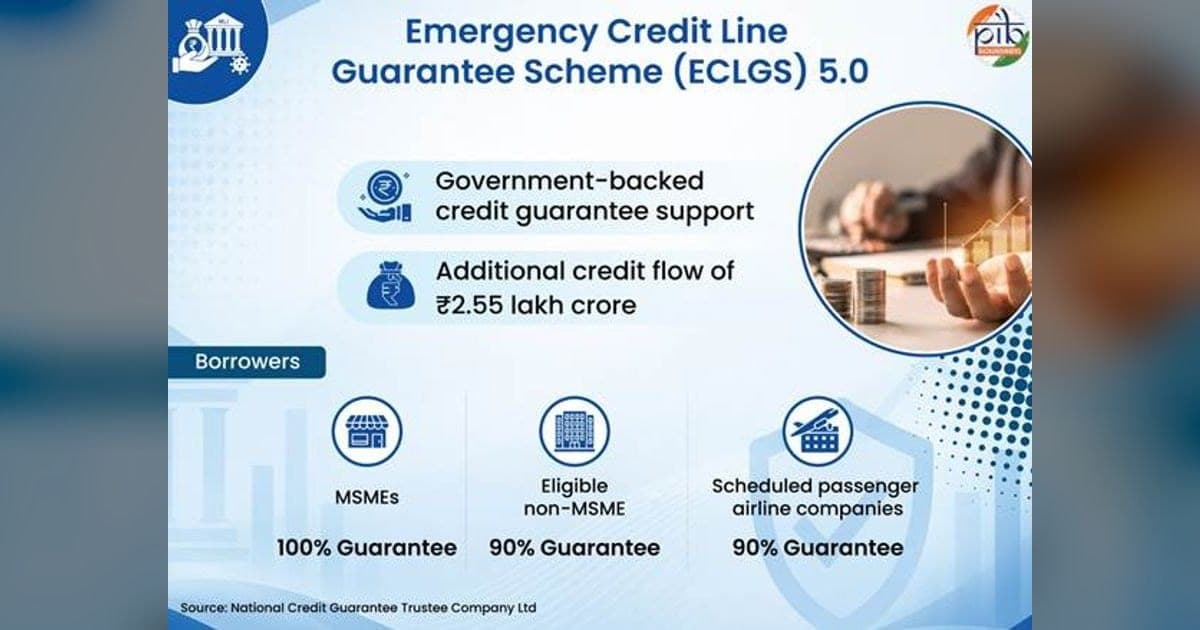
ECLGS 5.0 Explained: ₹2.55 Lakh Crore Credit Guarantee Push
5 September 2026 · 2 min read

Related GK
- Punjab GK: Formation, Rivers, History and Exam Facts
30 September 2026 · Indian States & UTs
- Indian Defence Forces and Missiles: Static GK and PYQs
30 September 2026 · Static GK
- Biotechnology in Agriculture and Health: Notes and PYQs
30 September 2026 · Science & Technology
Take the Quiz
- Current Affairs Quiz
NABARD Current Affairs Quiz: 30 September 2026
11 questions11 minutesStart Quiz