
Ayush Ministry Issues Skin Disorder Guidelines for Four Systems
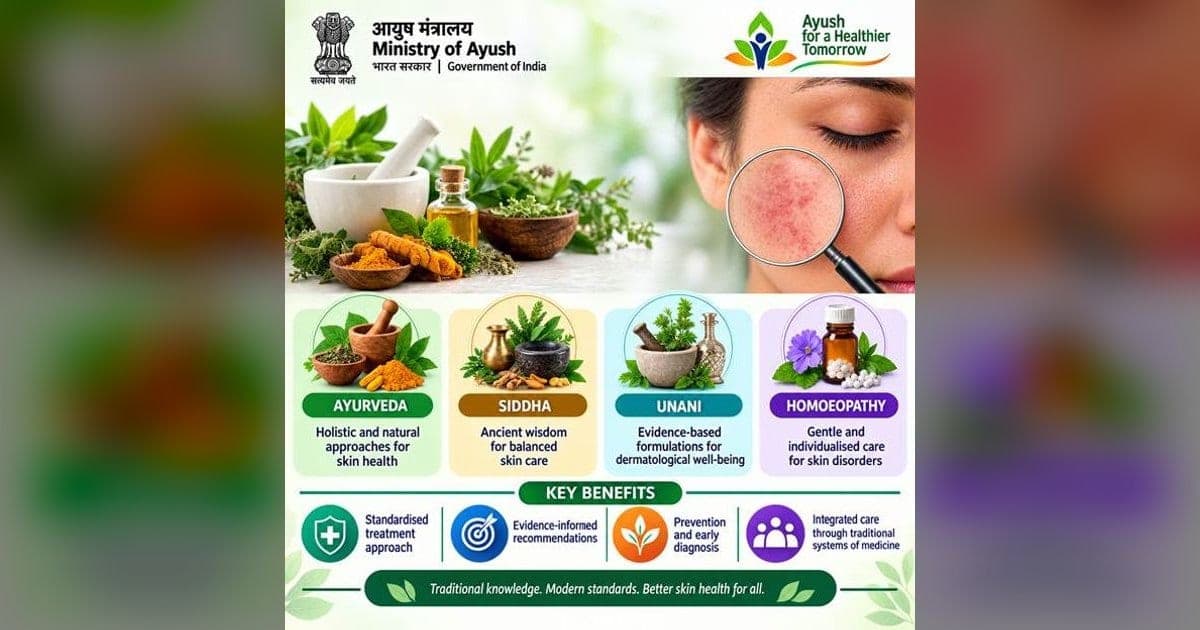
The Ministry of Ayush released Standard Treatment Guidelines on skin disorders for Ayurveda, Siddha, Unani and Homoeopathy on the 11th Ayurveda Day.
Why in News
On 13 October 2026 the Ministry of Ayush released Standard Treatment Guidelines on the management of dermatological disorders for Ayurveda, Siddha, Unani and Homoeopathy, made public on the occasion of the 11th Ayurveda Day.
The Ministry of Ayush has issued Standard Treatment Guidelines (STGs) on the management of dermatological disorders for four traditional systems of medicine, with Yoga brought into the fold as well. The four systems covered are Ayurveda, Siddha, Unani and Homoeopathy, and a separate document has been published for each. The guidelines were made public on the occasion of the 11th Ayurveda Day.
Who prepared them
The documents were drawn up by the Ayush Vertical of the Directorate General of Health Services under the Ministry of Health and Family Welfare. The stated aim is to bring greater uniformity, quality assurance and evidence-informed practice into clinical care across the Ayush systems.
Which conditions they cover
For every system the guidelines set out recommendations on prevention, diagnosis, treatment, follow-up and rehabilitation. The skin conditions addressed include psoriasis, dermatitis, vitiligo, urticaria and dermatophytosis, the complaints that bring most patients to a skin clinic.
What the officials said
Shri Prataprao Jadhav, Union Minister of State with Independent Charge for Ayush and Minister of State for Health and Family Welfare, said the guidelines would deepen the place of the Ayush systems within the national healthcare framework and support safe, effective and holistic care. Vaidya Rajesh Kotecha, Secretary in the Ministry of Ayush, described them as an important step towards standardisation and evidence-based practice, noting that they offer practical advice while preserving the founding principles of each system. Dr Loveneesh G. Krishna, Director General of Health Services, pointed to the value of multidisciplinary collaboration in improving skin care.
How they were built and tested
Preparation drew on the Ayush Research Councils, senior academic specialists in each of the four systems, Yoga experts and specialists in modern medicine. The process ran through expert consultations, a reading of classical texts, an assessment of current scientific evidence and consensus-based discussion. The protocols were then validated in the field: the Ayush Vertical worked with the Directorate of Ayush of the Government of the National Capital Territory of Delhi, testing them with Medical Officers in primary and secondary healthcare. Feedback from those officers on how usable the protocols were in practice was folded into the final documents. The guidelines are expected to serve as reference material for practitioners, clinicians, academicians, researchers and policymakers.
Important Facts
| Document | Standard Treatment Guidelines (STGs) on Management of Dermatological Disorders |
|---|---|
| Issued by | Ministry of Ayush |
| Prepared by | Ayush Vertical, Directorate General of Health Services, Ministry of Health and Family Welfare |
| Systems covered | Ayurveda, Siddha, Unani and Homoeopathy, with Yoga included |
| Occasion of release | 11th Ayurveda Day |
| Conditions addressed | Psoriasis, dermatitis, vitiligo, urticaria and dermatophytosis |
| Scope of advice | Prevention, diagnosis, treatment, follow-up and rehabilitation |
| Minister of State (IC), Ayush | Shri Prataprao Jadhav |
| Secretary, Ministry of Ayush | Vaidya Rajesh Kotecha |
| Director General of Health Services | Dr Loveneesh G. Krishna |
| Field validation partner | Directorate of Ayush, Government of NCT of Delhi |
Exam Point of View
Remember the four systems covered (Ayurveda, Siddha, Unani, Homoeopathy) with Yoga included, the preparing body (Ayush Vertical of the Directorate General of Health Services), the occasion (11th Ayurveda Day), the conditions listed (psoriasis, dermatitis, vitiligo, urticaria, dermatophytosis), the Ayush Minister of State Prataprao Jadhav, Secretary Vaidya Rajesh Kotecha and DGHS Dr Loveneesh G. Krishna.
Practice Questions
The new Standard Treatment Guidelines on dermatological disorders cover which four traditional systems?
- A.Ayurveda, Yoga, Naturopathy and Siddha
- B.Ayurveda, Siddha, Unani and Homoeopathy
- C.Ayurveda, Unani, Naturopathy and Sowa-Rigpa
- D.Siddha, Unani, Sowa-Rigpa and Homoeopathy
Show answer
Explanation
The correct answer is Ayurveda, Siddha, Unani and Homoeopathy. The Ministry of Ayush has published a separate Standard Treatment Guidelines document for each of these four systems, and Yoga has been brought into the guidelines as an inclusion rather than as a fifth system with its own document. Option A wrongly lists Yoga and Naturopathy as systems with their own guidelines in this set. Option C and Option D bring in Sowa-Rigpa, which is indeed one of the systems under the Ayush umbrella but is not among the four for which these skin disorder guidelines have been issued. Candidates should also note that the documents were prepared by the Ayush Vertical of the Directorate General of Health Services under the Ministry of Health and Family Welfare, and that they were released on the occasion of the 11th Ayurveda Day.
On which occasion were the Ayush Standard Treatment Guidelines on skin disorders made public?
- A.World Health Day
- B.National Doctors' Day
- C.The 11th Ayurveda Day
- D.International Yoga Day
Show answer
Explanation
The correct answer is the 11th Ayurveda Day. The Ministry of Ayush chose this occasion to put the guidelines in the public domain, which ties the release to the ministry's own calendar of observances. Option A, World Health Day, is marked by the World Health Organization and was not the occasion here. Option B, National Doctors' Day, honours the medical profession in India but is unconnected with this release. Option D, International Yoga Day, is a natural guess because Yoga has been included in the guidelines, yet the release was not timed to it. The edition number matters for examinations, so remember that this was the eleventh observance of Ayurveda Day. The guidelines themselves address psoriasis, dermatitis, vitiligo, urticaria and dermatophytosis across Ayurveda, Siddha, Unani and Homoeopathy.
Who is the Union Minister of State with Independent Charge for Ayush who spoke on the new guidelines?
- A.Shri Prataprao Jadhav
- B.Vaidya Rajesh Kotecha
- C.Dr Loveneesh G. Krishna
- D.Shri Jagat Prakash Nadda
Show answer
Explanation
The correct answer is Shri Prataprao Jadhav, who holds independent charge of the Ministry of Ayush as Minister of State and is also Minister of State for Health and Family Welfare. He said the guidelines would deepen the integration of the Ayush systems with the national healthcare framework and would support safe, effective and holistic care for common skin conditions. Option B, Vaidya Rajesh Kotecha, is the Secretary of the Ministry of Ayush and spoke separately about standardisation and evidence-based practice, but he is an official and not the minister. Option C, Dr Loveneesh G. Krishna, is the Director General of Health Services and highlighted multidisciplinary collaboration. Option D names the Union Health Minister, a plausible distractor since the Directorate General of Health Services falls under the health ministry, but he is not the Ayush minister quoted here.
With which body did the Ayush Vertical partner to validate the treatment protocols in real clinical settings?
- A.All India Institute of Ayurveda
- B.Central Council for Research in Homoeopathy
- C.Directorate of Ayush, Government of NCT of Delhi
- D.National Medical Commission
Show answer
Explanation
The correct answer is the Directorate of Ayush, Government of NCT of Delhi. Field-level validation was a notable feature of the exercise: the protocols were tried out with Medical Officers working in primary and secondary healthcare under this directorate, and the feedback they gave on how usable the protocols were in day-to-day practice was built into the final documents. Option A, the All India Institute of Ayurveda, is a major Ayurveda institution but is not named as the validation partner. Option B, the Central Council for Research in Homoeopathy, belongs to the group of Ayush Research Councils whose technical expertise went into drafting the guidelines, which is a different role from field validation. Option D, the National Medical Commission, regulates modern medical education and had no part in this process. The drafting itself involved classical texts, current evidence and consensus-based deliberation.
Frequently Asked Questions
What are the new Ayush Standard Treatment Guidelines about?
They cover the management of dermatological disorders in four traditional systems, namely Ayurveda, Siddha, Unani and Homoeopathy, with Yoga included, and set out recommendations on prevention, diagnosis, treatment, follow-up and rehabilitation for each system.
On what occasion were the guidelines released?
They were made public on the occasion of the 11th Ayurveda Day. The documents were prepared by the Ayush Vertical of the Directorate General of Health Services under the Ministry of Health and Family Welfare.
Which skin conditions do the guidelines address?
Common dermatological conditions such as psoriasis, dermatitis, vitiligo, urticaria and dermatophytosis are covered, with system-specific clinical recommendations for each of the four Ayush systems.
How were the protocols tested before release?
The Ayush Vertical partnered with the Directorate of Ayush of the Government of NCT of Delhi to try the protocols out with Medical Officers working in primary and secondary healthcare, and their feedback on operational usability was built into the final documents.
Sources
- https://www.pib.gov.in/PressReleasePage.aspx?PRID=2322793 (opens in a new tab) — Press Information Bureau
Current Affairs 13 October 2026
- Ashtalakshmi Darshan Programme Takes 590 Students to NortheastGovernment Schemes
- Khadi Sales Touch Record Rs 1.87 Lakh Crore in 2025-26Government Schemes
- Bloomberg New Economy Forum Held in India for the First TimeSummits & Conferences
- BHASHINI Runs Live Translation at NCGG Mussoorie ProgrammeScience & Technology
- DARPG Releases 53rd CPGRAMS Monthly Report for September 2026Reports & Indices
- Indian Railways Freight Loading Rises 6.14% in September 2026Economy
- NLMC's First End-to-End E-Auction Sells 150 RINL Land PlotsEconomy
- Delhi Gets 150 Electric Buses and 13 New CAAQMS StationsEnvironment
Related Current Affairs
Related GK
- Narmada and MP Rivers: Dams and Water Projects
13 October 2026 · Madhya Pradesh
- Malwa, Vindhya and Satpura: Plateaus of Madhya Pradesh
13 October 2026 · Madhya Pradesh
- Haryana Rivers and Lakes: Yamuna, Ghaggar and Wetlands
13 October 2026 · Haryana
Take the Quiz
- Current Affairs Quiz
SSC CHSL Current Affairs Quiz: 13 October 2026
11 questions11 minutesStart Quiz