
World Development Report 2026 on AI Launched in New Delhi
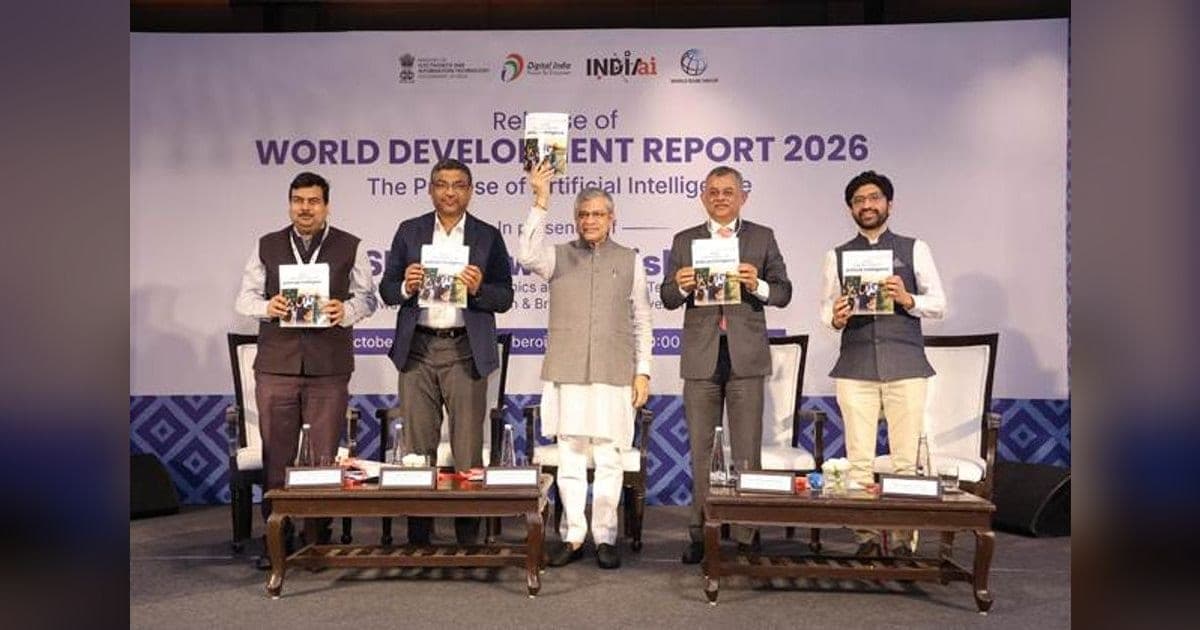
Union Minister Ashwini Vaishnaw launched the World Bank Group's World Development Report 2026: The Promise of Artificial Intelligence in New Delhi.
Why in News
On 8 October 2026 Union Minister Ashwini Vaishnaw launched the World Bank Group's World Development Report 2026: The Promise of Artificial Intelligence at an event in New Delhi hosted by the IndiaAI Mission and MeitY with the World Bank Group.
The World Bank Group's World Development Report 2026, subtitled 'The Promise of Artificial Intelligence', was launched in India on 8 October 2026 by Ashwini Vaishnaw, Union Minister for Electronics and Information Technology, Railways, and Information and Broadcasting. The event was held at The Oberoi in New Delhi and was organised by the IndiaAI Mission under the Ministry of Electronics and Information Technology (MeitY) together with the World Bank Group.
What the report argues
The report studies what artificial intelligence means for developing economies and offers them a three-step path: adopt, adapt and then advance. Its advice to such countries is summed up in three words, be optimistic, be strategic and be pragmatic. Rather than spending billions on building advanced systems from the ground up, poorer countries are told to take existing tools and fit them to local conditions, and to make cost-conscious choices in their triple role as enabler, user and regulator of the technology. The report warns of a mismatch: the countries that stand to gain most from AI are often the least prepared, and of the world's 25 low-income economies only one has published a national AI strategy. It also judges the threat of job displacement to be less immediate in developing economies, while cautioning that every gain depends on dependable electricity and connectivity, computing capacity, good data, skills and capable institutions.
Examples the minister cited
Addressing the gathering, the minister said AI is already changing ordinary lives. In Baramati, sugarcane yields rose 40 per cent while water and fertiliser use fell 30 per cent, achieved by farmers who had never touched a computer and worked instead through voice on a phone, drawing on satellite, Internet of Things and weather data. Tuberculosis detection, he said, has risen 35 per cent. In Gujarat, AgriStack is used by 5 lakh farmers, and an animal health service called Sarlaben reaches 3 crore cattle and their owners.
India's AI architecture
The IndiaAI Mission is being built on seven pillars: compute capacity, an innovation centre for indigenous foundation models, the AIKosh datasets platform, application development, FutureSkills, startup financing, and Safe and Trusted AI. Under the last pillar the government is backing homegrown tools for bias mitigation, algorithm auditing, explainable AI, privacy-preserving AI and deepfake detection. MeitY Secretary S. Krishnan said the report's regulatory advice, to lean on existing law and voluntary compliance and revisit rules as the technology moves, matches India's own approach, and he announced that work is under way on an AI Talent Mission.
Who spoke
World Bank Group Chief Economist and Senior Vice President Michael Kremer delivered the keynote lecture and held up India's AI-based monsoon forecasting, which predicted the unusual 2025 monsoon and is now being copied by Ethiopia, as a lesson for the developing world. Somik Lall, Director of Strategy for Development Economics, said the report's message is about deploying AI rather than creating it. Gaurav Nayyar, Director of the report, presented its findings. A State AI Showcase displayed Navachetana from Andhra Pradesh for early screening of children up to six years, MahaVISTAAR AI from Maharashtra, EdskGrid from Meghalaya and the Vyuhaa-Cerviai cervical cancer screening tool.
Important Facts
| Report | World Development Report 2026: The Promise of Artificial Intelligence |
|---|---|
| Published by | World Bank Group |
| Launched in India by | Ashwini Vaishnaw, Union Minister for Electronics and IT, Railways, and Information and Broadcasting |
| Venue | The Oberoi, New Delhi |
| Organisers of the India launch | IndiaAI Mission and MeitY with the World Bank Group |
| Framework | Adoption, adaptation and advancement |
| Core advice | Be optimistic, be strategic, be pragmatic |
| Key finding | Only one of the world's 25 low-income countries has published a national AI strategy |
| Keynote lecture | Michael Kremer, Chief Economist and Senior Vice President, World Bank Group |
| Report Director | Gaurav Nayyar |
| New initiative announced | AI Talent Mission, flagged by MeitY Secretary S. Krishnan |
Exam Point of View
Remember the publisher (World Bank Group), the report and its subtitle (World Development Report 2026: The Promise of Artificial Intelligence), who launched it in India (Union Minister Ashwini Vaishnaw) and where (New Delhi), the hosts (IndiaAI Mission and MeitY), the three-step framework of adoption, adaptation and advancement, the finding that only one of 25 low-income countries has a national AI strategy, and the keynote speaker Michael Kremer, Chief Economist of the World Bank Group.
Practice Questions
Which organisation publishes the World Development Report, whose 2026 edition is subtitled "The Promise of Artificial Intelligence"?
- A.International Monetary Fund
- B.World Bank Group
- C.World Economic Forum
- D.United Nations Development Programme
Show answer
The correct answer is the World Bank Group, which brings out the World Development Report every year; the latest edition carries the subtitle "The Promise of Artificial Intelligence" and was launched in India by Union Minister Ashwini Vaishnaw.
Read the full explanation →The World Development Report 2026 recommends which three-step path for developing economies on artificial intelligence?
- A.Adoption, adaptation and advancement
- B.Research, regulation and rollout
- C.Invent, invest and integrate
- D.Compute, connect and commercialise
Show answer
The report examines the opportunities and risks AI brings to developing economies and offers this sequence as the framework through which such countries can turn the technology into development gains.
Read the full explanation →Who delivered the keynote lecture "From AI Pilots to Scale: The Promise of AI in India" at the report launch?
- A.Somik Lall, Director of Strategy, Development Economics
- B.Gaurav Nayyar, Director of the report
- C.Michael Kremer, Chief Economist, World Bank Group
- D.S. Krishnan, Secretary, MeitY
Show answer
He pointed to India’s AI-based monsoon forecasting, built by combining several models including open-access ones and delivered to farmers through text, voice and advisories, which anticipated the unusual monsoon of 2025 and is now being followed by Ethiopia.
Read the full explanation →Frequently Asked Questions
What is the theme of the World Development Report 2026?
'The Promise of Artificial Intelligence'. The World Bank Group report sets out how developing economies can harness AI for development through adoption, adaptation and advancement, and it was launched in India on 8 October 2026.
Who launched the World Development Report 2026 in India?
Union Minister for Electronics and Information Technology, Railways, and Information and Broadcasting Ashwini Vaishnaw, at The Oberoi in New Delhi, at an event hosted by the IndiaAI Mission and MeitY with the World Bank Group.
What does the report say about low-income countries and AI?
It warns that the countries with the most to gain from AI may be the least prepared, noting that only one of the world's 25 low-income countries has published a national AI strategy.
Sources
- https://www.pib.gov.in/PressReleasePage.aspx?PRID=2320883 (opens in a new tab) — Press Information Bureau
Current Affairs 8 October 2026
- GMPCS Licensing: Government Calls Satcom Rules Non-DiscriminatoryScience & Technology
- Women Form 43% of Ayush Services Workforce: RIS ReportReports & Indices
- India Seeks Balanced COP31 Outcome at Pre-COP in Nadi, FijiEnvironment
- National SC-ST Hub Procurement Rises Nearly 39-Fold in a DecadeGovernment Schemes
- Veteran Hindi and Marathi Actor Nana Patekar Passes AwayObituaries
- PM Modi Opens 10th India Mobile Congress at YashobhoomiScience & Technology
- Nadda Launches JOSH Teams for Youth-Led TB EliminationGovernment Schemes
- C.R. Paatil Chairs 20th Ganga Empowered Task Force MeetingEnvironment
Related Current Affairs
- Government Schemes
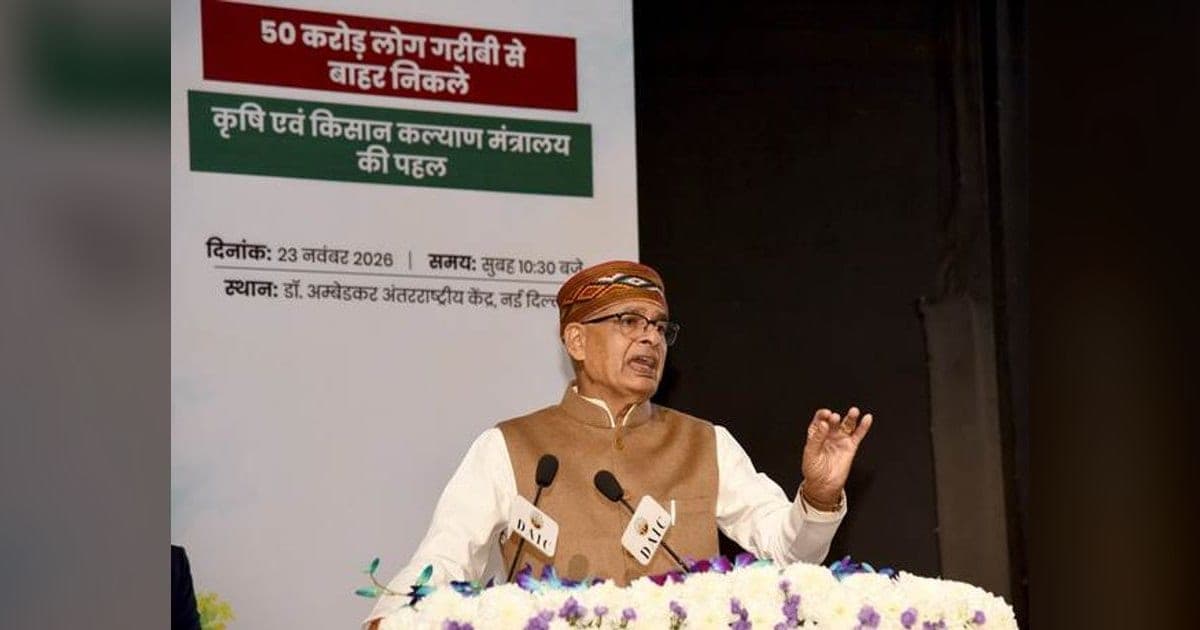
Shivraj Chouhan Chairs Joint Poverty Eradication Workshop
23 November 2026 · 2 min read
- Reports & Indices
World Bank Report: 49.60 Crore Indians Exit Poverty Line
22 November 2026 · 2 min read
- Environment
India's Solar Capacity Touches 175 GW, 62-Fold Rise Since 2014
17 November 2026 · 3 min read
Related GK
- BIS, ADB, AIIB and NDB: Institutions for Bank Exams
6 October 2026 · Banking & Financial Awareness
- G20, BRICS and Economic Groupings: Exam Notes
4 October 2026 · Indian Economy
- IMF, World Bank and WTO: Functions and Facts
3 October 2026 · Indian Economy
Take the Quiz
- Current Affairs Quiz
UPSC Current Affairs Quiz: October 2026
50 questions50 minutesStart Quiz