
MoHUA Workshop Charts Shared Roadmap for Clean Delhi
The Department of Capital Development under MoHUA held a workshop with Swachh Bharat Mission-Urban to build a shared roadmap for a cleaner national capital.
Why in News
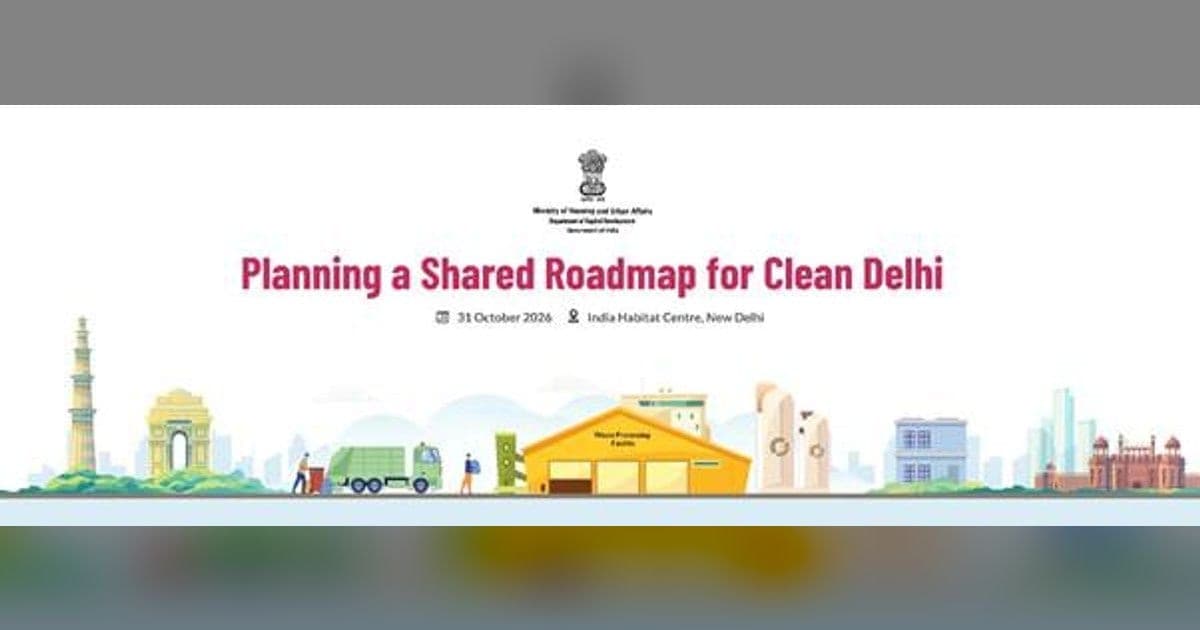
The Department of Capital Development under the Ministry of Housing and Urban Affairs, along with Swachh Bharat Mission-Urban, organised a participatory workshop on 'Planning a Shared Roadmap for Clean Delhi' with sanitation inspectors, supervisors and urban local body officials.
Sanitation workers and the officials who plan their work sat in the same room in the capital. The Department of Capital Development (DoCD) of the Ministry of Housing and Urban Affairs, working with Swachh Bharat Mission-Urban, held a workshop titled Planning a Shared Roadmap for Clean Delhi, which brought sanitation inspectors, supervisors, urban local body officials and other stakeholders together to work out practical answers for a cleaner and more liveable capital.
Who took part
Ms D. Thara, Secretary of the Department of Capital Development, took part along with senior officials of the NDMC, the MCD, the DDA and the ministry. The organisers said this was the first time that functionaries from the top of the system to the lowest rung came on to a common platform to debate the city's sanitation problems and settle a collective path forward. The workshop opened with a motivational address by BK Hussain of the Brahma Kumaris.
What was discussed
The core of the day was an interactive session built around ten critical questions. Among them:
- Why visible cleanliness in Delhi still lags despite heavy investment and effort
- How the city can move towards being bin-less through more efficient and frequent door-to-door collection of waste
- How to deal with recurring Garbage Vulnerable Points, or GVPs, and stop littering and waste from reaching water bodies
- How to keep public toilets clean, safe and working through the day
- How to improve the system for redressing citizens' complaints
Listening to the front line
The thinking behind the format was that sanitation staff stand at the front of service delivery and can describe the day-to-day obstacles first hand, which lets planners design solutions that work on the ground rather than only on paper. An online digital poll was run among the participants to pick out the main challenges to cleanliness in the city and to gather views from those working at the grassroots. The exercise produced feedback on operational gaps, citizen behaviour, service delivery and the openings for improvement. Best practices were shared as success stories, along with photographs of spots that need focused attention.
The Secretary's message
Addressing the gathering, Ms D. Thara congratulated the sanitary inspectors and supervisors for their work on the city's cleanliness standards. She called the sanitation workforce the most vital part of any municipality, and said that while a doctor gives medicine after a diagnosis, the sanitation team works before the doctor does, preventing disease by keeping the city clean. The invited inspectors and supervisors were felicitated for their contribution to urban sanitation, and the workshop closed with a shared commitment to practical, citizen-centric and results-oriented measures for a cleaner Delhi.
Important Facts
| Workshop | Planning a Shared Roadmap for Clean Delhi |
|---|---|
| Organised by | Department of Capital Development, Ministry of Housing and Urban Affairs |
| In collaboration with | Swachh Bharat Mission-Urban |
| Secretary who addressed it | Ms D. Thara, Secretary, Department of Capital Development |
| Bodies represented | NDMC, MCD, DDA and MoHUA |
| Format | Interactive discussion on ten critical questions, plus an online digital poll |
| Key terms | Garbage Vulnerable Points (GVPs); bin-less city through door-to-door collection |
| Opening address | BK Hussain of the Brahma Kumaris |
Exam Point of View
Note the organiser (Department of Capital Development, Ministry of Housing and Urban Affairs), the partner mission (Swachh Bharat Mission-Urban), the workshop title, the Secretary who addressed it (Ms D. Thara), the bodies represented (NDMC, MCD, DDA), the full form of GVP (Garbage Vulnerable Points) and the idea of a bin-less city through door-to-door collection.
Practice Questions
The workshop 'Planning a Shared Roadmap for Clean Delhi' was organised by which department, in collaboration with Swachh Bharat Mission-Urban?
- A.Department of Capital Development, Ministry of Housing and Urban Affairs
- B.Department of Drinking Water and Sanitation, Ministry of Jal Shakti
- C.Department of Urban Development, Government of Delhi
- D.Department of Administrative Reforms and Public Grievances
Show answer
It held the workshop together with Swachh Bharat Mission-Urban, and its Secretary, Ms D. Thara, addressed the gathering along with senior officials of the New Delhi Municipal Council, the Municipal Corporation of Delhi, the Delhi Development Authority and the ministry.
Read the full explanation →In the context of urban sanitation discussed at the Clean Delhi workshop, what does the abbreviation GVP stand for?
- A.Garbage Vulnerable Points
- B.Green Verification Protocol
- C.Gross Vehicle Parking
- D.Garbage Volume Projection
Show answer
These are the spots in a city where waste keeps accumulating however often it is cleared, and tackling such recurring points was one of the ten critical questions the workshop was built around, along with measures to stop littering and to keep waste out of water bodies.
Read the full explanation →Which of the following bodies was represented at the Clean Delhi workshop by senior officials?
- A.Only the Municipal Corporation of Delhi
- B.NDMC, MCD and DDA
- C.Only the New Delhi Municipal Council
- D.Delhi Jal Board and Delhi Metro Rail Corporation
Show answer
The correct answer is NDMC, MCD and DDA, that is the New Delhi Municipal Council, the Municipal Corporation of Delhi and the Delhi Development Authority, whose senior officials took part along with officers of the Ministry of Housing and Urban Affairs.
Read the full explanation →What was the purpose of the online digital poll conducted among participants at the Clean Delhi workshop?
- A.To elect office bearers of the sanitation staff association
- B.To identify the key challenges affecting cleanliness in Delhi
- C.To rank wards for a municipal cleanliness award
- D.To decide the location of new waste-to-energy plants
Show answer
The poll produced feedback on operational gaps, citizen behaviour, service delivery difficulties and the openings for improvement, which is exactly the material planners need if solutions are to work on the ground.
Read the full explanation →Frequently Asked Questions
Which department organised the workshop on a shared roadmap for Clean Delhi?
The Department of Capital Development of the Ministry of Housing and Urban Affairs, in collaboration with Swachh Bharat Mission-Urban.
What are Garbage Vulnerable Points?
GVPs are spots where garbage keeps piling up again and again. Preventing such recurring points, and stopping waste from entering water bodies, was among the ten critical questions discussed.
What does a 'bin-less city' mean in this context?
A city that does away with public bins by making door-to-door waste collection more efficient and frequent, so that waste is picked up at source instead of being dumped at collection points.
Who addressed the workshop as Secretary, Department of Capital Development?
Ms D. Thara. She called the sanitation workforce the most vital part of any municipality and said its work prevents disease before a doctor is needed.
Sources
- https://www.pib.gov.in/PressReleasePage.aspx?PRID=2330869 (opens in a new tab) — Press Information Bureau
Current Affairs 31 October 2026
- Kendriya Grihmantri Dakshata Padak 2026 Goes to 490 PersonnelAwards & Honours
- Social Security Cover at 68.4% as EPFO Ceiling Hits Rs 25,000Economy
- PMGSY-IV Clears 45 Mizoram Road Works Worth Rs 710.40 CroreGovernment Schemes
- GSLV-F18 Launches NVS-03 to Strengthen NavIC SystemScience & Technology
- Rashtriya Ekta Diwas Marks Patel's 151st Birth AnniversaryImportant Days
- Panchayat Workshop Pushes Atmanirbhar Panchayats, EV MoUGovernment Schemes
- Bharat Parv 2026 at Ekta Nagar: PM Visits CCIC PavilionNational
- CCI Clears Power Sector Buyouts by Adani and Aditya BirlaEconomy
Related Current Affairs
Related GK
- Famous Personalities of Rajasthan: Exam Notes
28 October 2026 · Rajasthan
- Districts and Divisions of Rajasthan: Exam Notes
28 October 2026 · Rajasthan
- Tourism and World Heritage Sites of Rajasthan Notes
27 October 2026 · Rajasthan
Take the Quiz
- Current Affairs Quiz
Banking Current Affairs Quiz: 31 October 2026
25 questions25 minutesStart Quiz