
Soybean Varieties NRC 268 and NRC 270 Show 20 Quintal Yield Signs
ICAR's Indore soybean institute found its improved varieties NRC 268 and NRC 270 pointing to about 20 quintals a hectare despite poor weather this season.
Why in News
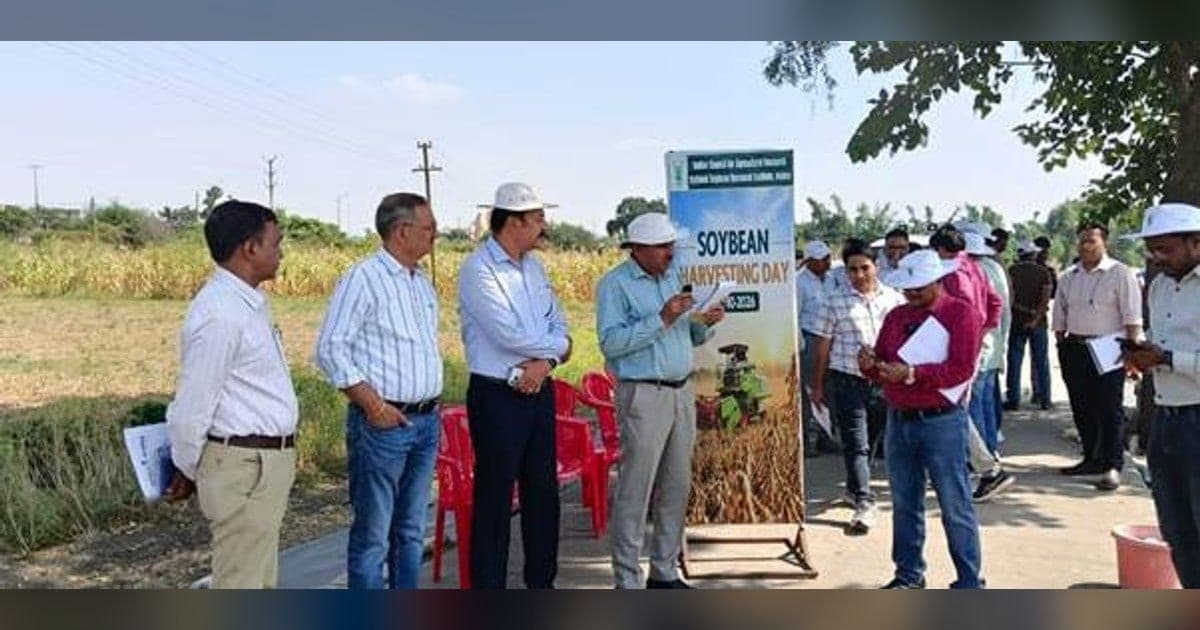
On 13 October 2026 the Ministry of Agriculture and Farmers Welfare said the ICAR-National Soybean Research Institute, Indore had recorded signs of about 20 quintals per hectare from the improved soybean varieties NRC 268 and NRC 270 at a Soybean Harvest Day held on 9 October 2026.
The ICAR-National Soybean Research Institute, Indore held a Soybean Harvest Day on 9 October 2026 to measure what its own improved varieties can deliver in the field. Two varieties bred at the institute, NRC 268 and NRC 270, were put to the test. One acre was harvested under each variety, and the first set of readings points to roughly 20 quintals per hectare from both.
Why the reading is striking
The season brought unfavourable weather, which makes the figure more significant than it looks. Soybean in India at present returns an average of about 10 to 11 quintals per hectare, so the two varieties are pointing to nearly double the national average. The exercise helps scientists judge how improved varieties behave when the weather turns against the crop.
What trials elsewhere suggest
Work by the institute and by the All India Coordinated Research Project on Soybean indicates that 15 to 20 quintals per hectare is within reach for a farmer who takes up improved varieties along with the right production practices. Where conditions are favourable, the same package can push output towards about 22 to 25 quintals per hectare.
What the officials said
Dr M. L. Jat, Secretary of the Department of Agricultural Research and Education and Director General of the Indian Council of Agricultural Research, welcomed the early numbers. He said improved varieties and scientific production methods matter a great deal in lifting the country's soybean output, and called the signs from the two varieties highly encouraging given the weather. Scientific analysis of the data, he added, would shape future research strategy.
Why the data is collected year after year
The Director of the Indore institute said the value of Harvest Day figures goes well beyond a single season. Collected and analysed over several years, such data shows how productivity shifts across regions, varieties and growing conditions, and gives a scientific base for estimating future gains. Long-run figures also reveal how well research and technology outreach are working. The institute holds these events regularly to carry information on high-yielding varieties and scientific practices to farmers, tightening the link between research, extension services and the field.
Important Facts
| Institute | ICAR-National Soybean Research Institute, Indore |
|---|---|
| Event | Soybean Harvest Day, held on 9 October 2026 |
| Varieties assessed | NRC 268 and NRC 270 |
| Area harvested | One acre under each variety |
| Indicated yield | About 20 quintals per hectare |
| Present national average | About 10 to 11 quintals per hectare |
| Achievable with improved practices | 15 to 20 quintals per hectare |
| Potential in favourable conditions | About 22 to 25 quintals per hectare |
| Project cited | All India Coordinated Research Project on Soybean |
| DG, ICAR and Secretary, DARE | Dr M. L. Jat |
Exam Point of View
Remember the institute (ICAR-National Soybean Research Institute, Indore), the varieties (NRC 268 and NRC 270), the event (Soybean Harvest Day on 9 October 2026), the indicated yield of about 20 quintals per hectare, the national average of 10 to 11 quintals per hectare, the achievable range of 15 to 20 and the potential 22 to 25, and Dr M. L. Jat as Secretary DARE and Director General ICAR.
Practice Questions
Which institute developed the improved soybean varieties NRC 268 and NRC 270?
- A.ICAR-Indian Institute of Pulses Research, Kanpur
- B.ICAR-National Soybean Research Institute, Indore
- C.ICAR-Indian Agricultural Research Institute, New Delhi
- D.ICAR-Central Research Institute for Dryland Agriculture, Hyderabad
Show answer
Both varieties were bred at this institute, which functions under the Indian Council of Agricultural Research, and it was the institute that organised the Soybean Harvest Day on 9 October 2026 at which their yield potential was assessed.
Read the full explanation →What is the present average soybean productivity in India?
- A.About 5 to 6 quintals per hectare
- B.About 10 to 11 quintals per hectare
- C.About 18 to 19 quintals per hectare
- D.About 30 to 32 quintals per hectare
Show answer
This is the figure for the country's average soybean productivity at present, and it is the benchmark against which the new reading of roughly 20 quintals per hectare from NRC 268 and NRC 270 is being judged.
Read the full explanation →Who is the Secretary of the Department of Agricultural Research and Education and Director General of ICAR who commented on the soybean yield data?
- A.Dr M. L. Jat
- B.Dr Himanshu Pathak
- C.Dr Trilochan Mohapatra
- D.Dr Abhilaksh Likhi
Show answer
He holds both posts, Secretary of the Department of Agricultural Research and Education and Director General of the Indian Council of Agricultural Research, and it was he who welcomed the early figures from the two varieties.
Read the full explanation →Under which project, along with the Indore institute's own trials, is a yield of 15 to 20 quintals per hectare reported as achievable for soybean?
- A.National Food Security Mission
- B.All India Coordinated Research Project on Soybean
- C.Rashtriya Krishi Vikas Yojana
- D.National Mission on Edible Oils
Show answer
Research and trials carried out across the country by the ICAR-National Soybean Research Institute and under this coordinated project indicate that a yield of 15 to 20 quintals per hectare can be reached by adopting improved varieties together with appropriate production technologies, and that favourable conditions may lift output to…
Read the full explanation →Frequently Asked Questions
Which institute developed the soybean varieties NRC 268 and NRC 270?
The ICAR-National Soybean Research Institute at Indore, which works under the Indian Council of Agricultural Research, bred both varieties and assessed them at its Soybean Harvest Day on 9 October 2026.
What yield did NRC 268 and NRC 270 indicate?
Preliminary data from one acre harvested under each variety points to roughly 20 quintals per hectare, which is notable because the season had adverse weather and the present national average is about 10 to 11 quintals per hectare.
What yields do soybean trials suggest are possible in India?
Research by the institute and under the All India Coordinated Research Project on Soybean shows 15 to 20 quintals per hectare with improved varieties and suitable production technologies, rising to about 22 to 25 quintals per hectare in favourable conditions.
Why does the institute hold Soybean Harvest Day every year?
To measure the real yield potential of different varieties, to understand the effect of improved technologies, and to pass information on high-yielding varieties and scientific practices to farmers. Data gathered over several years gives a scientific base for judging productivity gains.
Sources
Current Affairs 13 October 2026
- Ashtalakshmi Darshan Programme Takes 590 Students to NortheastGovernment Schemes
- Khadi Sales Touch Record Rs 1.87 Lakh Crore in 2025-26Government Schemes
- Bloomberg New Economy Forum Held in India for the First TimeSummits & Conferences
- BHASHINI Runs Live Translation at NCGG Mussoorie ProgrammeScience & Technology
- DARPG Releases 53rd CPGRAMS Monthly Report for September 2026Reports & Indices
- Indian Railways Freight Loading Rises 6.14% in September 2026Economy
- NLMC's First End-to-End E-Auction Sells 150 RINL Land PlotsEconomy
- Delhi Gets 150 Electric Buses and 13 New CAAQMS StationsEnvironment
Related Current Affairs
- Science & Technology
BHASHINI Runs Live Translation at NCGG Mussoorie Programme
13 October 2026 · 2 min read
- Science & Technology
IMD Launches Cyclone Warning Decision Support System
12 October 2026 · 2 min read
- Science & Technology
8th India-UK Science and Innovation Council Meets in Delhi
12 October 2026 · 2 min read




Related GK
- Haryana National Parks and Wildlife Sanctuaries Notes
14 October 2026 · Haryana
- Haryana Climate, Soils and Forests: Complete GK Notes
14 October 2026 · Haryana
- UP Agriculture, Crops and Livestock: Notes with PYQs
14 October 2026 · Uttar Pradesh
Take the Quiz
- Current Affairs Quiz
NABARD Current Affairs Quiz: 13 October 2026
11 questions11 minutesStart Quiz