
SEMICON India 2026: Whole-of-Industry Push for Semiconductors
SEMICON India 2026 drew over 600 exhibitors and 56 MoUs, as industry bodies pressed for a whole-of-industry approach to India's semiconductor ambitions.
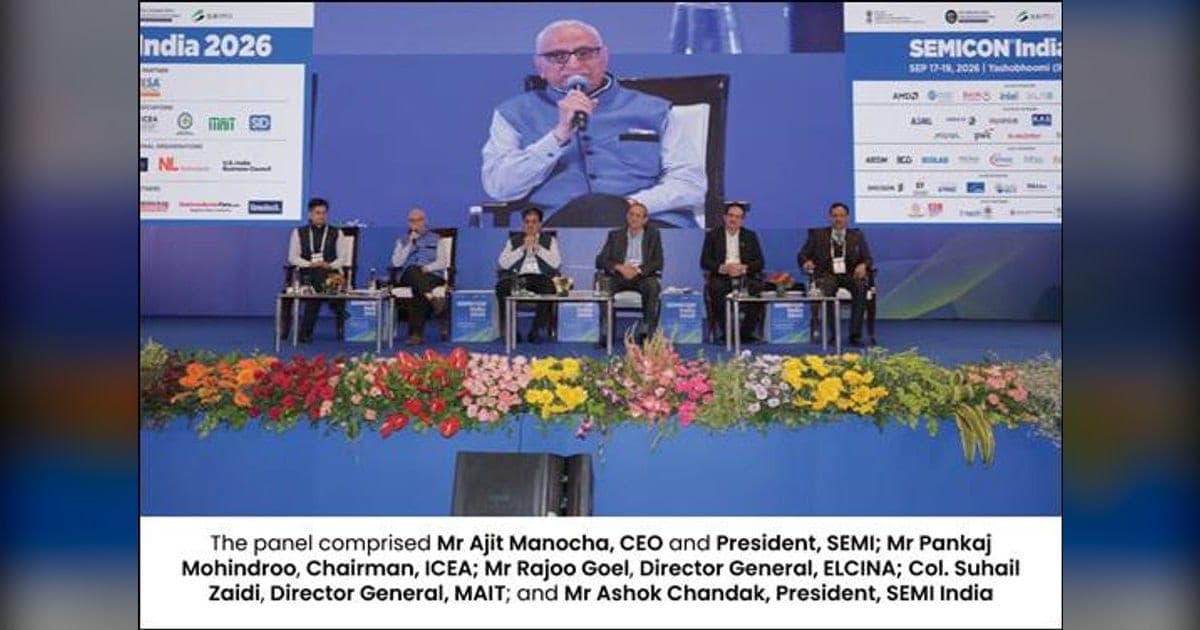
Why in News
A PIB backgrounder issued on 23 September 2026 set out the 'whole-of-industry' approach urged by industry associations at SEMICON India 2026, along with the event's tally of exhibitors, MoUs and the standing of India's approved semiconductor projects.
India's electronics and semiconductor sector is being asked to stop thinking in separate pieces. At SEMICON India 2026, a panel titled "Industry Associations Advancing India's National Agenda" argued that the next round of growth cannot come from any one segment working on its own, and called instead for a whole-of-industry approach that turns scattered strengths into one national capability.
Who led the discussion
The session was moderated by Amitesh Kumar Sinha, Chief Executive Officer of the India Semiconductor Mission (ISM), and brought senior office-bearers of the leading industry associations to the same table.
The argument made
Chips, the panel noted, no longer carry value on their own. Their worth appears when they sit inside a device, a product or a system. Fabrication leans on materials and equipment, and manufacturing leans in turn on packaging, testing and the wider electronics base. Because the parts depend on each other, the associations that speak for them need firmer links across the value chain.
Speakers also wanted the conversation to outlive the conference. They floated a standing community mechanism, a permanent forum where the associations could keep talking and coordinate on questions of national importance. It would not replace any body's specialised role; it would give them common ground. All of this sits under the wider Silicon to Systems vision, where design, manufacturing, packaging and technology solutions move together.
The event by numbers
- More than 600 exhibitors took part, of whom nearly 300 were international companies.
- 56 MoUs, strategic initiatives and industry announcements were recorded, spread across manufacturing, design, packaging, artificial intelligence, research and development, logistics and skilling.
Where government support stands
The Production Linked Incentive schemes and the India Semiconductor Mission remain the main instruments for building domestic capability. Under the Semicon India programme the government has cleared 12 semiconductor projects, and as of September 2026 five commercial semiconductor units are already running. The message from the sector is that the story has moved past building factories: what now decides the pace is how well industries, institutions and technologies connect to one another.
Important Facts
| Event | SEMICON India 2026 |
|---|---|
| Panel discussion | Industry Associations Advancing India's National Agenda |
| Moderator | Amitesh Kumar Sinha, CEO, India Semiconductor Mission (ISM) |
| Exhibitors | More than 600, including nearly 300 international companies |
| MoUs and announcements | 56 |
| Vision cited | Silicon to Systems |
| Projects approved | 12 under the Semicon India programme |
| Units operational | Five commercial semiconductor units, as of September 2026 |
| Key schemes | Production Linked Incentive (PLI) schemes and India Semiconductor Mission |
Exam Point of View
Remember the event (SEMICON India 2026), the panel theme ('Industry Associations Advancing India's National Agenda'), the moderator and his post (Amitesh Kumar Sinha, CEO of the India Semiconductor Mission), the exhibitor count (over 600, nearly 300 of them international), the MoUs and announcements (56), the vision named ('Silicon to Systems'), the scheme names (PLI and Semicon India) and the project tally (12 approved, five commercial units running as of September 2026).
Practice Questions
Who moderated the panel discussion 'Industry Associations Advancing India's National Agenda' at SEMICON India 2026?
- A.The Chief Executive Officer of NITI Aayog
- B.Amitesh Kumar Sinha, CEO of the India Semiconductor Mission
- C.The Governor of the Reserve Bank of India
- D.The Chairman of ISRO
Show answer
Correct answer: B. Amitesh Kumar Sinha, CEO of the India Semiconductor Mission
Explanation
The correct answer is Amitesh Kumar Sinha, Chief Executive Officer of the India Semiconductor Mission. The backgrounder names him as the moderator of the session, which brought senior representatives of the leading industry associations together to discuss how deeper cooperation could speed up the country's semiconductor and electronics plans. The Chief Executive Officer of NITI Aayog is wrong, as that office is not connected with this session in the release. The Governor of the Reserve Bank of India is wrong because the discussion concerned manufacturing and industry coordination rather than monetary policy, and no central bank official is mentioned. The Chairman of ISRO is wrong for the same reason; the space agency has no role in the panel described. Aspirants should remember the mission's name along with the office, because questions often ask which body the moderator headed rather than his name, and the India Semiconductor Mission is itself a frequently tested institution.
How many exhibitors took part in SEMICON India 2026?
- A.More than 400
- B.More than 600
- C.More than 800
- D.More than 1,000
Show answer
Correct answer: B. More than 600
Explanation
The correct answer is more than 600. The backgrounder records that the event brought together this many exhibitors, of whom close to three hundred were international companies, and treats that mix as a sign of the global interest now being shown in the country's semiconductor and electronics ecosystem. The first option is wrong because it falls short of the stated count and appears nowhere in the release. The third option is wrong for the opposite reason; it overstates the number, and no such figure is given. The fourth option is wrong as well, since a four-figure count is not claimed anywhere in the document. The useful pairing for an examination is the total against the international share, because a question may supply one and ask for the other, and the second figure is also the one that shows how much of the participation came from outside India.
How many semiconductor projects have been approved under the Semicon India programme, and how many commercial units were operational as of September 2026?
- A.Ten approved, three operational
- B.Twelve approved, five operational
- C.Fifteen approved, six operational
- D.Twenty approved, eight operational
Show answer
Correct answer: B. Twelve approved, five operational
Explanation
The correct answer is twelve approved and five operational. The backgrounder states that the government has cleared this many semiconductor projects under the Semicon India programme, and that five commercial semiconductor units were already running by September of that year. The first option is wrong on both counts, understating the approvals as well as the units in production. The third option is wrong because it inflates the approvals and the operating units alike, and no such tally appears in the release. The fourth option is wrong for the same reason and is the furthest from the stated position. The point worth carrying forward is the gap between approvals and operations: a project being approved does not mean a plant is producing, which is why the release reports the two numbers separately. Candidates should also link this with the Production Linked Incentive schemes and the India Semiconductor Mission, the two instruments named as driving this build-up.
Frequently Asked Questions
What is the 'whole-of-industry' approach discussed at SEMICON India 2026?
It is the idea that semiconductors, electronics manufacturing, components, materials, design and packaging are interdependent, so industry associations should coordinate across the value chain rather than each working within its own segment.
How many semiconductor projects has the government approved?
12 projects have been approved under the Semicon India programme, and five commercial semiconductor units were already operational as of September 2026.
How large was SEMICON India 2026?
More than 600 exhibitors took part, nearly 300 of them international companies, and the event recorded 56 MoUs, strategic initiatives and industry announcements.
Sources
- ‘Whole-of-Industry’ approach to drive India’s Electronics and Semiconductor ambitions (opens in a new tab) — Press Information Bureau
Current Affairs 23 September 2026
- KAVACH 4.0 Goes Live First Time on South Central RailwayScience & Technology
- Ayushman Bharat Completes Eight Years, 60 Crore BeneficiariesGovernment Schemes
- IMEI Tampering Draws Three-Year Jail Under Telecom Act, 2023National
- WAVES OTT and MyWAVES Turn Viewers Into Content CreatorsScience & Technology
- Special Campaign 6: MHA Targets Pendency and SwachhataNational
- NRAA Holds REWARD Meeting on Watershed Guidelines for PMKSYEnvironment
Related Current Affairs
- Economy
Mines Ministry Launches Concept Paper on Critical Mineral Recycling
22 September 2026 · 2 min read


Related GK
- Fundamental Rights (Articles 12–35): Notes, Writs and PYQs
23 September 2026 · Indian Polity
- Preamble of the Indian Constitution: Notes, Keywords and PYQs
22 September 2026 · Indian Polity
- Making of the Indian Constitution: Notes, Key Dates and PYQs
21 September 2026 · Indian Polity
Take the Quiz
- Current Affairs Quiz
State Exams Current Affairs Quiz: 23 September 2026
21 questions21 minutesStart Quiz